Dudu Fisher

Ethics of the Mother

Linda Haase

Empty nester Linda Haase considers lessons learned and progress made in her lifetime, through a Jewish woman’s lens.

Ethics of the Mother

Back to the future at age 21

 Permanent link

On my daughter's 21st birthday, I spent part of the day reading a sampling of what I'd written when I was 21 myself.

Weeks ago, we were among those whose basements flooded, and I am still sifting through aspects of my life that had been in storage. This is how I found myself perusing my college papers and grad school clips, plus my grad school application essays, and coming face-to-face with the dreams I'd had at 21 on the very day my only child turned that same age.

It should go without saying that I wanted to change the world--or maybe that's just what I thought I was supposed to want. I was precocious and intense, and spent a lot of time trying to be witty. I was rough around the edges, read too much Anne Sexton and wore too much eye makeup.

I have often wondered what my younger self would think of who I have become, but this is the first time I really stopped to consider what she'd think of my daughter--and what my daughter would think of her.

Would they even like each other?

I suspect 21-year-old Linda would have been jealous of 21-year-old Jenna, who has a great boyfriend, thick blonde hair, and is pre-occupied with more interesting subjects than her make-up. My younger self would have been envious of Jenna's cheerful feminism and her spirit of adventure, and bewildered by her affection for early morning.

If I am honest, I expect that had my 21-year-old mother known me at the same age, she would have been taken aback by my coed group of friends, how I made time for theater and choir and other extracurriculars, and my blood-red nail polish. She would have been envious of my boldness in speaking up in class, and bewildered by my ability to sleep until noon.

On Mother's Day, I asked Jenna what she believes we would have thought of each other as college contemporaries.

"Where would we have met each other?" she demurred. "We would have had completely different classes and schedules."

"We would have had choir together," I persisted.

"True."

She shrugged. "I probably would have been scared of you. Hey, are we wearing the same nail polish?"

We were indeed.

"That's crazy!" she laughed. "Want to get coffee?"

I guess what matters is that we're becoming friends now, at that bittersweet, permeable phase when Jenna makes the last transition into adulthood. 

I would like to think that my own awkward journey helped make it possible for her to be at a different place today than I was at her age, just as my mother's journey brought me to a better starting point than she had had.

Perhaps this is the greatest gift mothers pass on to our daughters: the chance to be different.

Uncivil discourse

 Permanent link

During Shabbat dinner, our friend announced that he was ready to reveal something about himself that might mean we wouldn't like him anymore. Joel and I couldn't imagine what dark secret "Rick" was preparing to reveal.

He told us he owned a gun.

As a young man, Rick had enjoyed going to rifle ranges and taking aim at targets. He had never been hunting, hadn't belonged to the NRA in decades, but still had a firearm. And he would understand if that changed our feelings about him.

Joel and I were dumbfounded.  Rick has devoted his life to helping others. He is insightful, funny and unfailingly kind. He is a gentleman in every sense of the word. Yet Rick was genuinely concerned that his owning a gun could change our high opinion of him.

This is what is wrong with American society today. The idea that intelligent, good-hearted people cannot disagree and still respect and even like one anotherthe division of the world into pro- or con-, liberal or conservative, us and themis unraveling the social fabric of American life.

Deb and I have been the closest of friends since 1975, and she is a devout Christian. Over the decades we have rarely agreed on the major issues of the day; I doubt we have ever voted for the same candidate for President.  Prayer in the schools, the Equal Rights Amendment, capital punishment; you name it, we've diverged. At times we may have aggravated each other, but we have never for a moment doubted one another's intelligence or integrity

Unfortunately, as the nightly news and daily Facebook news feeds reveal, Deb and I are a rare pair.  Today pundits regularly demonize people who dare disagree with them about abortion or government spending, gay rights or fracking, gun control or health care policy, global warming or intermarriage. Then everyday citizens do the same thing on Facebook. It seems that there is no room for ambivalence, and certainly no allowance for shades of gray.

Instead, the popular refrain is: "They just don't get it." This conclusion does not allow for the possibility that someone might indeed understand what you mean, but just not happen to agree. And still might be a wonderful person worth knowing.

I have always believed in compromise and incremental progress. I also think it is counterproductive to alienate people who you hope to enlighten. Thirty years ago, if I had avoided every acquaintance who had qualms about feminism,  disdained every colleague who didn't see government spending priorities the way I did and discarded every friend who didn't agree with me 100% about gay rights, I would have been lonely indeed.

I am not sure how often, and over how many issues, I am willing to draw a line in the sand. At what point do you embrace diversity, and at what point is a person's point of view a deal-breaker in your relationship?  

At my 30th college reunion, I became reacquainted with Bob, a classmate who is a reader of this blog. He had very kind things to say about my work, and my character, and said he wished he'd known me better in college. I was deeply moved by what he said. We became Facebook friends, and I looked forward to keeping in closer touch.

In the weeks that followed, I couldn't help but notice that Bob posted a lot of anti-Israel/pro BDS material.  I attempted measured responses to particularly egregious posts, but this yielded nothing but wrath from Bob's other Facebook friends. After one truly virulent post, I sent Bob a painstakingly worded, private message asking if he realized how personally hurtful what he wrote was to me and other Jews. He responded that I "just didn't get it" and clearly didn't understand the impact of power imbalance on the persecuted peoples of the world. He did not acknowledge the possibility that his post might have been too sweeping in its pronouncements, nor did he express the slightest regret that his words might have caused me pain.

I stared at the computer screen for a long time, and finally clicked "unfriend."

In the classic film The Way We Were, Robert Redford and Barbra Streisand portray a couple whose differences ultimately prove stronger than their love. In a pivotal scene, his character argues that "people are more important than their principles," while hers insists that "people are their principles."

Our challenge is to do what this couple could not: to find that precious balance where people respect both their ideals and one another.

Working Mom

 Permanent link

During a break at a conference in 1992, I called home to hear how my baby's check-up had gone. It went fine, my husband assured me; the pediatrician even cleared her starting solid foods.  So that morning, he fed Jenna a banana.

I burst into tears. My baby had tasted her first solid food, and I missed it.

Much has been said about the myth of women "having it all." The prevailing new wisdom is that women can have it all, just not at the same time.  Which is swell if you're Grandma Moses, who started painting at age 70, or Laura Ingalls Wilder, who first published the Little House books in her 60s, or Julia Child, who  launched her first cooking show at age 50. But the harsh reality for most working women is that the peak years for both our careers and our fertility happen to be the same ones.

Mine is among the one in three households today where the wife is the primary bread earner. Joel's work is seasonal, and he is the one who stayed home to rear our daughter. When she was small, he did the laundry and the grocery shopping and made dinner during the week.

When they learned this, my colleagues would gasp-women with envy and men with horrified disbelief. "You are so lucky," women would say. Men at best shook their heads.

"Yes," I would reply with a tight smile. "He is wonderful." I didn't want my co-workers to think I didn't appreciate Joel, but wondered how many of them would have told him how lucky he was if I were the one who worked part-time and cooked dinner.

As a Mom Who Worked Outside The Home, I definitely overcompensated.

School bake sale? Of course! I whipped up batches of gourmet cookies and brownies, only to find that other moms had brought in Entenmann's mini-muffins.

Halloween costume? Heck, yeah! I was there with my hot glue gun, creating enormous  monarch butterfly wings out of felt, only to find all the other kids wearing store-bought Disney costumes.

Softball games? I'd be Team Mom! Every year! Arriving for each game with a trunk full of snacks and ice packs-and, I might add, missing only two games in five seasons.

You get the picture. Funny, right?  But there were also moments of true soul-searching.

"She has a very close relationship with her dad, and I believe this has been important for her self-esteem as a woman," I often intoned. I actually did (and do) believe this to be true, but when Jenna was small I agonized: What if she was closer to her Daddy than her Mommy?  I cannot describe the unmitigated relief I felt when Jenna was three and scraped her knee at the playground. Both Joel and I were there-but she sobbed for her Mommy.

So yes, sometimes we fell into our deliberately assumed traditional roles.  I baked her birthday cakes and took her shopping for her Bat Mitzvah dress; Joel taught her knock-knock jokes and helped her learn her Torah portion.  But Joel taught Jenna how to throw, and I taught her how to hit. He taught her to ride a bike, and I taught her to drive a car. Both of us helped her with homework, brought her to work with us, and took her on college visits. So I always liked to think Jenna got the best of both worlds.

Of course, I was never sure what she would have to say about that. The opportunity to find out came her freshman year in college, when the Gender Studies class was assigned to write an essay about a personal experience confronting gender-based societal expectations. Jenna couldn't think of a topic, and I finally suggested she tackle the obvious, the household in which she grew up.

She didn't know what I meant.

"You know," I said. "The whole me going to work, Dad staying at home thing."

"Oh," she said. "Is that not usual?" 

Inauguration Day

 Permanent link

On Martin Luther King's birthday, an African-American man was sworn in as President of the United States, his hand upon bibles that belonged to Dr. King and President Abraham Lincoln, signer of the Emancipation Proclamation.

The oath of office was administered to his Vice President by a Latina Supreme Court Justice, one of three women currently serving on the U.S. Supreme Court.

An original poem was recited by the youngest Inaugural Poet in U.S. history, a gay man who is the child of Cuban refugees.

In the VIP section were two women who had served, respectively, as U.S. Speaker of the House and U.S. Secretary of State.

Nearby stood the newly-elected Asian-American Congresswoman from Illinois, a decorated war veteran who lost both her legs in Iraq.

My, how times have changed.

We are definitely closer to the day of which Dr. King dreamed, the day when people "will not be judged by the color of their skin but by the content of their character." We are moving towards the day feminists have long envisioned, when both women and men view one another as human beings first and sex objects last. And we are nearing the day when everyone views a person with disabilities as more than her disability, and a person who is LGBTQ as more than his sexuality.

My daughter, who is a junior in college, thinks this is all as it should be-and it is. It's just that when I was her age, I could not have imagined any of these scenarios, much less President Obama's second inauguration, in my wildest dreams.

When I was 20, there was only one woman in the U.S. Senate. Today there are 20.

When I was 20, an African-American Member of Congress was a pioneer. Today, there are members of Congress who are African-American, Asian-American, Native American and Hispanic.

When I was 20, every single member of the Supreme Court was male, eight out of nine were white, and eight out of nine were Protestant. Today, not one member of the Supreme Court is a white Protestant man.

When I was 20, people with disabilities were still called "handicapped," overlooked and denied access to jobs, school activities, housing and many mainstream events because they literally could not get through the doors. Today, the law of the land demands the accessibility of public facilities, housing, education and employment.

When I was 20, fewer than 1 in 10 Americans supported gays' right to marry. Today, more than half of Americans do.

Of course, we still have a long way to go. I asked a colleague what she had thought of the inauguration, and her first comment was: "Thank God Hilary Clinton has finally done something with her hair."

River stones and the river of life

 Permanent link

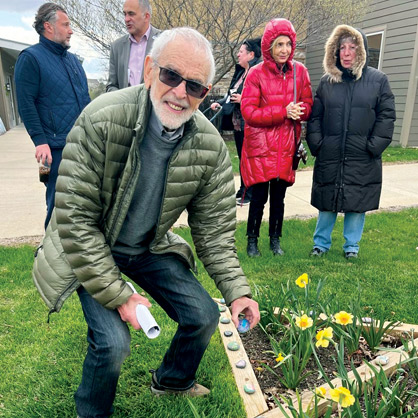
Nestled under my car's dashboard is a clear, plastic pouch of river stones in the hues of the earth and sea. I bought them nearly five years ago for my father-in-law's funeral, figuring it was a good alternative to having elderly mourners scrounging for rocks on that icy February day. They have remained in my car-and been used on a regular basis-ever since.

And thus I mark a new time in my life, the phase where I actually check the death notices every morning, the years when I witness the generation before me bid adieu to life on this earth.  Throughout the last year, there has been a steady stream of our friends' parents, and our parents' friends, who have faded away, leaving their survivors dazed and rudderless.

My dear friend Leslie's dad, Lowell. My Dad's dear friend, Hyman.

Rather than staring boldly into the abyss, we survivors busy ourselves with the business of death, attending to funerals and deli trays, emptying closets and putting homes on the market, all the while not truly believing that this utterly unique individual is truly gone.

Our Uncle Irv died at age 99½, a beloved Louisville patriarch who'd had a long life well-lived.  Now he was no longer tethered to an oxygen tank, no longer straining to hear conversation, no longer attempting to summon the strength just to come down to supper in the assisted living dining room. It didn't matter; we, and he, had still had wanted to celebrate that 100th birthday. And we could not conceive of a world without him in it.

He had been married a total of 72 years, 33 to his first wife, Blanche and then, after he was widowed, 39½ years to our Aunt Zera. Now Zera was left to solider on, alone, in her 90s. One of the first things she did was go to the Apple Store to buy an iPad, determinedly maneuvering her walker through the displays and rendering the young sales geeks speechless with the relevance of her questions. Now she is moving to Arizona, saying farewell to her few surviving friends and divesting of a lifetime of belongings to be near her daughter, grandchildren and great-grandchildren. How she has found the strength to begin again is truly beyond my comprehension.

My father-in-law's best friend, Mel, succumbed to cancer a few weeks ago. Mel was one of the most elegant people I have ever known, and a sweetheart of a husband.  At the shiva, his widow said: "After 65 years of marriage, he wasn't my husband.  He was half of me."  As if that weren't bewildering enough, she is among many women of the Greatest Generation who will live alone for the first time in their lives when they are widowed. My heart cracks for her. It must be terrifying-not just for her, but for her friends, whose husbands are in failing health.

It is also incomprehensible for the adult children left behind.  Our friends Bobby and Ellen lost both of their remaining parents within a few months of each other. After years that were an exhausting flurry of elder care errands and appointments, paperwork and case workers, hospitals and hospice, suddenly there was silence.

In a flash, the adult child is transformed from a human doing into a human being-and a human being who's an orphan, at that. As my friend Aaron Cohen said in his eloquent eulogy for his father, Jerry, who died just before Chanukah:

"Life is fleeting and old age is relative. When you're fortunate enough to bury a parent as you, yourself, are middle aged, perspective shifts. You see the sweep of a long life as a series of moments and phases that tumble together and ultimately collapse on themselves.

Edifices of family roles and relationships-the structures that provide the shelter of your youth, and the confines from which you try to break free-prove fragile. Putting them back together again is impossible, though, with the death of a parent, you might try…"

In facing death, many of our elders teach us a lot about life. My friend Leslie Millenson's mother, Judith, beat cancers of the breast, bladder and skin, and battled ovarian cancer for eight years. (Leslie says she thinks her mother was was determined to outlive the Bush Administration.)  Through it all, she never stopped learning, devouring the news, or lending a listening ear to a friend in need.  The same day she signed up for hospice, Judith went to renew her driver's license. When the hospice nurse called for the first intake conversation, Judith said: "I'm sorry. I can't talk to you now. I'm in line for my driver's license photo."

Leslie closed her passionate, profound tribute to her mother by saying:

"In the past few weeks, I've come across so many things that caused me to reflect on Mom and our life together. The one that touched me most came from our friend Ina Pinkney's newsletter. She declared that July should be devoted to courage, to being courageous in our own lives. She offered up a quote from the work of A. A. Milne, whose works were favorite bedtime reading with Mom. Christopher Robin says to Winnie the Pooh: "Promise me you'll always remember you're braver than you believe, and stronger than you seem, and smarter than you think." Our beautiful, smart, self-deprecating mother told us just that in so many ways, directly and indirectly, our whole lives.She loved us fiercely, and we are so blessed that we had her with us for so long, and that we will have her memory to inspire us for the rest of our lives."

Perhaps this is the legacy bequeathed to us by many of our elders:  the charge to be courageous in our own lives, and with our own lives, in the time allotted to us.

Progress

 Permanent link

At CJE SeniorLife's annual meeting, the Chairman of the Board ended his remarks by thanking his life partner for his love and support throughout the year. The audience smiled, and the meeting came to a close.

It was as if no one had noticed the earthquake that had taken place right before their eyes.

The CJE Annual Meeting took place on an auspicious date: Oct. 11. That week marked the 14-year-anniversary of one of the most horrific anti-gay hate crimes on record: the murder of Mathew Shepherd, a gay Wyoming college student who was abducted by two men, beaten unconscious, tied to a fence and left for dead.

Fourteen years ago, I daresay even the most optimistic among us would never have imagined that one of the largest Jewish communal agencies in Chicago would have an openly gay man at its helm. Or that marching in the annual Gay Pride Parade would be de rigeur for every major politician in the state. Or that half the American public would support the right to marriage for gay citizens. Or that the President of the United States' favorite television show would feature a gay couple named Mitch and Cameron.

During the 1980s, I worked for the Illinois Department of Public Health, where I helped to establish the AIDS Unit (back in the days before the term HIV). In those dark days, the nascent progress of the gay rights movement was inextricably intertwined with the fight against AIDS. In the early years of the epidemic, parents often learned that their sons were gay, and that they were dying, at the same time. Many considered both realities to be equally upsetting.

What I saw during those years shaped my world view. I bore witness as teenagers who came out were brutalized, shunned by their families, and even kicked out of their homes. There were no gay/straight alliances in high schools and precious few on college campuses.  PFLAG Chicago was only six years old. In the City of Chicago, it was still legal to fire someone for being gay or lesbian.

It was during this bleak time that I fell in love with the organized Jewish community.

I was smitten when the Union of American Hebrew Congregations (the precursor to the Union for Reform Judaism) printed a brochure titled AIDS: A Glossary of Jewish Values, which gently and firmly outlined how the mitzvot applied to the AIDS epidemic. There was nothing like it published by any other faith-based group.

At a time where the majority of the Illinois public believed that anyone at risk for AIDs should be permanently quarantined, this brochure taught the mitzvah of Pikuach Nefesh  (the tenet that saving a life overrides virtually every other commandment), extolled Bikkur Cholim (the obligation to visit the sick) and encouraged Gemilut Chasadim (the duty to perform acts of lovingkindness).

At a time when many pastors taught that AIDS was God's punishment for homosexuality, local rabbis invited me into their synagogues to teach their congregations about how to practice safer sex.

At a time when too many parents turned away from their children, Jewish parents organized chapters of PFLAG.

And at a time when most faith-based communities stood idly by while their neighbors bled, I had the privilege of participating in the Jewish Community Coalition on AIDS, an interdenominational, interagency initiative to address the needs born of the AIDS epidemic.

The inaugural meeting of the Jewish Community Coalition on AIDS was my first experience with the organized Jewish community. We met at the old Federation building (where, it should go without saying, we were served tuna fish for lunch). I don't remember everything that was said or done, but I do remember how my Judaism caught fire that day.

Until then, I had thought of myself more as a Jew than as a member of the Jewish community. Jewish was the main lens through which I viewed the world, but not the main world in which I lived. However, that day at One South Franklin I realized that these were the people I wanted in my foxhole; who were already in my foxhole.

I did not know, then, that in the years to come both the City of the Chicago and the State of Illinois would pass Human Rights ordinances that protect LGBTQ citizens, or that someday gays and lesbians would be able to serve openly in the U.S. military. I never imagined that one day my parents would regularly pair up with a gay couple to attend the opera, or that my daughter would live in the Queer & Ally House on her college campus without giving it a thought. I never envisioned how the Jewish Federation would launch a Jewish Lesbian & Gay Endowment Fund, or that an openly gay man would rise to the top of one of the most important Jewish institutions in the city. And I never dreamed that my passion for Tikkun Olam eventually would lead me to become a Jewish communal professional.

For all these things, I say: Baruch Atah Adonai, Eloheinu Melach HaOlam, Shehechiyanu, V'Kiymanu v'higiyanu lazman hazeh. Amen.  

Transitions

 Permanent link

The dream is always the same: I am back at Kalamazoo College because I forgot to finish my degree. The term starts on Monday, and I've arrived on campus late Friday afternoon without knowing my class schedule or dorm assignmentand the administration office is about to close for the weekend. My hearts twists as I walk down Academy Street and turn onto the Quad; everything is both sharply familiar and utterly foreign. I am sidetracked, waylaid, and finally lost.  I am too late. I awaken with my heart in my throat.

Did I mention that I just made the hotel reservation for my 30th college reunion?

I have been to college reunions at least twice before, but never at a time of such transition in my own life. Then, I knew who I was and what I was moving towards, or at least I thought I did. Now I am not so sure. Yes, I have a husband I adore, a daughter who's my heart, and a career I love. I serve on volunteer boards and have a garden and can make a fine pie crust. What I don't have is a sense of what comes next, after the empty nest and before the grandchildren.

Hence the anxiety dreams.

Sometimes, my current Self breaks into the dream and wakes me, gently scolding: "You already have a degree. Actually, you have two degrees. And a career and a family. You have a life. It's time to let this go."

I awaken wondering what it is I am supposed to let go of.

Since my college days, it seems that piece by piece I have misplaced bits of my younger self. I have forgotten virtually all the French I ever spoke, much of the symbolism of the paintings of the Pre-Raphaelite Brothers, many of the intricacies of Soviet foreign policy surrounding World War II, and the more subtle nuances of John Stuart Mill's political thought. I have never again trained across Europe or been on stage or stayed up all night talking about the meaning of life with my friends.

When I think about college, I experience a sense of loss that leaves me breathless.

The funny thing is that when I talk to my classmates, they shudder when remembering our college years. And of course, I am appropriately mortified when I consider my 20-year-old self. I was insecure and anxious; my emotions were raw and my neediness was embarrassing. I was obvious and vulnerable and just plain foolish, in so many ways.

But I also had a sense of limitless possibilities. I mean, I actually believed I could be president. I felt like I could change the world.  And I want that feeling back.

Maybe that's why I enjoy being around college students so much, which I had the chance to do this summer. It was a balm to spend so much time with my daughter and some of her closest friends, young people who are so bright, thoughtful, funny and achingly honest. If I close my eyes, I can picture them as the adults they will be in 10 years; I can see them as parents and professionals, can imagine the contributions of the future neuroscientist and teacher, can envision the brilliance of the art conservationist and writer they will become. However, what none of us can see clearly is the road ahead for each of them—and as much as people will tell them to relish these years and to "enjoy the journey," that looming uncertainty makes them feel painfully fragile.

When you're young, you don't realize how brave you are or how strong you can be. Until you have stared down a serious illness or a devastating job loss, until you have lost a loved one or a nest egg, until you have endured the betrayal of a dear friend or the abdication of a cherished lover—you don't grasp what tough stuff you're made of.

I guess that's the trade-off of getting older: giving up your sense of limitless potential in exchange for a sense of security in yourself. By the time you become comfortable in your own skin, it usually sags a little.

For years, I used to suffer pangs of jealousy when reading my alumni magazine. As I learned about classmates who had experiences that sounded so interesting, accomplishments that sounded so genuinely important, I felt insignificant. Now I have a newfound sense of security, which comes not from a sense of accomplishment, but simply the knowledge that I've earned my own place in the world, combined with a healthy dose of gratitude. What's that line from Follies? "I made it through all of last year, and I'm [still] here."

Plus, something inside me shifted over the last few years, the stirrings of a renewed sense of kinship with any and all of the people I have known along my life's path. I feel proud instead of competitive, and disconcertingly tender towards contemporaries I haven't seen in years. I feel crestfallen rather than smug when a Facebook friend request pops up from classmate who's hard to recognize.  Interestingly, I can no longer remember what grades I got in which classes, or exactly why I had a falling out with a particular classmate. Instead, I feel a diffuse sense of affection for all the people making this journey with me, and for all the times and places in which I have loved them.

Who knows? Next time I have that anxiety dream, I might make it to the administration office before closing time.