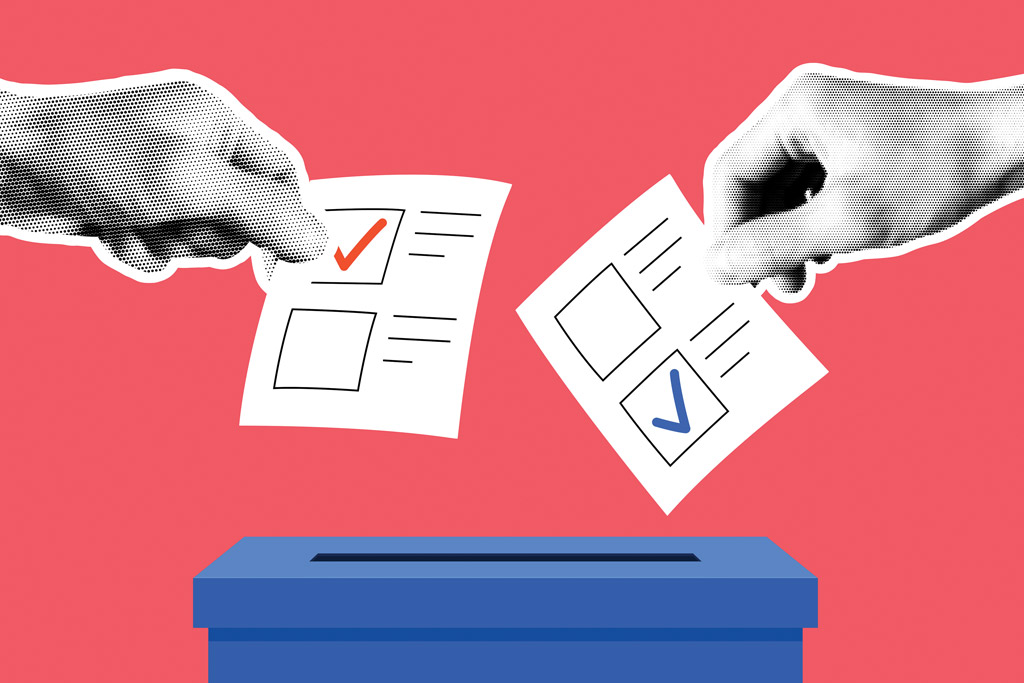
Rabbi Moshe Feinstein, one of the foremost Orthodox Jewish legal authorities of the 20th century, identified a throughline from a fundamental Jewish principle of hakarat hatov—recognizing and appreciating the good we are given; in a word, gratitude—and participation in elections. “It is incumbent upon each Jewish citizen to participate in the democratic system which guards the freedoms we enjoy. The most fundamental responsibility […] is to register and to vote,” he wrote in a 1984 letter.
American Jews have heeded this principle since our community gained the right to vote in the 19th century. In fact, Jews tend to vote at a higher rate than the general population. With midterm elections coming up on Nov. 3 this year, it also feels pertinent to highlight the consistently high rates of civic engagement among our community. The religion and civics scholar Ryan Burge highlights that, among religious groups, Jews’ level of political engagement is below only members of the Episcopal Church and the United Church of Christ.
The nonpartisan Jewish Voters Resource Center (JVRC) described American Jews as a “highly engaged political constituency” that “turns out to vote at a higher rate than the general population.” The JVRC noted that Jewish voter turnout reached 71% in the 2024 presidential election, compared with 64% for the general population—a seven-point gap.
The difference is even more pronounced in non-presidential elections. The JVRC found that 67% of American Jews voted in the 2022 midterm elections, while only 46% of the overall electorate participated. In other words, Jewish turnout exceeded national turnout by 21 percentage points, in the most recent midterm election studied.
Chicago may be infamous as the place where we “vote early and vote often,” but the reality paints a different picture. Chicagoans’ voting rates hover at about 30% in primaries and at about 68% in the general election, with the rates significantly lower in non-presidential years. For example, only 43% of voters submitted ballots in the 2022 midterms.
Given these trends, it becomes ever more important to exercise what Rabbi Feinstein called “a minimal expectation of citizenship.” The results of the Nov. 3 election will impact our community’s public policy priorities—including our social services—plus support for efforts against antisemitism and for Israel.
This November will also give Chicagoans their first chance to elect the entire Board of Education and its president, giving us a chance to have a greater impact on the policies and priorities that will shape K-12 education in Chicago. Engaging in free, fair, secure elections protect the Jewish community’s ability to thrive, participate fully in civic life, practice our tradition freely, and advocate for our interests.
In Illinois, the deadline to register to vote in person or by mail is Oct. 6; online voter registration is open until Election Day. Early voting will begin Sept. 24.
It’s also important to remember that the City of Chicago will vote for mayor, and all 50 aldermanic positions, on February 23. Register now, and you are set to vote in both November and February.
To check your registration or to register, go to elections.il.gov. Voters may also check the location of their polling places at the site.
Jane Charney is the Associate Vice President of Local Government Affairs for JUF.
Lewis Summer Intern Program participant Noah Tennenbaum contributed to this story.
In this issue
-
-
-
Catching up with Gold
Actor, writer, and comedian Judy Gold is known for her edgy wit and sharp timing
Read more