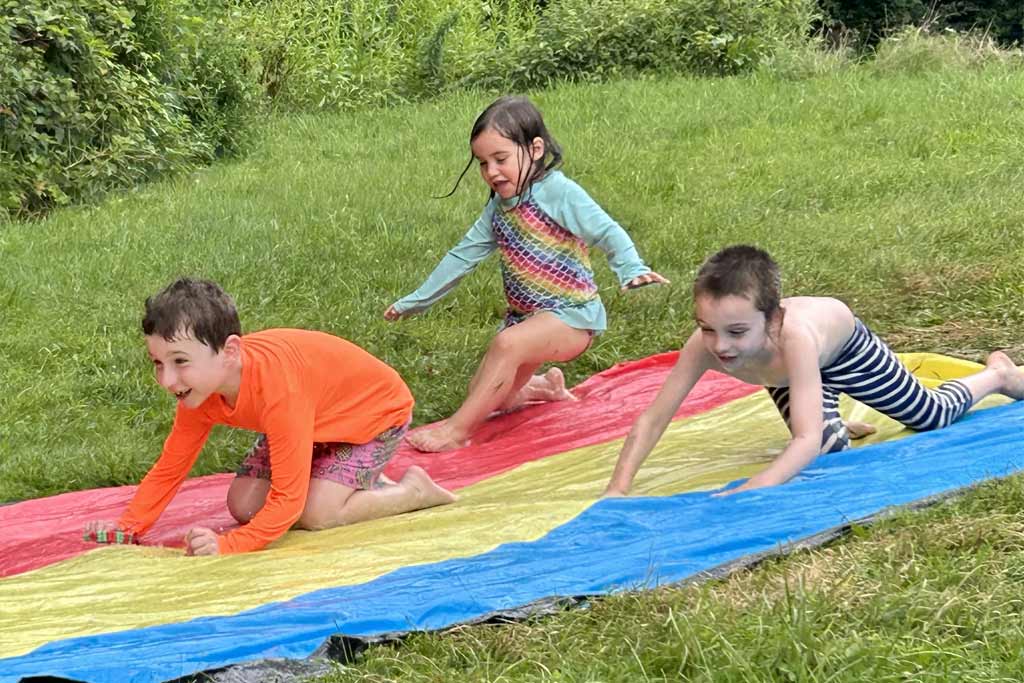
Outdoor water play at Camp Enga Benga. Enga Benga was held for the first time last summer, with plans to return in 2027. (Photo courtesy of Camp Enga Benga / Shifra Whiteman)
“I want to go to Enga Benga,” said my older daughter. “I want to work on my Yiddish.”
It was bedtime, and we were discussing—in English—a new summer camp: a day camp in New York that would be full Yiddish-language immersion.
I learned Yiddish as an adult and had spoken it with my two daughters, ages 5 and 8, hoping to raise them bilingual. But we have been speaking more and more English; it’s my native language, it’s the dominant language around us, and, well, life is hectic. Still, I’ve kept Yiddish up with them just enough to keep a linguistic door open.
Camp Enga Benga was created for families like ours. The five-day camp is for young children being raised with Yiddish in the home. The parents involved are Yiddishists: Yiddish speakers of all flavors and denominations, including secular, passionate about speaking the language as a daily vernacular. “Enga Benga” comes from a children’s counting rhyme, like “eeny meeny miny moe”:
Enge, benge, stupe, stenge,
Artze, bartze, gele, shvartze,
Eygele, feygele, khik!
Fifteen children, ages 3 to 8, attended Camp Enga Benga, traveling from Chicago, Evanston, the East Coast, Pittsburgh, and Jerusalem. Kids did arts and crafts, climbed on the playground, slid down Slip N’ Slides, ate popsicles, read stories, sang songs, and played board games—all in Yiddish. The camp was supported in part by a grant from the Sonia and Aaron Fishman Foundation for Yiddish Culture.
“At the beginning of the week I was a little scared to go to Enga Benga because I had never been to a camp like this,” said Hannah*, my 8-year-old. “But it helped me a lot.”
The way counselors modeled Yiddish felt natural to her. “They weren’t [saying] ‘The word for summer camp is zumer-lager‘—they were letting me experience just speaking Yiddish, and letting me get used to it,” Hannah said. (Meanwhile, my 5-year-old, Molly*, said her favorite part was eating Fritos.)
Enga Benga is designed to be an on-ramp—socially and linguistically—into the overnight camp immediately following: an annual week-long Yiddish-language immersion retreat called Yidish-Vokh (Yiddish Week). Each August, up to 170 people come from around the world to YV, held at a camp in the Berkshires and run by the organization Yugntruf – Youth for Yiddish.
Benna Kessler, a social worker and Yiddish teacher who lives in Rogers Park, grew up speaking Yiddish. Kessler has gone to YV “pretty much every year” since she was almost 3, and has a close-knit group of friends from the retreat. They all still go to YV. “It’s almost like a family reunion,” Kessler said.
Avi Fried, who lives in Edgewater and is also a Yiddish teacher, learned the language in his 30s, and even met his wife thanks to Yiddish. Fried described how activities become vivid at Yiddish Week. “I’m not much of a singer,” he shared, “but if it’s a zingeray (singing circle) and there’s some Yiddish, okay! Now I want to sing.”
For the nearly 40 kids who went to Yiddish Week this past summer, the week is pure camp fun. Kids attend “kindergrupes,” swim in the pool, play gaga, roast s’mores at the bonfire, and surreptitiously feed the lake’s many turtles. Hirsch, a 7-year-old from Evanston, said he loves performing at the “talantarnye” (talent show) and going “shifln,” kayaking and canoeing.
For my family, the back-to-back immersion experiences were a wild success.
On Saturday night at Yiddish Week, my daughters and I were outside, wondering if Shabbat was over. I said that we could look for “dray shtern”—three stars—to be sure.
Hannah looked at me and then her sister. “Ikh ze nor tsvey shtern!” she joked, saying that she only saw two “shtern” but using the Yiddish word for “forehead”: also shtern.
It was a Yiddish pun! A good one, too. I kvelled.
*Children’s names have been changed.
In this issue
-
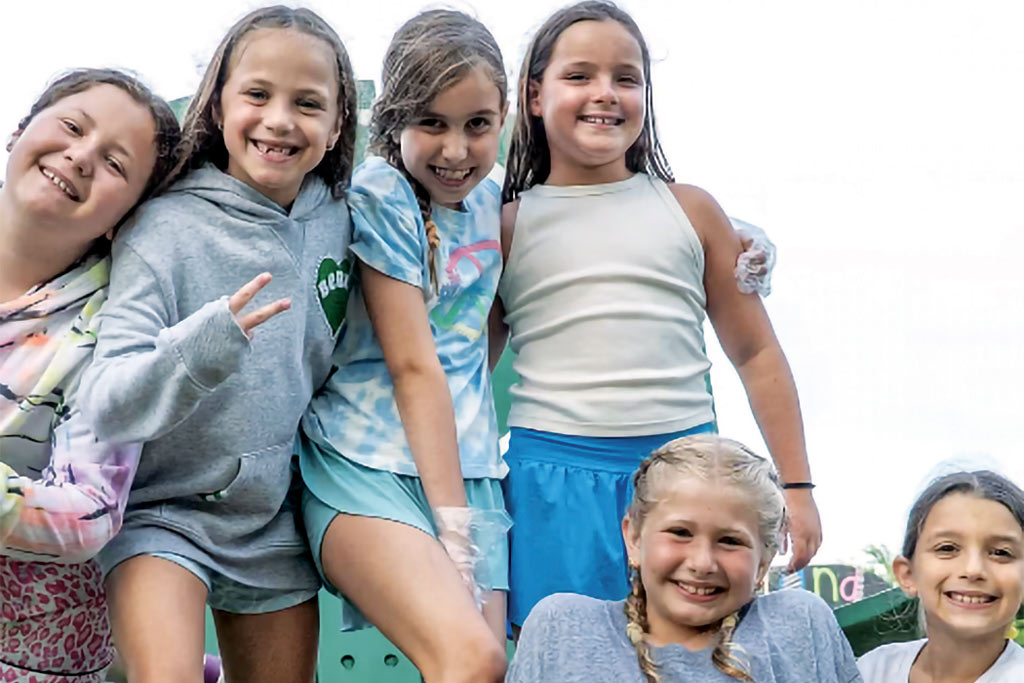
Making Jewish summer overnight camps more affordable
One Happy Camper grants provide up to $1,500 to Jewish children
Read more -
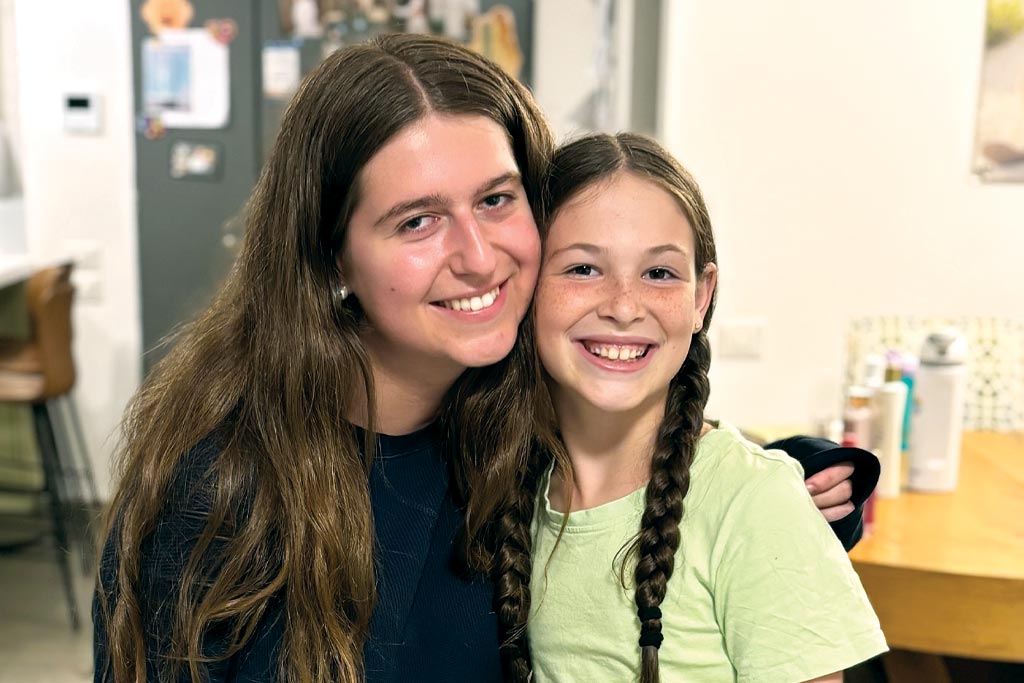
Finding my way back to Israel
JUF’s Kefiada is an English-immersion day camp in Kiryat Gat, Israel
Read more -