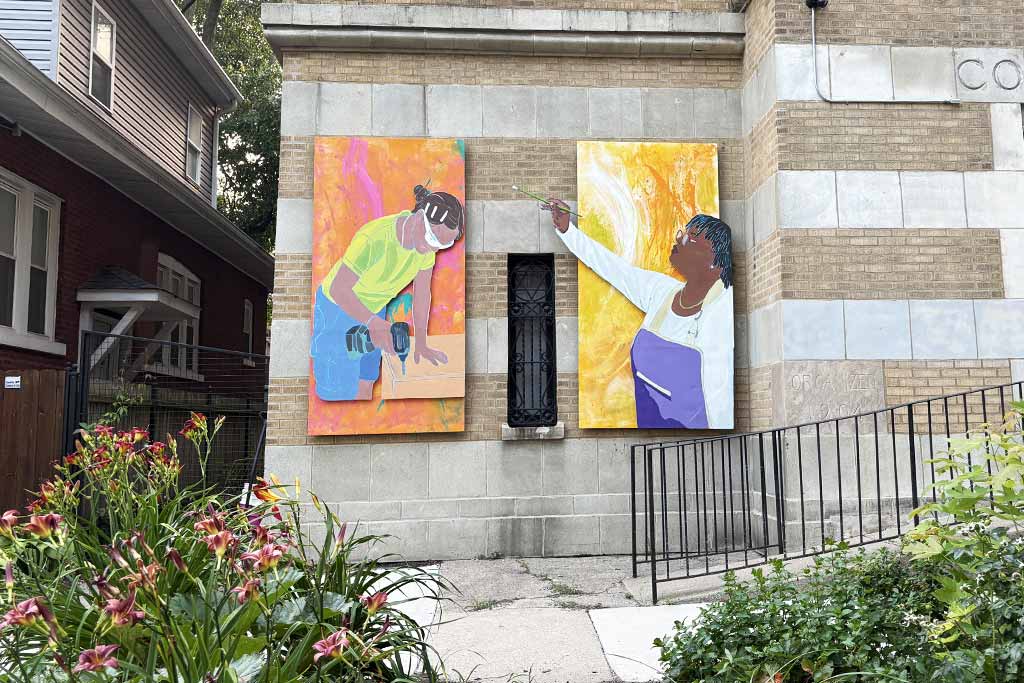
An outdoor art installation at Narrow Bridge Art Club. (Photo courtesy of Narrow Bridge Art Club)
The former Congregation B’nai Betzalel was supposed to become 27 condos. Instead, Amber Ginsburg helped turn the century-old Woodlawn building into Narrow Bridge Arts Club, a carbon-neutral, solar-positive home where artists ranging from ages 18 to 80 create side by side.
This 1923 building has been a site of worship for a century, first as a synagogue, and, since the late 1940s, as a number of churches. Most recently, the building was home to the Cosmopolitan Church of Prayer.
“The most economically efficient thing to do was to bulldoze the building, which meant bulldozing the social history of this space over the past 100 years,” Ginsburg said. “It also meant demolishing the past labor and material of this structure. I just couldn’t let this building and this history be demolished. It has been a site of song and worship, mourning, births, and funerals.”
That instinct runs through Ginsburg’s work as an artist and teacher. A sculptor who teaches at the University of Chicago, she works collaboratively at the intersection of beauty, material, and speculation, often inviting audiences not only to encounter her art but to help complete it. She also serves as Executive Director of Narrow Bridge.
“However, I call myself a civic director and not an executive director,” Ginsburg explained. “Executive brings in a kind of term of business that maybe doesn’t apply a community space—where there is one person who makes all the decisions and everyone is below that.”
Narrow Bridge forgoes the traditional model of private art studios and, instead, promotes an open concept approach to learning and sharing resources. It features a fiber arts studio, woodshop, co-making space, and dance rehearsal space. Outside, a “food-for-all” garden and other outdoor exhibitions are on display for the South Side community.
“There are no walls,” Ginsburg said. “We learn in a very ancient way. We learned the way that humans evolved to learn. We have ‘quiltivists,’ artists, and painters who have been practicing on the South Side of Chicago for 50 years. We also have young artists who are just starting to do something in a very untraditional way and experienced artists are looking at them and learning.”
The club offers low monthly fees together with required participation in operations and governance to ensure access to artistic instruction, exchange of ideas, and responsible art production. “We are an all-volunteer organization,” Ginsburg said. “There are zero paid employees”
Another important feature of Narrow Bridget is its commitment to environmental sustainability and carbon neutrality. The space makes use of a variety of adaptive reuse concepts. “This building now generates more energy than it uses every day,” Ginsburg said. “We give energy back to the grid.”
Ginsburg approached the project as if she “inherited” the building. “How you would treat your grandmother’s china is very different than how you would treat something that you don’t care about,” she said. “So, every single material that was not toxic stayed on the site and was used back in the building.”
Ginsburg’s Judaism has also inspired her approach to Narrow Bridge. “Every way that you go about the world is a form of ethics,” she explained. “There’s no ‘away’ when you throw away. Where is ‘away’? We share a watershed. We share land in a landfill. There isn’t an ‘away’. To think about where your actions impact is a form of kindness, chesed.”
Gimsburg added, “We are making history. Right here, right now. In the next 100 years, the people who are working here are our history.”
In this issue
-

The remarkable writing life of Talya Jankovits
The Very Unremarkable Life of Mrs. Etty Bloom debuted this June
Read more -
A novel a decade, and a lifetime, in the making
Gerilyn Bass Greenberg’s debut is personal, yet universal
Read more -
‘No one who has read me can ignore… that I am a Jew’
Biography takes full measure of poet Paul Celan
Read more