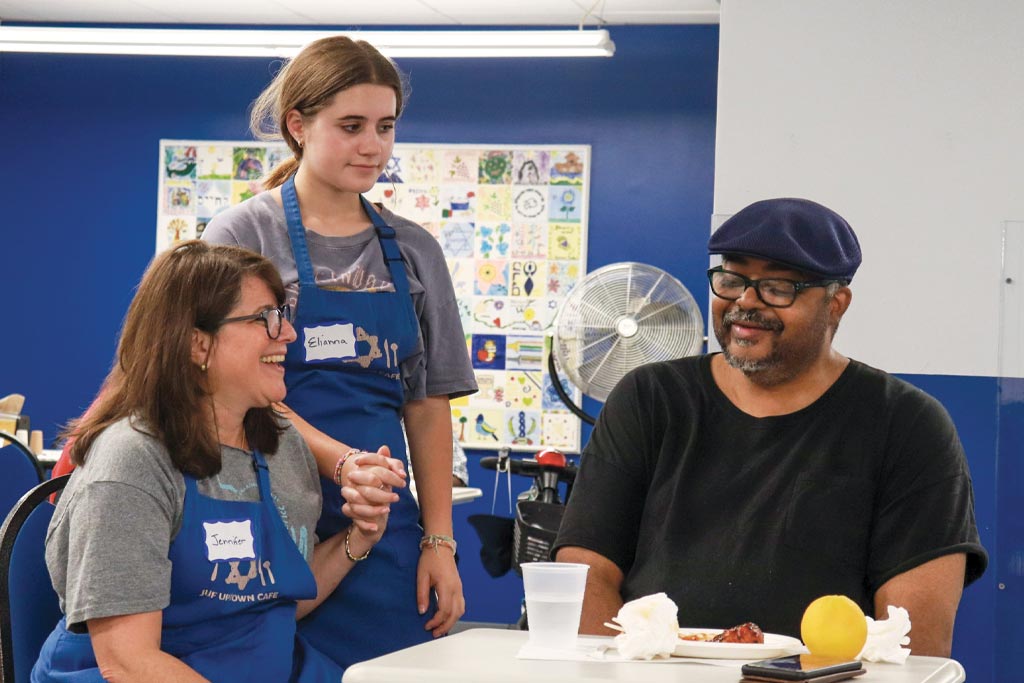
Two volunteers with a client at Uptown Cafe. (Photo courtesy of EZRA)
When Carrie* unexpectedly lost her job earlier this year, Dina & Eli Field EZRA Multi-Service Center’s rent assistance helped keep a roof over her head. Months later, she found a new job at a north suburban coffee shop and was able to help the organization that had supported her.
Carrie shared EZRA’s impact with the coffee shop’s owner, who was moved by the center’s work. The shop began collecting donations for, and contributing tips to, EZRA, inviting customers to support the organization that had made a personal difference for one employee and the wider Chicago community.
The experience captures what EZRA works to make possible: Helping community members regain stability, stay connected, and when their circumstances improve, pay that support forward.
Founded in 1983 to meet the needs of economically disadvantaged community members, EZRA began as a 24/7, toll-free hotline staffed by volunteers providing information, advocacy, service referrals, and connections to care. Over time, it has grown into a multi-service center offering support to both Jewish and non-Jewish clients, services for Russian-speaking immigrants, and a food pantry. Its programs include kosher meals at JUF Uptown Cafe, healthy-movement classes, mental health services, and social activities, including holiday celebrations.
From July 1, 2024, to June 30, 2025, EZRA served more than 1,900 individuals through this expanding network of programs.
The same spirit that helped Carrie regain stability also guides Olga Prutnikov, Assistant Director at EZRA, whose work is shaped by her own family’s immigrant experience.
Prutnikov first joined EZRA after she finished graduate school through its Center for Russian Speakers, a program that serves Russian-speaking Jewish immigrants and others navigating life in a new country. Her own family had come from the same region as many EZRA clients, and she saw in the center an opportunity to support the community that had helped her family begin again.
“That is the community I came from,” she said. “I wanted to be part of the next generation that could give back, and provide the same help that my family got almost 40 years ago.”
Rooted in tikkun olam, EZRA helps community members live with dignity through compassionate programming, advocacy, and collaborative care. Today, the center provides wraparound services for vulnerable clients.
One focus is addressing barriers to self-sufficiency. EZRA helps prevent homelessness and food insecurity through financial literacy courses and assistance in applying for benefits.
“We help people learn how to use money,” Prutnikov added. In fact, EZRA recently launched its first asset building program for clients. “It’s a four-to-six-month program that involves meeting one-on-one with caseworkers to help clients grow their savings. We’re also providing matching funds to help clients build their assets.”
But EZRA also helps reduce isolation. “Food stamps aren’t enough,” Prutnikov said. “We help combat social isolation and keep people connected in the community.”
EZRA has stayed especially nimble in today’s volatile political climate. When the “One Big, Beautiful, Bill Act” imposed new work requirements on SNAP recipients, it put food assistance benefits at immediate risk for those falling short of 80 working hours per month. In response, EZRA provided $60,000 worth of ALDI gift cards to clients.
“The gift cards were especially helpful for our new Ukrainian arrivals as they are waiting for work authorization,” Prutnikov said. “They have very little benefits, and we were able to provide them with this most basic need.”
As needs continue to grow and evolve, Prutnikov says EZRA’s work depends on the strength of the community. Volunteers, donors, and other partners help ensure that clients receive not only food and services, but also the message that they have not been forgotten.
To learn more about volunteering with EZRA or to donate, visit juf.org/ezra.
*Name changed to protect client’s identity.