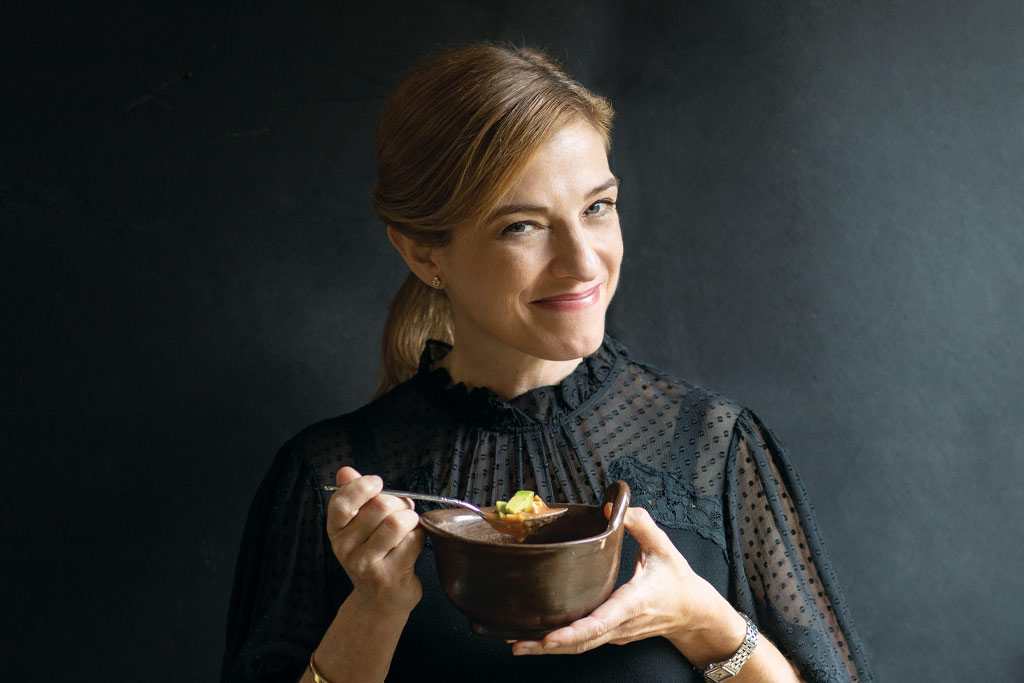
(Photo credit: Jennifer Chase)
“I was born and raised in Mexico.”
That is the first thing Pati Jinich says when people ask where her love for food comes from.
Despite going on to become a celebrity chef, television host, and cookbook author, Jinich grew up dreaming of a career in academia. She earned her bachelor’s degree in political science from the Instituto Tecnológico Autónomo de México and master’s degree in Latin-American studies from Georgetown University. She then worked as a political analyst for the Inter-American Dialogue, a Washington, D.C. think tank.
However, Jinich found herself “obsessively” thinking about food rather than politics, so she registered for the night program at L’Academie de Cuisine in Gaithersburg, Md. Since then, she’s never looked back.
Today, she is host of the four-time James Beard Award-winning PBS television series Pati’s Mexican Table, the James Beard Award-winning PBS primetime docuseries La Frontera, and Panamericana. She also serves as the resident chef at the Mexican Cultural Institute in Washington, D.C.
Her new cookbook, Foods of La Frontera, comes out on Sept. 15, and will feature 125 recipes celebrating the rich cultures and foods from where the U.S. and Mexico meet.
What was the last book you read? The Correspondent by Virginia Evans. What moved me most was what it says about connection—that the written word, sent out into the world, is how we preserve ourselves and find each other. For someone who has spent her whole life trying to build bridges between cultures and people through food and storytelling, that landed very close to home.
What’s your all-time favorite movie? Groundhog Day. Underneath the comedy, it is a genuinely profound film about personal transformation.
What’s your favorite Jewish food? Lahmajine as its expressed in Mexico. It is one of the most beautiful examples of what happens when cultures put down roots somewhere new and cook their way into belonging. Mexican-Jewish cuisine did not start 10 years ago—it has been evolving for hundreds of years, and the Mexican version of lahmajine is a delicious example.
What are you listening to these days? Norteño music. It is the soundtrack of Coahuila, where I am filming Season 15 of Pati’s Mexican Table. I’m also a regular listener to The Daily and Ezra Klein, and I don’t miss any of the NPR StoryCorps stories.
Who was the last person you texted on your phone? My son Sami, who is spending a year in Israel on a fellowship at Givat Haviva.
If you could invite three people to a Shabbat dinner, who would they be? Always, always, always my three sons—Alan, Sami, and Juju. That is the dinner I am always hoping for and working toward. And, of course, anyone they want to bring along!
If you could have any other occupation, what would it be? A singer, if I had the gift of a good voice, which I absolutely do not. But what draws me to it is the same thing that drives everything I do: The ability to interpret something, to connect emotionally with people, to make them feel seen and less alone. Food does that for me. A great song does it in just a few minutes and can stay with you forever.
Who are two of your biggest role models? My two grandmothers. They each lost everything and rebuilt beautiful, joyful lives in Mexico. My father’s mother fled the pogroms in Poland. My mother’s mother escaped the Nazis from Austria. They were radically different with very different education, very different ways of approaching life and family, but they both cooked. They fed people. They built a world out of what they had. They wove what they carried with them into what they found in Mexico. That is the lesson I try to live by every single day. Honor what came before you and nurture where you stand.
What are you currently binging on TV? I just finished the last season of The Diplomat. I really admire the professional evolution of Kerri Russell and her depth in acting. I also keep returning to old episodes of Anthony Bourdain: Parts Unknown. He did something with storytelling and travel that I think about constantly.
If you could offer the teen version of yourself one piece of wisdom, what would it be? The things that make you feel like you don’t quite fit—the Mexican girl who is also Jewish, the political analyst who keeps sneaking into the kitchen, the immigrant who loves two countries equally—those are not your weaknesses. Those are your story. Protect them fiercely. Embrace standing in the middle of the bridge. They will become your superpower in helping people gain greater understanding and connect.