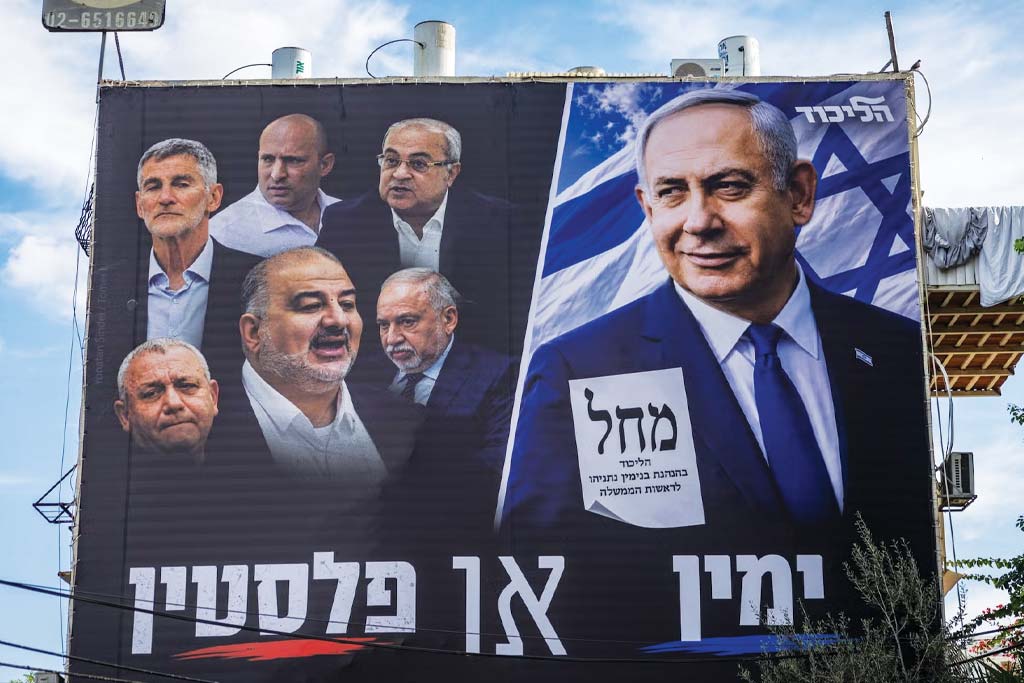
View of a giant election campaign poster displayed on a building in the southern Israeli city of Ashdod, showing Prime Minister and Likud party chairman Benjamin Netanyahu alongside leaders of opposition parties, with the slogan “Right or Palestine,” ahead of Israel’s upcoming general elections, October 5, 2026. (Photo credit: Yonatan Sindel/Flash90)
Note: While this analysis was written before Israel’s elections were held, it will be relevant regardless of the election results.
According to the current polls, the two leading parties—Likud, headed by PM Benjamin Netanyahu, and Yashar, headed by Gadi Eizenkot—are tied. Israelis, like people everywhere, believe that “our guy” (in this case, it is all men) will emerge victorious, then forming a governing coalition of at least 61 Knesset seats.
Though it seems like a familiar refrain, our 2026 elections are possibly the most important in decades. Since October 7, Israel has been at war in Gaza, with Hezbollah, Iran, the Houthis, and other forces. At the same time, the image of Israel has been attacked nonstop on campuses, in cities around the world, in legislatures, and online.
The elections are about many issues, as always, but the main topic is that day of infamy, October 7—the events that led to it, whether it could have been prevented, the war, and the hostage crisis. Voters will consider who defended our nation, and who didn’t serve, and why not.
It boils down to what kind of country we want. There are three overarching issues on Israeli voters’ minds:
Issue 1: Responsibility for October 7
Netanyahu supporters have downplayed his personal responsibility from day one. Their defense is that Netanyahu was not warned by Israeli intelligence and the IDF leading up to the attack, and that if they had warned him, he would have raised the alarm, and the IDF would have protected the Gaza envelope.
The other side places the blame squarely on Netanyahu’s shoulders, alongside those of the military and intelligence. In their view, Netanyahu, who had been at the helm almost continuously for close to 15 years, had designed the policy allowing Hamas to gain strength in Gaza as a counterbalance to the Fatah-led Palestinian Authority in the West Bank.
Issue 2: The Reservists
Since October 7, more than 350,000 reservists have been called up to active duty. Many have not been home for over 500 days. Many lost businesses. Half have reported issues in their marriages. Many returned with severe post-trauma impacts. Hundreds did not return at all. The army is in desperate need of manpower, even going so far as to discuss lengthening the mandatory service for men.
The issue of who serves in the IDF is chronic, but current massive losses among reservists have made it acute.
While the fact that a majority of the ultra-Orthodox are still not serving in the IDF remains a painful, divisive issue for most Israelis, it must be noted that there are ultra-Orthodox serving in the IDF, and they are among the fallen.
Because of Netanyahu’s coalition and close relationship with the ultra-Orthodox parties, he has been under pressure to pass a law exempting ultra-Orthodox from military service. That demand, coming during a war that has taken such a heavy toll, has further caused societal discord.
The toll paid by reservists has been disproportionally high in the modern Orthodox community.
While they see no conflict between service and religious tradition, their demand for universal service has often clashed with their support for the Netanyahu government.
Issue 3: Leadership
Finally, the elections were about the leadership’s experience. The Netanyahu side campaigned with the unquestionable fact that with 19 non-consecutive years in power, he is the longest-serving prime minister in our history. To his followers, his experience overshadows any miscalculations he may have made.
To the opposition, his longevity is no guarantee of infallibility, with the events surrounding October 7 serving as proof. They have argued that the leader’s experience may actually be a detriment, and that what counts more is the leader’s integrity and their team.
Following the harshest three years in our country’s history and a muddy election campaign that occupied the remaining attention span, the results of the elections will not be clear for a few weeks following October 27.
That’s because in our multi-party parliamentary system, a leader must build a supportive coalition among multiple, diverse parties to form a majority in the Knesset before he or she can become prime minister. That process typically takes between up to two months, with the clock starting on election day.
Ofer Bavly is a JUF Vice President and the Director General of the JUF Israel Office.
In this issue
-
An open door at Northwestern Pritzker Law
The Antisemitism Legal Advocacy Project has launched
Read more -

-