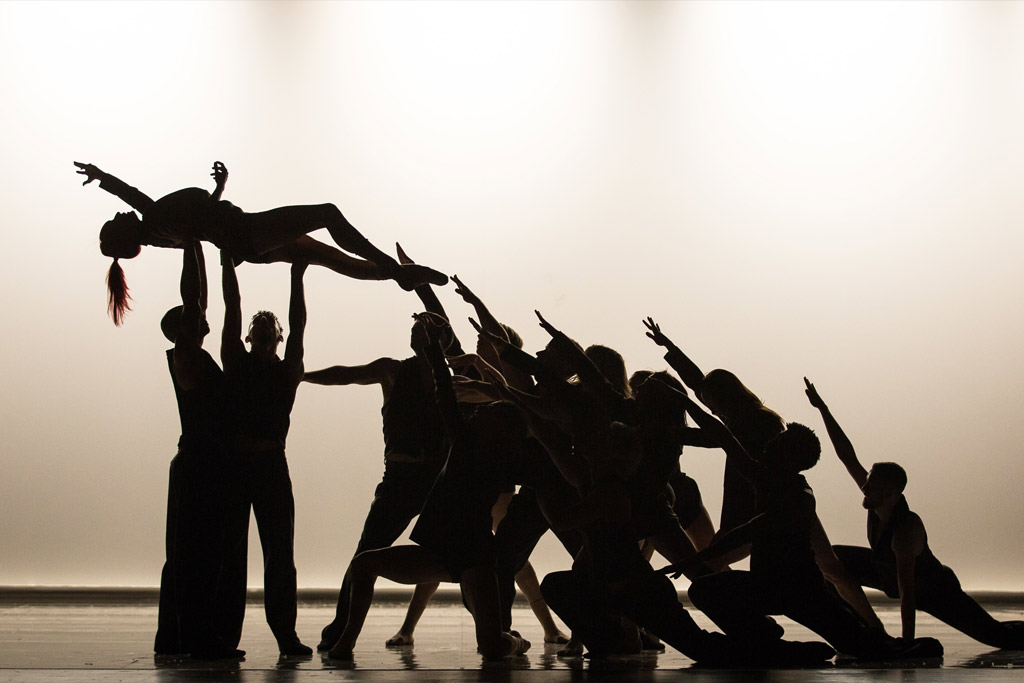
Montréal presents Dance Me: The Music of Leonard Cohen, in honor of the 10th anniversary of the great Canadian songwriter’s passing. (Photo credit: Thierry du Bois)
This fall, you can give thanks for a musical, a play, a dance, a concert, stand-up routine, a sculpture exhibit … and for all the Jewish talent that creates it.
A musical yartzeit for Leonard Cohen
Many great songwriters have been Jewish, but arguably the most Jewish—in theme and content—was Leonard Cohen. He was born in a suburb of Montreal, which boasts skyscraper-sized murals honoring him.
In honor of the 10th anniversary of his passing, Ballets Jazz Montréal will present a new production called Dance Me: The Music of Leonard Cohen. The performance also marks the Chicago debut of this 14-member ensemble.
The show’s title refers to Cohen’s klezmer-esque classic “Dance Me to the End of Love.” Cohen said it was his reaction to learning that Nazi guards forced Jewish prisoners to play music in the death camps. That song—as well as classics like “Suzanne” and “Hallelujah”—will be featured, accompanied by both stage sets and video projections. The project was approved by Cohen before he died.
Many of Cohen’s songs, like “Story of Isaac” and “Samson in New Orleans,” contain Biblical references. “Hallelujah” references the David and Bathsheba story; in “You Want It Darker,” he sings, “Hineni, hineni.”
Jewish prayer was another favorite source of Cohen’s. “If It Be Your Will” refers to the liturgical expression, “Yihi Ratzon.” “Who By Fire” updates that High Holiday passage. And, as if to balance “Hallelujah,” Cohen wrote a song titled simply, “Amen.”
When asked in 1985 about his music sounding “more Jewish” by an Israeli TV interviewer, Cohen responded, “My songs are always Jewish. They can’t be anything else.”
Dance Me will be performed on Nov. 7 at The Auditorium, 50 East Ida B. Wells Drive, on Saturday, Nov. 7. To learn more, visit auditoriumtheatre.org for tickets and info.
[Pics 1-3]
A tale (almost) as old as time
She Loves Me, a Tony-winning 1963 musical, is being revived at Northwestern University in November. It will be directed by Elizabeth Margolius, who recently directed Fiddler on the Roof at Drury Lane and The Flying Lovers of Vitebsk at Northlight.
“While keeping the romance firmly in place, she wrote, “I am also interested in exploring the darker themes surrounding the piece: political and social unrest, high unemployment, mass demonstrations, and the precarious position of taking place between two world wars.”
Its story was born in the 1937 play Illatszertár, by Hungarian Jewish playwright Miklós László, and introduced to America as Parfumarie. The play inspired She Loves Me… and also the 1940 film The Shop Around the Corner, by a Jewish director, Ernst Lubitsch, and screenwriter, Samson Raphaelson.
That film, in turn, gave us the 1949 Judy Garland musical In the Good Old Summertime, set in Chicago. The most recent version of the Parfumarie story is You’ve Got Mail, the 1998 romcom written and directed by Nora Ephron.
Like all the other versions, She Loves Me has its own Jewish connections. Its music and lyrics were by the Fiddler team of Bock and Harnick; its book was written by Cabaret’s Joe Masteroff; its debut was directed by Hal Prince.
She Loves Me runs from Nov. 13-22 at Northwestern University’s Wirtz Center for the Performing Arts, at the Josephine Louis Theater, 20 Arts Circle Drive, in Evanston. To learn more, visit wirtz.northwestern.edu/she-loves-me.
[Pics 4 and 5]
One performance, many nations
When Vadim Gluzman plays Prokofiev’s Second Violin Concerto, several nations will share the moment. The composer was Russian, born in what is now Ukraine, raised in Latvia, and lives in Israel; his family made aliyah when he was 17. His instrument, a Stradivarius, is Italian; it was formerly owned by Hungarian-Jewish virtuoso Leopold Auer.
Gluzman himself studied at Juilliard and was mentored by the legendary Isaac Stern. He specialized in debuting works by living composers.
Performances will run November 19-21, at Orchestra Hall, Symphony Center, 220 S. Michigan Ave. To learn more, visit cso.org.
[Photo 7]
An even more magnificent mile
If you have walked along Michigan Avenue recently, you may have seen a series of sculptures of people in swimwear—not swimming, but meditating, or even dreaming.
This exhibition, Monuments of Stillness, was created by Jewish sculptor Carole Feuerman; it runs through Nov. 15. The 10 statues—of resin, bronze, or painted steel—are placed along the famous avenue from Oak Street south to the Wrigley Building.
There is an accompanying exhibit of smaller works in the series, showing at the Hilton Contemporary’s River North Gallery at 716 N. Wells St.
Feuerman helped pioneer her style, Hyperrealism, in the 1970s. Since then, her award-winning works have been shown worldwide and grace the collections of more than 30 museums.
[Photos 8-12]
Paul Wieder, former Associate Editor of this publication, is a freelance writer, editor, and proofreader living in Chicago.
In this issue
-
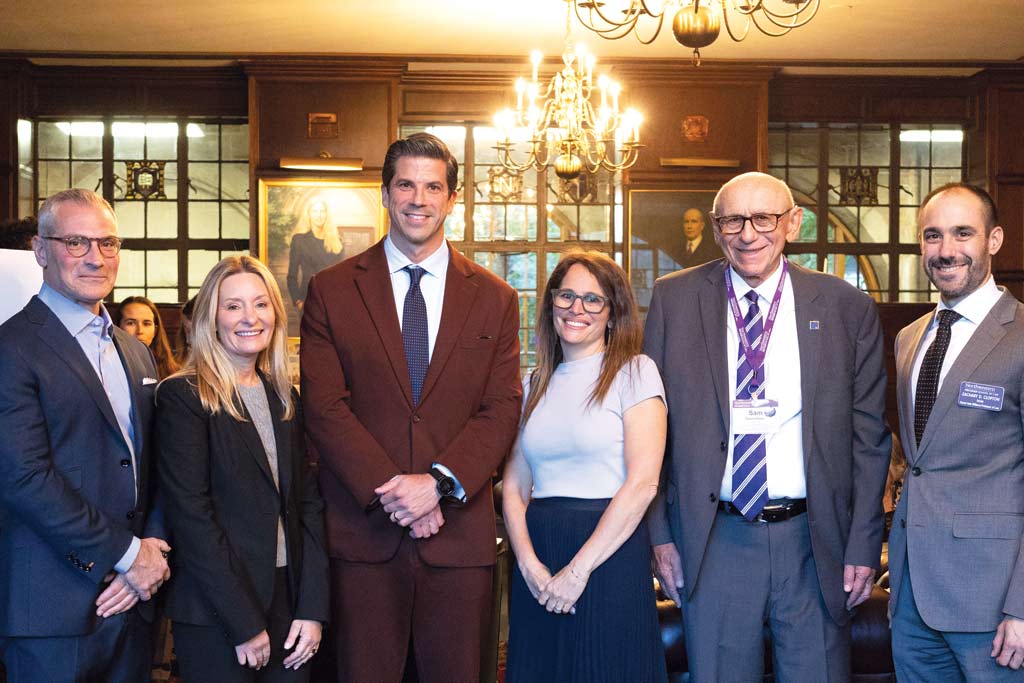
An open door at Northwestern Pritzker Law
The Antisemitism Legal Advocacy Project has launched
Read more -
-