Local physician creates a world of thinkers, soldiers, and spies in geopolitical thriller
Robert Nagler Miller
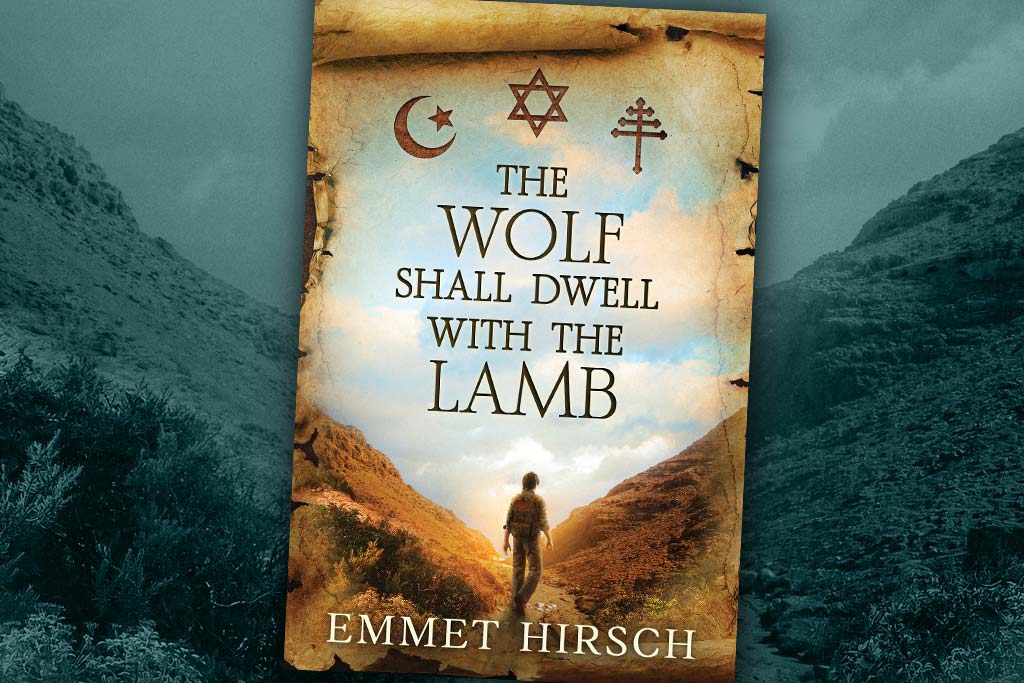
Part coming-of-age story, part historical fiction, part geopolitical thriller, and part psychological mystery, Emmet Hirsch’s The Wolf Shall Dwell with the Lamb lays out in vivid detail the hardships of a young Jewish man, Joseph Friedmann, in the Mideast in the years before and after the establishment of Israel. On a parallel course, it tracks the struggles of the Jewish state, whose resilience has been tested time and again by its hostile neighbors.
Hirsch’s Joseph—born in Lebanon in 1931 to a teenage mother from a Syrian-Jewish family and a European-Jewish father three times her age—is abandoned by both parents by the time he is 8 years old.
For the next seven years, he survives, and intellectually thrives, in a Maronite Catholic convent in Bhamdoun, a Beirut suburb. The mettle Joseph develops at the convent, in the face of countless challenges, serves him well as he grows into an able Israeli soldier and spy. But his scars—a few visible, a majority hidden—never completely dissipate … even decades later, when, dying, he looks back on the events of his life.
“The character of Joseph was inspired by my mother-in-law,” said Hirsch, an Evanston-based obstetrician-gynecologist, recounting the life of the late Aliza Davidson Feldman, who was born in Beirut in 1937. While Joseph’s career does not in any way resemble Feldman’s, Hirsch said, the character’s years in the convent and the abuse and neglect he sustained were very much informed by Feldman’s early experiences.
Hirsch’s time in Israel also informs much of The Wolf Shall Dwell with the Lamb, a title taken from the Book of Isaiah that prophecies a world of peaceful coexistence. Hirsch moved with his family to Israel in 1973, when his father, the late Rabbi Richard G. Hirsch, a civil rights leader, ardent Zionist, and major force in Reform Judaism, became Executive Director of the World Union for Progressive Judaism. Hirsch completed his secondary school education there, along with his military training.
The sources for many of the book’s descriptions of Lebanon, which had a vibrant Jewish community before 1948, come directly from Hirsch’s time as a soldier stationed there in the early 1980s. He recalled “walking around the town of Bhamdoum and stumbling upon the synagogue.”
Following his military service, Hirsch returned to the U.S., where he was accepted into Northwestern University’s six-year medical program. It was during his student years, he said, that he started publishing professionally. He had a weekly column in the university’s newspaper.
“I called it ‘Jabberwocky,’” he said, as a nod to Lewis Carroll’s poem and other nonsense rhymes Hirsch loved. “I was given free rein, and I ended up writing the column for a year.”
Though Hirsch said he loves the world of medicine—in fact, his wife, radiation oncologist Dr. Arica Hirsch, and all four of their children are in health-related professions—he has always made time for writing.
While he has published more than 70 research articles in scientific journals, Hirsch has been penning essays and short fiction for years. His debut novel, The Education of Doctor Montefiore, a humorous account of an ob/gyn resident, came out in 2016.
Now that he has completed The Wolf Shall Dwell with the Lamb, which received first place in the Finest First Five Pages contest of the Chicago-area Off-Campus Writers’ Workshop, he is set to work on publishing the memoir of his mother, the late Bella Hirsch, a nurse. She spent her early years as one of the few Jews in Zlatoust, an industrial town in Russia’s Ural Mountains, before immigrating to Israel on one of the first boats to enter the country following statehood. It is she, Hirsch said, who instilled in him a love of literature. Among his earliest memories, he said, is “sitting on my mother’s lap and reading Dr. Seuss.”
Robert Nagler Miller is a journalist and editor who writes frequently about arts and Jewish-
related topics from his home in New York.