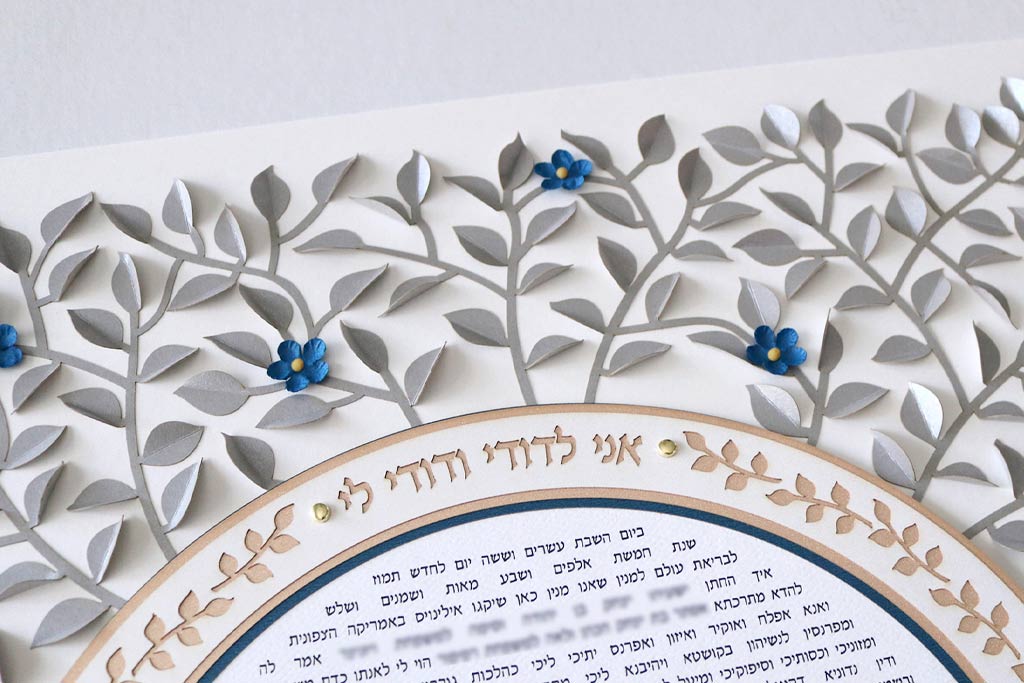
A ketubah designed by Skokie-based artist Shikma Benmelech. (Photo courtesy of Shikma Benmelech)
While one well-known element of a Jewish wedding—the ketubah (Jewish wedding contract)—is a legal contract, it is also a way for couples to express themselves. Many families proudly frame and display their ketubot as works of art.
Ketubot (plural of ketubah) have ancient origins. They originally were written in Aramaic and enumerated specific obligations a husband had to care for his wife. While Orthodox ketubot continue to use the traditional Aramaic text, Conservative and Reform ketubot often use more egalitarian language and sentiments.
Many ketubots are embellished with paint, decoupage, or calligraphy. And two Chicago-area ketubah artists use the Jewish tradition of papercut art to help couples create personalized pieces reflecting their personalities.
“If you have a ketubah that you’re personally displaying in your home as you’re starting this journey together as a married couple, it’s very special to have something that is made for your [home] about you, which represents your story,” explained Shifra Whiteman, an Evanston-based ketubah artist whose work often includes bright colors and watercolor elements.
Whiteman began learning about Jewish folk art, including papercutting techniques, as a child growing up in New York City. Her family also embraced Eastern European Jewish culture. She learned Yiddish at home, and continues to speak the language with her own children today.
It wasn’t until 2016, however, that she began designing ketubot, starting with her own. A few years later, she designed a ketubah for friends, and soon began selling to more couples as word of her talents spread.
“I love getting to know new people, and hearing their stories, and getting to know [about] their values,” Whiteman explained. When working with new clients, she typically spends a couple of months discussing the design process before beginning work.
“I joke that this is a little bit like couples’ therapy. For most couples, this is the first piece of custom art they are purchasing together,” Whiteman notes. She adds that many couples aren’t accustomed to discussing their artistic preferences, and need to spend some time considering what images, colors, and themes they want to include.
Skokie-based ketubah artist Shikma Benmelech uses papercut art to create vibrant floral and plant motifs in her work, sometimes incorporating flowers that reflect the cities where couples are building their new homes together. Clients typically choose a prototype from her online storefront on Etsy, then discuss ways to personalize the piece.
Benmelech grew up in Nehalim, a religious moshav (farming community) in central Israel. After working as a graphic designer there, she moved to the U.S. and taught school while creating custom ketubot.
Today, she enjoys helping couples incorporate images and words that tell their stories. “I like to help each couple find the text that works for them,” she said. Knowing Hebrew, English, and Aramaic is a plus, too.
Her papercuts are luminous. “I use acid-free premium paper, and cut leaves from shimmering gold paper,” Benmelech said. “Some of my work has a mosaic look, and some uses watercolor and gold paper together.”
Because ketubot capture major life milestones, the creation process often comes with deeply personal stories. For both artists, certain custom requests have left a lasting impression.
Benmelech recalls having to alter a ketubah when a couple decided to speed up their timeline and get married in the hospital room of a sick relative.
Whiteman remembers one couple who introduced a fun Chanukah tradition in their neighborhood, hiding 100 dreidels around their street, then challenging friends to find them all. When it came time to design their ketubah, they asked Whiteman to hide 100 dreidels in the document.
These individualized requests reflect what makes a personalized ketubah so meaningful: an ancient tradition cut and shaped to tell a unique couple’s special story.
Yvette Alt Miller, Ph.D., is a freelance writer living with her family in suburban Chicago.
In this issue
-
-
-

Catching up with Ken Olin
Before shaping some of TV’s most memorable stories, he was a Chicago kid with Hollywood dreams
Read more