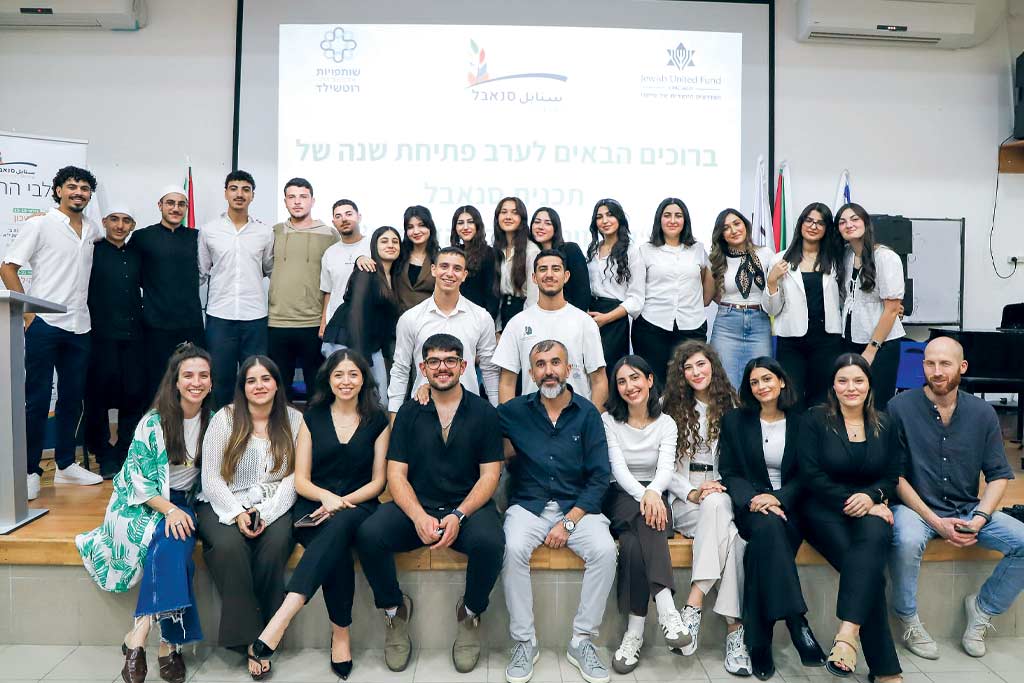
Sanabel Cohort 1 participants at the year 3 opening event, November 2025. (Photo credit: Janan Aburish)
Three years ago, Rayan Abu Nemer realized there weren’t enough bus stops for residents of his village in northern Israel. Abu Nemer lives in Yirka, one of Israel’s largest Druze villages. He approached Yirka’s bus company about creating more stops “so that everybody can move around the village easily,” he recalled—thinking especially of older residents and children.
“It was such a success,” Abu Nemer said. “We got to do it.” The bus company added stops in each of Yirka’s neighborhoods.
Abu Nemer was only 15 years old at the time. The initiative was his project for his first year of the JUF Sanabel Druze Leadership Program, a 10-year program that supports Israeli Druze youth ages 15 to 25. The Druze are an ethnoreligious minority of approximately 150,000 people in Israel, and Sanabel, Arabic for “stalk of wheat,” evokes the program’s cultivation of its young leaders as well as their own deep connection to the land.
“Their instructors provide them with the skills and tools to become the leaders of the Druze community in the future, and also leaders nationally for all of Israel,” said Ofer Bavly, a JUF Vice President and Director General of JUF’s Israel Office, who helped launch the program with direct support from local donors here in Chicago.
Today, 18-year-old Abu Nemer is about to begin flight school within the IDF, training to become a pilot. Serving in the IDF as a pilot has always been his dream. “I’m very excited,” he said.
Abu Nemer, along with 14 fellow participants from Sanabel’s first cohort of 27, visited Chicago’s Jewish community this past July in part to share their experiences of the program. Each group is intentionally diverse, with gender parity, diversity from a wide range of Druze villages, and representation of secular as well as religious participants all being high priorities.
“Sanabel has changed me,” shared Seren Henw, from Maghar, who is in the first cohort. “Sanabel [taught] me how to become confident, how to take responsibility, how to step out of my comfort zone.” Henw’s first-year project educated young people about the harmful effects of bullying.
Salih Abu Raid, from Isfiya, agreed with Henw’s assessment of Sanabel, saying that the program “showed me the way to reach the best version of me.” Abu Raid, who self-identifies as religious, shared that he wanted to give Sanabel “something in return” while also supporting Israel. Abu Raid plans to help the program as his official National Service, the details of which are still being confirmed.
Bavly explained that the second phase of Sanabel is beginning for Abu Nemer, Henw, Abu Raid, and the rest of their cohort, as some go to the army, some do National Service, and some go to university. After three years, when the bulk of the group will be attending universities, the cadence of meetings and overnight seminars will increase again.
Lurian Nabwani, from Julis, is no stranger to juggling responsibilities and activities. Last year, on top of her schoolwork and Sanabel, she served as Chairperson of her local youth council and volunteered with Magen David Adom as a first aid responder. She will attend Ha’Kerem, a prestigious technological National Service program in partnership with the Ministry of Defense. Nabwani credits Sanabel for coming at “the perfect time.”
Nabwani shared two people who are as grateful as she is for Sanabel: her parents. “When my parents meet a new person, they just start, ‘My daughter is in [the] Sanabel program,’” she laughed, joking that now half of Israel knows about the program.
What seems likely, though, is that one day the Sanabel graduates themselves will be well-known for their impact—in their own communities and within the greater fabric of Israeli civic life.
The Sanabel Druze Leadership Program is made possible by individual donors. If you are interested in learning how to support Sanabel, either to support the general operating budget or to sponsor a specific participant, contact JUF Chief Development Officer, David Prystowsky at [email protected].