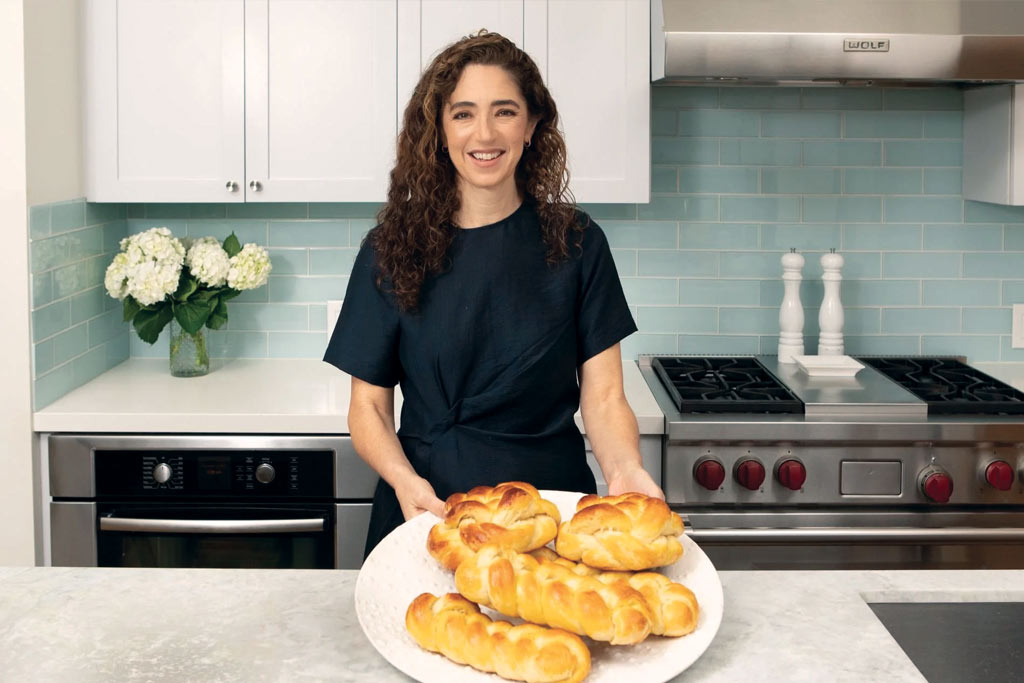
Dr. Beth Ricanati found that baking challah brought her peace and contentment.
Bake two challot and call me in the morning.
Perhaps not the advice most of us expect to hear from our physician, but this is the prescription that Dr. Beth Ricanati, an internist, recommends for both physical and mental wellbeing.
In her latest book, The Braided Prescription: Seven Practices for Living Well from the Ancient Ritual of Making Challah, Ricanati explores how making challah can become an antidote to many of the challenges people face every day, especially stress, loneliness, and disconnection. This book, released on Sept. 1, expands on the story she began in her memoir, Braided: A Journey of a Thousand Challahs.
Twenty years ago, as a busy physician and mother of three young children, Ricanati felt overwhelmed and extremely burned out. When she started to experience chest pains, she attributed her symptoms to heart disease. But her own doctor diagnosed the true culprit: stress.
She found, however, that she experienced peace and contentment while baking challah for Shabbat every week.
This realization led Ricanati to start a unique stress management practice, based on how this weekly commitment transformed her health and her life. “I had the privilege of experiencing firsthand how the best medicine can often be found in community, connection and friendship,” Ricanati said.
Ricanati made some key changes, and said she now feels “so much calmer.” She stepped back from the parts of her life that were causing so much stress, and leaned into her two loves: challah baking and caring for people. This has literally become a way for Ricanati to participate in her own tikun olam, repairing the world. Ricanati still volunteers weekly as a general internist in a Venice, Calif. medical clinic, seeing the largest population of underserved patients in southern California.
Since her first book was published, Ricanati has conducted more than one hundred challah-making workshops, with thousands of attendees, all over North America and beyond, both in person and via Zoom.
In this new book, Ricanati shares stories of those years, and dives deeper into the health and wellness components that baking challah provides. “I want people to understand that this book can help all of us live well. In a very stressful world, these small, intentional acts literally transform your days and your life,” Ricanati said. “Somehow an ordinary moment becomes transformative. And when people bake challah together with others, it becomes a shared experience. You become much more connected to others.”
She continued, “I love to hear the stories. I love to hear from people. It has been such a privilege to hear how they were impacted by challah baking. It is such a provocative and interesting way to reconnect to ourselves, and to each other, with what matters most.”
The book incorporates seven practices, which make up the braided prescription, including: Act with Intention; Stop and Breathe; and Embrace Imperfection.
When baking challah, Ricanati said that one way to do so with intention is to practice the meaningful tradition of saying out loud, “I am making this challah in merit of ______.” That practice can make the intention “action-oriented. It’s actually about putting a thought into the practice.”
The Braided Prescription is full of positive stories of a variety of people, both Jewish and non-Jewish, who have embraced the ritual of weekly challah baking. It is sprinkled with medical knowledge, and many commonsense suggestions that are doable for everyone. For example, keep a bowl of fruit on the table or in the refrigerator for healthy snacking options.
Through the lens of a physician, Ricanati provides easy-to-accomplish tasks to pave the road to a healthier, happier, and more connected life. Some of these are as simple as making a phone call, sending a text, and being in nature.
“It is fascinating to see how an ancient ritual, like challah baking, incorporates so many facets of modern lifestyle medicine,” Ricanati said.
Rochelle Newman Rubinoff is a freelance writer living in the northern suburbs of Chicago.