The least Jewish of Jewish holidays
Rabbi Yehiel E. Poupko
(Photo credit: Jennifer Chase)
Rosh Hashanah, while widely known as the Jewish New Year, is the least “Jewish” of all Jewish holidays. Passover commemorates the liberation from slavery of only the Jewish people. Shavuot celebrates the giving of the Torah to only the Jewish people. Sukkot celebrates the desert wandering experience of only the Jewish people. Yom Kippur commemorates the uniquely Jewish way to attain forgiveness from and reconciliation with G-d.
Rosh Hashanah commemorates and celebrates the creation of the world, and especially the creation of the human being. And so on Rosh Hashanah we declare: “hayom harat olam”—this day the world is conceived. All who emerge from those first two human beings, Adam and Eve, are created in the image of G-d. Rosh Hashanah is the universal holy day of the Jewish People.
Listen now to the way the ancient Rabbis describe the first day in the life of Adam and Eve:
–In the first hour, the Adam (the human) emerged as a thought in G-d’s mind.
–In the second hour, G-d took counsel with the Angels as to whether or not the Adam should be created.
–In the third hour, G-d gathered up the earth.
–In the fourth hour, G-d kneaded the earth.
–In the fifth hour, G-d shaped the body.
–In the sixth hour, G-d stood the Adam up as an unanimated corpus.
–In the seventh hour, G-d cast the breath of life into the Adam.
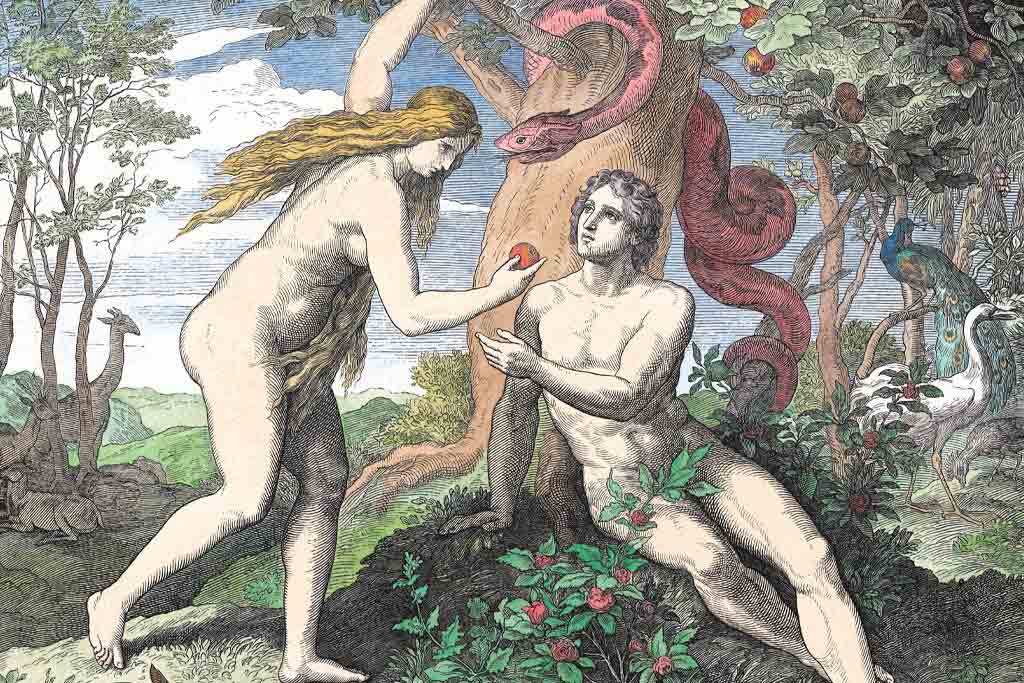
–In the eighth hour, G-d brought the Adam into the Garden of Eden.
–In the ninth hour, G-d commanded the Adam not to eat of the fruit of the Tree of Knowledge.
–In the tenth hour, the Adam sinned and ate of the fruit of the Tree of Knowledge.
–In the eleventh hour, the Adam came in judgment before G-d.
–In the twelfth hour, the Adam went forth, a free person, from G-d’s presence.
G-d told the Adam: Let this fact be a sign for your descendants. Just as you were judged this day, and went forth free, so will humanity, henceforth, be judged this day and go free.
Rosh Hashanah commemorates an event. It is Judgment Day, when the first persons, Adam and Eve, sinned. Instead of being put to death for violating G-d’s first command, they go forth free.
In Christianity, Adam is seen as the first to sin. In Judaism, Adam is seen as the first to be forgiven.
Rosh Hashanah celebrates G-d’s commitment to humanity: the forgiveness of sin. On Rosh Hashanah, we come into judgment before G-d. We remember that first judgment, when G-d set Adam free. Just as G-d set Adam and Eve free on that first day, so does G-d do the same for us in commemoration of that first day. Having thus removed the punishment that we each deserve, for each of has sinned, G-d turns to us and says: Now that the punishment has been removed, repent in the next ten days, and return to me on Yom Kippur.
Rosh Hashanah is the one holiday that inspires the Jewish people to live in the balance between the universal and the particular. We are, simultaneously, radically parochial and absolutely universal. Our chosen-ness has no meaning unless it comes from the one universal G-d. But our universalism has no meaning unless it is pursued in our particular life of mitzvot. From this high-wire balancing act between particularism and universalism, it is the responsibility of the Jewish people to intercede with G-d in order to gain a good year on behalf of all humanity.
As the year 5787 dawns, we wish ourselves—and the world—a year blessed with good health, nourishing food, comfortable clothing, warm shelter, and continued greatness in the service of the one G-d, the Jewish People, and all those created in G-d’s image.
Rabbi Yehiel E. Poupko is Rabbinic Scholar at JUF.