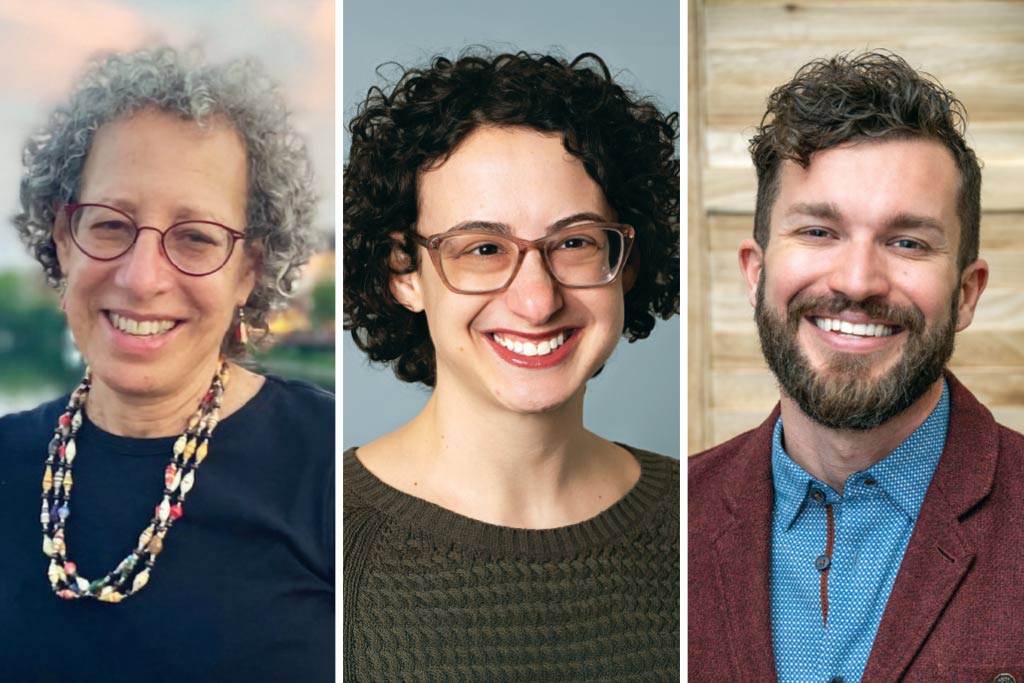
Pictured, from left: Dr. Elizabeth Feldman is a cofounder of the Progressive Chevra Kadisha(PCK). Leah Shefsky, a 30-something social worker, has performed tahara through the PCK.Mishkan Chicago Rabbi Steven Philp’s congregation is part of the PCK.
When her Aunt Beverly* died this past spring, Carol* was heartened to learn from her Chicago Jewish funeral director that a volunteer burial society, a “chevra kadisha,” was available to provide purification and dressing rituals for her aunt before interment.
“I’m Jewish,” said Carol, “but I knew nothing about this service. When I expressed interest in taking part in it, too, the funeral director reached out to the chevra kadisha” to find out whether this was a possibility. The term is Hebrew for “holy society.”
Elizabeth Feldman is a member of Chicago’s Progressive Chevra Kadisha (PCK) who worked with Beverly’s family. Generally speaking, she said, survivors of the deceased remain separate from the process of tahara, the ritual washing and purification of the body, including the dressing of the body in tachrichim, the traditional burial garments. These tasks are undertaken by Jewish community members specially trained to care for the deceased.
Anonymity and privacy are critical, but because Carol was a longtime caregiver to her aunt, enjoyed a loving relationship with her, and had a healthcare background, PCK allowed her to participate in the tahara, which also included the recital of prayers.
“It was very important to me,” added Carol. “I appreciated the opportunity to have more time with my aunt. I found it soothing.”
Feldman, an Evanston-based family physician, was not surprised that Carol found it meaningful. Feldman is a cofounder of the PCK—a consortium of six Chicago-area synagogues and chavurot whose members comprise their chevra kadisha. She also is a member of the Board of Directors of Kavod v’Nichum, the national organization of chevra kadisha, which is hosting Strengthening Sacred Communities: Chicago Day of Learning. This conference will be held on Sunday, October 25, at Sketchpad in Chicago’s Ravenswood neighborhood.
“I feel very strongly that rituals marking liminal experiences … [such as] separating the soul from the body … are valuable,” she said. She was moved to co-create PCK more than 20 years ago, after the death of her own father. Her family was given the opportunity to have her father’s body cared for by a chevra kadisha, and they found it immensely moving.
This was around the time that chevra kadishas—integral parts of Jewish communities for many centuries—gained a following, beyond the Orthodox, among the Reform, Conservative, Reconstructionist, Renewal, and secular movements.
As Rabbi Steven Philp, of Mishkan Chicago—whose congregation is part of PCK—noted,
“As more progressive Jews became disconnected from institutional Jewry,” with moves away from Jewish neighborhoods, many sought a reintroduction to Jewish practices and customs that provided them with emotional and spiritual sustenance. It also helps, he added, that people are now less afraid to talk about death and dying than they once were.
“There’s a lot of comfort for families knowing that their loved one is cared for,” said Rabbi Philp, who will be presenting at the Chicago Day of Learning. It’s about “showing up for each other.”
Today, said David Jacobson, the founder of Chicago Jewish Funerals, more than half of the bereaved families who come to him for funeral preparation opt into chevra kadisha services offered by PCK and other congregations.
Feldman added that many young people, including her daughter, Leah Shefsky, 34, a social worker in the Jewish community, see that value in becoming acquainted with these rituals. Shefsky, who has performed taharot with her mother, noted that she is far from the youngest volunteer.
While women generally care for deceased females and men for deceased males, Feldman explained, families working with PCK can request queer or mixed-gender chevra kadisha volunteers for deceased loved ones who identified as LGBTQ+.
The bottom line, she emphasized, is that no Jew, or Jewish family, should feel excluded from chevra kadisha.
Strengthening of Sacred Communities: Chicago Day of Learning is open to all interested in learning about chevra kadisha. To learn more about the workshop or to register, visit kavodvnichum.org/dayoflearning-chicago.
*Names changed to protect privacy.
Robert Nagler Miller is a journalist and editor who writes frequently about arts and Jewish-related topics from his home in New York.