Ta’am Spice Kitchen offers kosher and vegan Indian dishes. (Photos courtesy of Ta’am Spice Kitchen LLC)
The longstanding contribution of Jews to the theater is well-documented. But it’s not just a fact of history. Right now, you can see new Jewish creativity flourishing onstage, celebrating our storied past and peering forward into our likely future.
RBG in the spotlight, where she belongs
“I’m sometimes asked, ‘When will there be enough’ [women on the Supreme Court],” Ruth Bader Ginsburg said. “And I say, ‘When there are nine.’ … There’d been nine men, and nobody’s ever raised a question about that.”
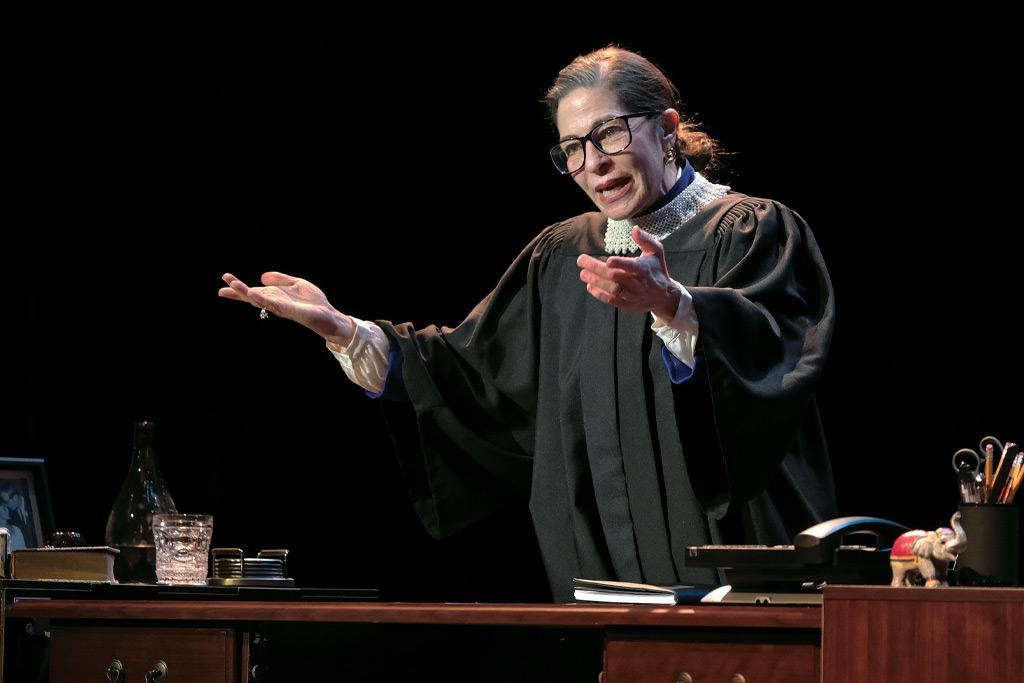
The strength of both her backbone and her funny bone are in evidence in the one-woman show All Things Equal: The Life & Trials of Ruth Bader Ginsburg. In the play, she shares stories of her life, work, and activism—including studying law at Harvard while raising her daughter Jane.
The title role will be played by singer-actor Michelle Azar. Her earlier one-person show, From Baghdad to Brooklyn, explores her Jewish, American, and Israeli upbringing. The co-star (with her real-life sister-in-law) of the show How to Beat Your Sister-in-Law (at everything), Azar’s other TV credits run from Party of Five to Criminal Minds.
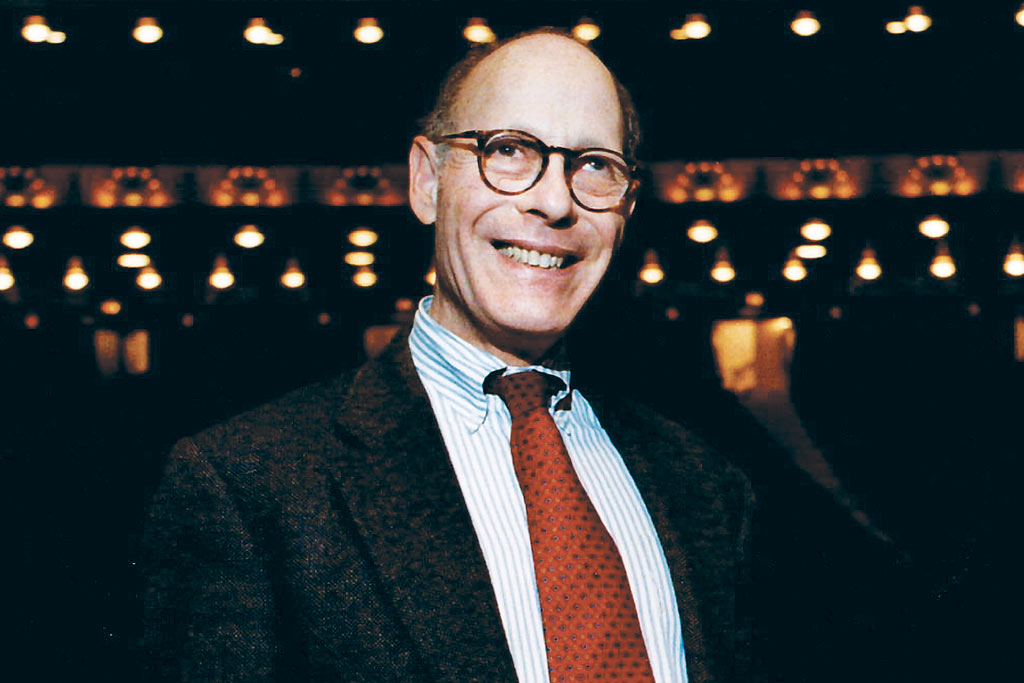
The work’s playwright, Rupert Holmes, was born David Goldstein in England; he moved with his family to New York at age 6. He majored in clarinet at the Manhattan School of Music, which would later give him an honorary doctorate.
Holmes has had two major careers. As a pop singer-songwriter, he recorded eight albums and a No. 1 hit: the immortal “Escape (The Piña Colada Song).” As a songwriter alone, Holmes composed for everyone from Dolly Parton to Britney Spears. His songs appear on six Barbra Streisand albums and in her film A Star Is Born.
His other career also involved writing: plays, musicals, TV scripts, and novels. His musical The Mystery of Edwin Drood snagged him two Tonys. Many of his stage works are based on movies, including Marty, The First Wives’ Club, and The Nutty Professor.
All Things Equal will be staged at the Broadway Playhouse at Water Tower Place, 175 E. Chestnut St., Jan 26.-28. The show is appropriate for ages 13 and up.
When Hard Drive Met Server
The musical Maybe Happy Ending is about an unlikely pair: Oliver and Claire, human-like “helper-bots” abandoned by their owners. Oliver is the older model— simple, durable, and not very socially aware. Claire is a newer model, more advanced in every way, but also “hungrier” in terms of her energy needs.
The musical was created by Hue Park, a Korean musical-theater writer, and Will Anderson, who has written scores for several musicals which tend to adapt children’s fare, from Hansel & Gretel to Pete the Cat.
Aronson grew up Jewish in Connecticut. He played trombone in high school, and said that his jazz ensemble’s playing Duke Ellington’s work inspired his Maybe Happy Ending songs. Aronson’s music degree is from Harvard, where he composed some Hasty Pudding productions. He also has won a Fulbright grant, and ASCAP award.
How universal are Maybe Happy Ending’s themes? Aside from its six Tonys, the work also won six Korean Musical Awards.
Maybe Happy Ending comes to the CIBC Theatre, 18 W. Monroe St., Jan 5-17.
Two timeless musicals return (briefly)
As Mandy Patinkin explores on his album Oscar & Steve, Oscar Hammerstein II mentored a young Stephen Sondheim. You can hear both composers’ works this winter:
- Rodgers & Hammerstein’s The Sound of Music comes back to the stage in December. Did you know that Theodore Bikel was the first Captain Von Trapp? The composers composed the song “Eidelweiss” for him to showcase his folk singing.
- The original West Side Story movie— which won 10 Oscars— will be screened in honor of its 65th anniversary, with live music provided by the Chicago Symphony Orchestra. The film’s team included a Jewish lyricist (Sondheim), composer (Leonard Bernstein), screenwriter (Ernest Lehman), and choreographer/co-director (Jerome Robbins); Jewish playwright Arthur Laurents wrote its book.
The Sound of Music comes to the Cadillac Palace Theatre, 151 W. Randolph St., Dec. 22-27.
West Side Story will play at Symphony Center, 220 S. Michigan Ave. on Jan. 29 and 30.
“The words of the prophets are written…”
The American Writers Museum has extended the run of its American Prophets: Writers, Religion, and Culture through March of 2027. The works, and belongings, of writers from many religions are on display, including the b’samim boxes of Sholem Asch. The Yiddish writer is only one of many Jewish artists represented; here, you can find Judy Blume’s novels, Allen Ginsberg’s poems, Leonard Cohen’s lyrics, and Harold Ramis’ screenplays.
The exhibit has five installations, covering topics like Spirituality & Song, Ritual & Rhyme, and Humor & Holiness.
“Throughout American Prophets visitors will see the connections between writers of different beliefs, which we hope inspires greater empathy, understanding and tolerance among people of any and all religions or beliefs,” said AWM President Carey Cranston. “For many readers, their chance to experience or understand spiritual practices outside of their own often comes from the stories they read or that they see represented on screen.”
The exhibit is on the second floor of the American Writers Museum, 180 N. Michigan Ave.
Through the eyes of a child
Like many artists, Franz Altschuler (1923-2009) started drawing with crayons. Unlike many artists, he spent his pre-teen years in Germany during Hitler’s rise to power, before his family’s 1936 move to the U.S. In Chicago, he studied at the at the Institute of Design (formerly the New Bauhaus) under its founder, Hungarian-Jewish artist László Moholy-Nagy; he later joined its faculty. During the war, however, he went back to Europe, serving with the Army and continuing to draw what he saw.
Now, his childhood drawings are on display at the Koehnline Museum of Art at Oakton Community College. One fourth-grade sketchbook alone contains 24 drawings, 22 of which depict Nazi military images; another contains classical Jewish themes. “Against this turbulent historical backdrop,” wrote Museum Curator Nathan Harpaz, “Franz’s experiences… reveal a remarkable story of childhood, creativity, resilience, and artistic growth during one of the most consequential periods of the Twentieth Century.”
The exhibit Franz Altschuler: Child Artist in the Shadow of Nazism is at the Koehnline Museum of Art from Dec. 3, 2026 through Jan. 22, 2027.
Paul Wieder, the former Associate Editor of this publication, is a freelance writer living in Chicago.
In this issue
-
Finding my way back to Israel
JUF’s Kefiada is an English-immersion day camp in Kiryat Gat, Israel
Read more -
-