As I write this, the centuries-old recounting of The Odyssey has laid claim to a new wave of fans and familiarity, with Christopher Nolan’s blockbuster film version topping a billion dollars in worldwide grosses and generating what seems like an industry of articles, analysis, fan fiction, and memes.
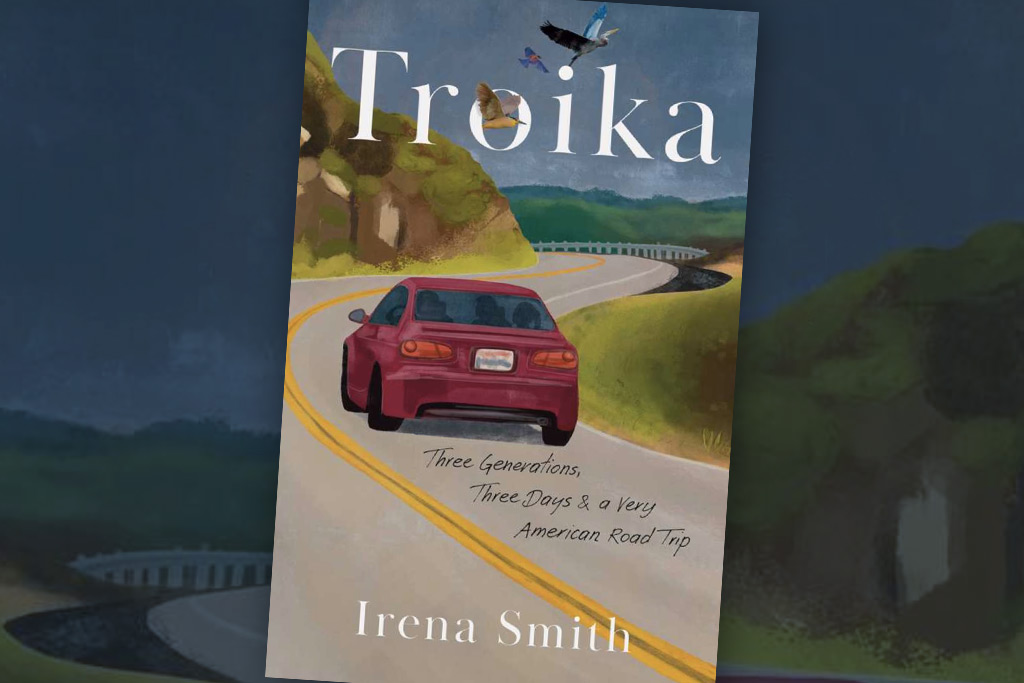
Irena Smith’s book Troika is its own (albeit much quieter, less bloody) version of The Odyssey, with a considerably smaller multigenerational cast of characters, a markedly shorter timeline, and fewer miles to transverse. But, like the ancient Greek poem and Nolan’s megahit, the journey in Troika is filled with worlds within worlds, and stories within the story—including a gripping retelling of Smith’s family’s emigration from the USSR in the 1970s, and struggles with the pressures of both Soviet and American barometers of success.
As many well-told stories do, Troika begins with a monumental storm. Our narrator is traveling along the California coast with her 77-year-old mother and young adult daughter. Like Ulysses, they encounter scary monsters (ostriches, in this case), unearth links between landmarks they pass (Stanford University and the cross-continental railroad), and take side quests (a hunt for artisan oat-milk lattes.)
Smith calls Troika a work of creative nonfiction, “the practice of selective and imperfect recollection,” where “the most improbable parts are the truest.” She learned English from watching Gilligan’s Island and Laverne & Shirley, and also holds a Ph.D. in comparative literature. So, it makes sense that this slyly bookish book refers to Odysseus’ journey and Shakespeare’s The Tempest, and explores whether The White Lotus was influenced by Henry James.
In free-flowing conversations with readers, Smith compares her mother to superhero-fashion designer Edna Mode from The Incredibles, and strays into explanations of words’ origins and iconicity. (I’ll save you from having to look this up; it means “when a word’s form has a relationship to its meaning.”)
Although this voyage is a very American road trip, stories are told of family lore from half a dozen countries, teasing apart ancestors’ advice—sometimes presciently meaningful, and sometimes, most definitively not. Remembrances explore experiences that brought family members together, or tragically tore them apart.
Throughout, our adventurers build a collection of joint experiences, shared touchpoints, and a common language that unites them in ways considerably more significant than the miles traveled together.
Betsy Gomberg reads (and sometimes writes about) Jewish books.