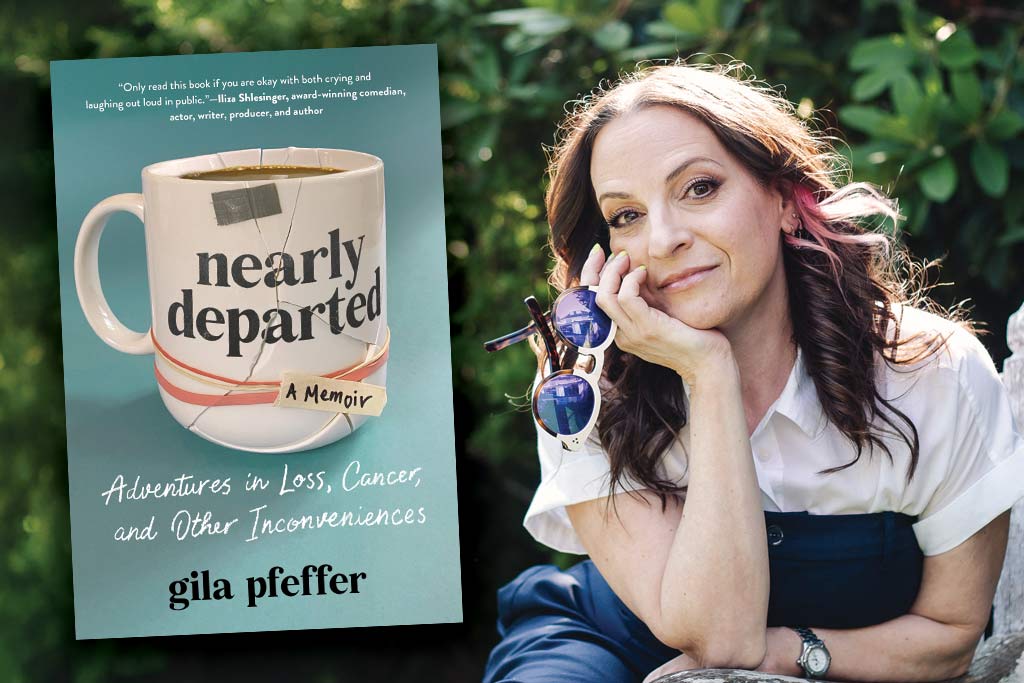
Six days after Gila Pfeffer underwent a preventive double mastectomy, her surgeon called with unexpected news. The procedure that was supposed to prevent her from getting cancer had uncovered an early, but aggressive, cancer that she already had in one breast.
“You saved your own life by doing this surgery,” the surgeon told her. That life-altering diagnosis, and the health journey that followed, are at the center of Pfeffer’s book, Nearly Departed: A Memoir: Adventures in Loss, Cancer, and Other Inconveniences (The Experiment, 2024)
In her memoir, Pfeffer recounts watching her 42-year-old mother die from breast cancer. Just a decade later, she lost her father to colon cancer. Pfeffer resolved to take a proactive approach to preventative health care, and tested herself for the BRCA gene. She was positive.
“By the time I was 30, I was the oldest living member of my entire family. I said, ‘Enough is enough; we need to reverse the cycle of early death,’” said Pfeffer, who went on to have her double mastectomy in 2008 as a mother of four young children.
“I woke up feeling like the hardest part was over. I did it,” she recalled. “I thought the road to recovery was just going to involve me sitting in a La-Z-Boy chair. I wouldn’t have the cloud of cancer looming over me.”
However, genetics had other plans. “I did everything I could to avoid it,” Pfeffer said. “I had gone for mammograms, ultrasounds, and MRIs. I was as on top of this as anyone could possibly have been, but your exposure can still be such that it’s still a real threat to you.”
Instead of the leisurely recovery that Pfeffer originally anticipated, she underwent eight rounds of chemotherapy, and had another surgery to have her ovaries removed. “I was very blessed to have had four kids, so I was like, ‘You can have these. All yours,’” Pfeffer said. Two months later, Pfeffer and her children—aged 2, 4, 5, and 8—moved to London for her husband’s job: “That was a very intense year.”
Humor permeates Nearly Departed. “By nature, I’m a cynical person, but there’s purpose to the cynicism,” Pfeffer said. “It’s more like a sarcasm. I had to go through the surgery, chemo, remove my ovaries, and hit menopause at 35, all while trying to hide my baldness from my kids at a time when there were no nice wigs available. I did what I had to do, while choosing to laugh or crack jokes about it, more than I chose to feel sorry for myself about it.”
Pfeffer’s relationship with Judaism shares center stage. However, writing her memoir through the lens of her Jewish experience didn’t originally occur to the author. It wasn’t until a close friend, who is also a literary agent, pointed out that Judaism was “fully enmeshed” in Pfeffer’s story.
“Judaism is a big part of my life. It impacts pretty much every second of every day,” said Pfeffer, who identifies as Modern Orthodox. “My Judaism has given me a structure to live within. My faith in G-d has also been really important to me throughout this.”
Writing Nearly Departed allowed Pfeffer to bring together the losses, medical decisions, humor, and faith that shaped her health journey.
The author has “loosey-goosey” plans to write future books, as well. “I don’t know exactly what it will be, but I’m pretty sure that it will be a nonfiction because I only know how to write in my own voice,” Pfeffer said. “I would hope that it would be Jewish because I very much want to celebrate our culture and our practices, and it absolutely will be funny. If I can’t write something that cracks myself up, then I don’t want to publish it.”
In this issue
-

The remarkable writing life of Talya Jankovits
The Very Unremarkable Life of Mrs. Etty Bloom debuted this June
Read more -
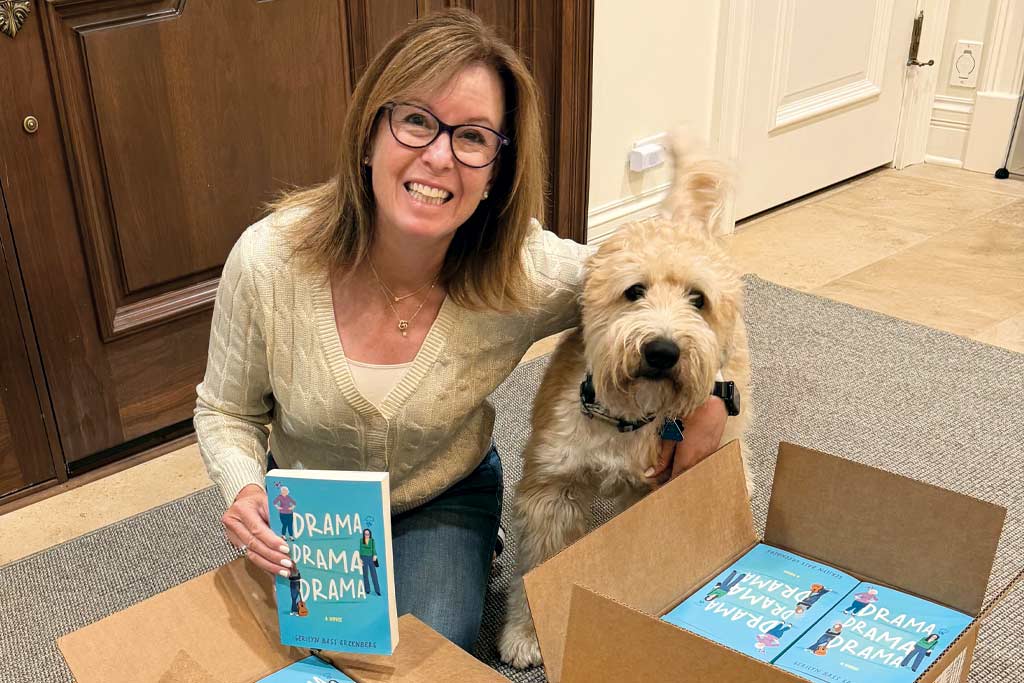
A novel a decade, and a lifetime, in the making
Gerilyn Bass Greenberg’s debut is personal, yet universal
Read more -

‘No one who has read me can ignore… that I am a Jew’
Biography takes full measure of poet Paul Celan
Read more