Gov. J.B. Pritzker visits JUF headquarters
PAUL WIEDER
JUF hosted a gubernatorial candidate briefing in August with incumbent Illinois Governor J.B. Pritzker, with 125 people in attendance.
Among the attendees: Illinois State Rep. Jonathan Carroll; Cook County Assessor Fritz Kaegi; Judge James Shapiro of the Illinois Circuit Court of Cook County; and Consul General of Israel to the Midwest Yinam Cohen. Pritzker also noted the presence of Dr. Ngozi Ezike, the former Director of the Illinois Department of Public Health, now President and CEO of Sinai Chicago.
JUF President Lonnie Nasatir welcomed the room to what was the first in-person Government Affairs event since the start of the pandemic. Before introducing Pritzker, Nasatir noted that JUF had invited Pritzker’s opponent, Ill. State Sen. Darren Bailey, to speak, but that Bailey had so far not accepted the invitation.
“My tenure has overlapped almost entirely with Gov. Pritzker’s tenure,” Nasatir noted. “I’m proud to say that Gov. Pritzker and his administration have been wonderful partners for JUF during these complicated times.”
Judy Smith, Chair of JUF’s Government Affairs Committee, thanked the governor for supporting the Illinois Non-profit Security Grant Program, and for his work toward “ensuring that Illinois pension funds do not invest in entities that boycott Israel.” Wendy Berger, Chair of JUF’s Jewish Community Relations Council, introduced the governor and moderated a Q&A with him.
The governor opened his remarks by likening his work to JUF’s. “We serve the people who need it most, who are often left out and left behind,” he said.
Pritzker addressed a range of topics, from the state budget to gas prices. Among his administration’s achievements, he said, were addressing a backlog of 129,000 applications for Medicaid and seeing Illinois receive six credit upgrades; raising the minimum wage to $15/hour by 2025, and increasing teachers’ salaries to a minimum of $40,000; expanding the Monetary Award Program, which provides grant assistance to eligible students based on need; passing “the largest infrastructure bill in Illinois history,” which provides $50 million in grants for infrastructure projects; and signing the Climate and Equitable Jobs Act into law. This landmark legislation sets the state on a path toward 100% clean energy by 2050 in a way that ensures that “Black and Brown communities that have suffered environmental injustice are not left out.”
Pritzker addressed the mass shooting at the Highland Park 4th of July parade: “It highlights that we have to ban assault weapons… for the state, and frankly, for the nation.” The governor said that he–along with Highland Park Mayor Nancy Rotering and Police Commander Chris O’Neill–met with President Biden after the shooting to discuss a potential ban. Other related efforts, he said, have included increasing state police, reinstating violence-prevention programs, funding youth employment, and increasing mental healthcare services.
When asked about combating antisemitism and anti-Israel sentiment on campus–specifically at the University of Illinois Urbana-Champaign–Pritzker said that he talks to the leadership of the university, and “there is a clear message from the governor and from the governor’s office…that hate has no place on the campus.”
While acknowledging that governors do not set foreign policy, Pritzker did note that he is the only current governor of Ukrainian Jewish heritage: “I am so proud to be Ukrainian-American [and] Jewish,” he said, “and to have a Jewish Ukrainian president fighting a war… close to the hearts of everyone in the United States.”
Pritzker was asked what role Illinois should play in light of the recent U.S. Supreme Court Dobbs ruling that overturned Roe v. Wade, giving the states full power to ban abortions. While abortion is still legal in Illinois, it is banned in several nearby states, compelling many women to travel to Illinois to seek abortions. “I am very proud of the fact that we passed the Reproductive Health Act in Illinois,” he said. “We are an oasis for women seeking to exercise their reproductive health.”
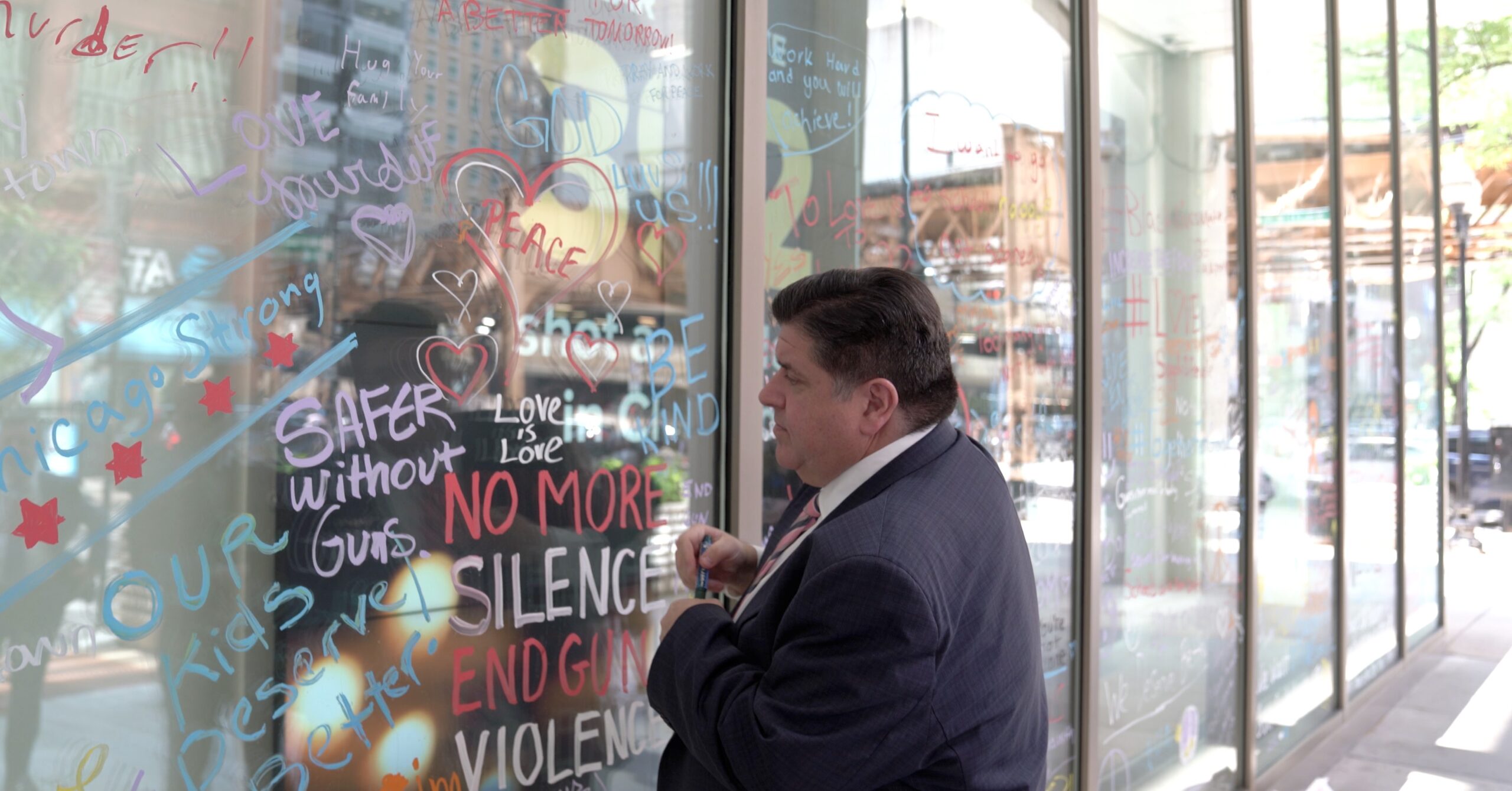
In addition to the briefing, Pritzker viewed the JUF’s external-facing Monroe Street windows, which over the summer were transformed into an interactive public art display protesting against gun violence. Behind the windows, the large video screen scrolled the name and age of every Chicagoan killed by gun violence in 2022. Visitors were invited to share their own reactions to the display. The governor wrote: “Pray and work for peace.”