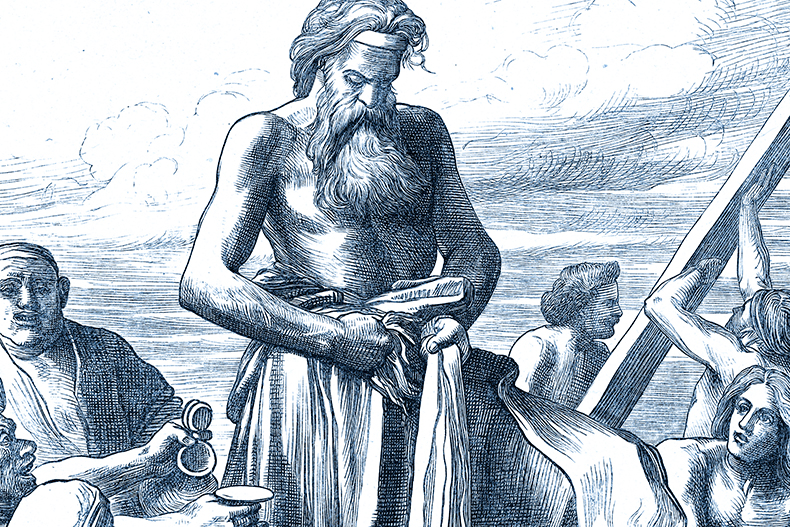
Adam and Eve were the first refugees. Driven out of Eden for their sins, God had compassion on them and made them clothing. Cain, who murdered their son Abel, was the second refugee. Driven to wander the earth, God protects Cain with a sign that shields him.
Noah was the third refugee, unique among refugees. The entire world was destroyed. There was no human to save him. God secured the welfare of the refugee, Noah, and his family in the Ark.
The next refugees were Abraham and Sarah, who fled pagan civilization to go to the Promised Land and birth the Jewish people. No sooner did they arrive than they became refugees a second time, driven out of the Land by famine and down to Egypt where God had to watch over them.
God redeemed them from Egypt and restored them to the Promised Land. Isaac is the only one who is not a refugee. However, his son Jacob has to flee the Promised Land following his brother Esau’s murderous designs. When he returns home, his son Joseph becomes a refugee in the Land of Egypt. Jacob also goes down to Egypt as a refugee. God watches over him. God says to Jacob, “Do not be afraid, I will go down with you to Egypt and I will watch over you there, and I will bring you back to this land.”
The whole Jewish people were refugees when after 400 years of slavery in Egypt they wandered in the desert for 40 years. God watched over them, sheltered them, clothed them, and brought them home. Israel to this day is the refuge of the refugee Jewish people.
The narrative of the Torah is the narrative of refugees and the ways in which God protected these refugees. Jewish experience is the stuff of mitzvot. Many mitzvot of the Torah are based on this primal experience of the Fathers and Mothers of the Jewish people.
The Fathers and Mothers of the Jewish people have two originating experiences. They are the first believers in the One God. At the same time they are the first refugees. The mitzvot of the Torah are designed to protect refugees of all sorts, beginning with the mitzvah: You shall not oppress the stranger for you know the very life of the stranger, for you were a stranger (a refugee) in the Land of Mitzrayim- Egypt. We must not allow to happen to others what happened to us. The Torah spells out all sorts of mitzvot that emerge from the nativity experience of Jews as refugees.
The Torah is not a conceptual book. Its mitzvot rarely instruct concepts, emotions, or inner-life experiences. Its mitzvot instruct behaviors. Behaviors give expression to thought and feeling. However, in one area there is a significant exception. There are three times in the Torah when love, which is surely both a thought and an emotion, is commanded as a mitzvah. We are commanded to “love the Lord, your God.” We are commanded to “love your fellow human being.” This is understandable. We might very well have developed these two great loves on our own. But now comes a third commandment to love.
For the LORD your God is God supreme and Lord supreme, the great, the mighty, and the awesome God… who upholds the cause of the orphan and the widow, and loves the stranger, providing him with food and clothing. You too must love the stranger, for you were strangers in the land of Egypt. (Devarim-Deuteronomy 10:17-19)
These verses, spoken to Israel as they are about to enter the Promised Land, are quite remarkable. They begin with the assertion that God is great, mighty, and awesome. The next verse presents the cosmic sovereignty and might of God in simple daily life. God, who is mighty and great, watches out for the widow and the orphan. Even more than that, God so loves the stranger, the refugee, that God gives the refugee food and clothing. We are expected to imitate God. The next verse commands us not just to engage in doing what God does for the refugee, providing food and clothing, it goes further. Food and clothing are not enough.
You shall love the stranger, the refugee, for you were strangers and refugees in the Land of Egypt. A Jew may never dare betray his or her own experience. In other words, not only is the Jew commanded by God to take care of the refugee because God does that, but
the Jew is commanded by personal experience.
Yet, the mitzvah to feed and clothe the stranger is still not enough. Something else is required of the Jewish people. The refugee, the stranger, must be loved. It is, at times, easy to provide food, clothing, and shelter to the refugee. Ultimately, it is not possible to care for the refugee as God cares for the refugee unless the refugee is loved. The refugee is not known. There is no family relationship with the refugee. There is no personal shared common experience with that refugee.
However, the Jewish people know what it means to be a refugee. Therefore, the Jewish people, out of their very experience and being, know that the ultimate plight of the refugee is abandonment. The opposite of abandonment is love. The Torah commands: Love the refugee.
Rabbi Yehiel E. Poupko is Rabbinic Scholar of the Jewish United Fund of Metropolitan Chicago.
Other stories
-

Mother’s Day, Father’s Day, and the Jewish way
Let us pause and consider what it means for us to truly honor our parents
Read more -

Each time we study Torah, we experience the revelation
The mystical tradition of Judaism that lifts up the number 600,000 from the Exodus
Read more -