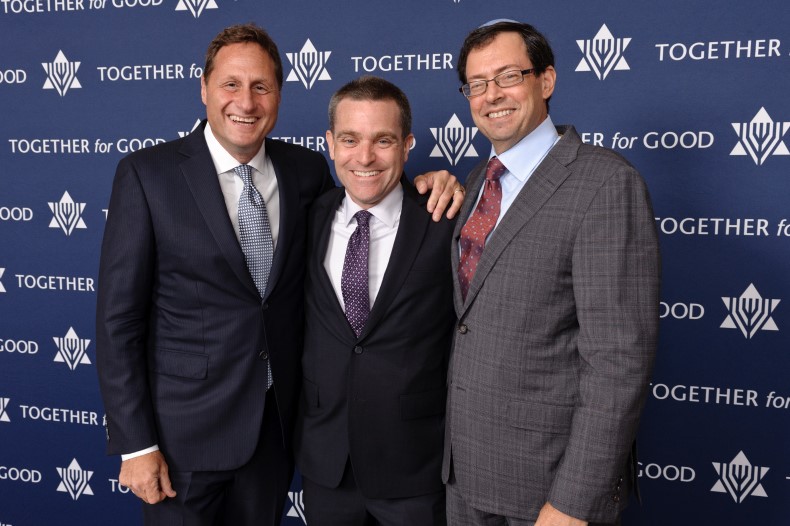
Outgoing JUF Chairman of the Board Andy Hochberg was at the helm of Chicago’s Jewish community from 2018 to 2020, possibly the most eventful term in modern history. JUF News sat down with Hochberg and asked him to share some insights about his momentous two years as Chairman.
Q. Andy, one month after you took office, the most lethal antisemitic attack in U.S. history took place at Pittsburgh’s Tree of Life synagogue. How did you respond?
A. We responded to the Tree of Life attack in various ways. First, we worked with our community leaders to immediately secure our communal institutions. We quickly engaged with the national Secure Community Network to assess best practices. We also provided moral support to Pittsburgh’s Jewish communal leaders. Finally, we launched a security fund to provide matching grants to encourage community institutions to invest in their security. Many institutions took advantage of this program, which leveraged $4 million to enhance security at 88 Jewish schools, synagogues, community centers, camps, and agencies across our community.
When Lonnie Nasatir became JUF President in July 2019, you became the first JUF Chairman of the Board in 40 years to partner with a new chief executive. How did you help ensure that transition was so seamless? What made you and Lonnie such a great team?
Lonnie is a dynamic leader who distinguished himself at the Anti-Defamation League fighting antisemitism and hate. He is doing an excellent job of leading our community. He is a great communicator; we have been clear and honest with each other in every interaction. Since he came aboard in the middle of my term, he quickly bought into some of my priority objectives, such as intensified focus on adults with developmental disabilities. As I have 25 years of service to this Federation, I had institutional memory and experience that I think he found useful, including my role as Campaign Chair. I was pleased to join in advancing his goals and objectives as well. We communicate very well-we have a standing call every day to check in and catch up.
COVID-19 has been a crisis of momentous proportions; JUF has been responding to the pandemic in profound ways from the beginning. Tell us how JUF’s bold response unfolded.
The crisis obviously came quickly and furiously. Lonnie and I knew that we were going to have to make swift decisions, so we convened a COVID-19 Task Force, including chairs of major committees and professionals from Planning & Allocations. We called every member of the Executive Committee personally and then got the Board involved in making important allocations and operational decisions, from cancellation of Israel trips to community support for human needs. We advanced money to organizations to support operations and enable them to accelerate delivery of emergency financial aid, food, and medical care. We provided PPE to institutions, too. We weren’t afraid to have skin in the game: JUF leveraged resources from not just the annual campaign, but also our endowment and access to additional credit. And Lonnie and Steve [Nasatir] were instrumental in the important stage of raising the COVID-19 relief fund from major donors.
What were some of the other challenges you faced during your Chairmanship? What are some of the challenges-and opportunities-you believe are most important for our community to focus upon in the years to come?
We must work on engaging the next generation in Federation life and connection to Israel. I think we know that the younger generations have passion, but it is often directed toward non-Jewish issues and decentralized Jewish community activity. One thing we learned during the pandemic is the importance of infrastructure; namely, larger institutions that can move quickly and powerfully to address crises. Look closely at what Federation does, and you will see that we work every day to achieve the tikkun olam and societal change that so many seek. Relating to Israel requires a discussion of its own; put simply, the organized Jewish community has to work to interest our young while at the same time understanding the community’s relevance to modern Israel. Our leadership has to adjust to a new reality where the relationship is a true partnership, with agreements and disagreements, that goes beyond the donor-donee relationship it was in previous generations.
Have your community priorities shifted during your time as Chairman? What are the issues or programs that are closest to your heart?
Yes. After the attack at Tree of Life, we had to be concerned primarily with community safety; that priority has morphed for now to health, safety, and financial sustainability. One of the ways we are helping agencies navigate in this unprecedented time is through our Technical Assistance Collaborative. It enables agencies to access wide-ranging professional expertise, from fundraising, finance, and marketing to technology, human resources, and employment law. It meets a new need and is an important way Federation adds value to the community. Also, I am very committed to Jewish education, both day school and supplementary. We must continue to find ways to make Jewish life affordable.
Engaging the next generations in Jewish life is critical to Jewish continuity. What are some of the strides that have been made, and what do you think comes next?
We have developed and are developing a tremendous number of programs oriented at the next generation. Models are changing in camp, synagogue, and day school life, even Hillels-and we are embracing and pioneering some of that change. Every year, we connect more young people to Israel, Jewish life, and one another. We are seeing thousands of young Jews participating in Jewish life today, but we want to see tens of thousands of young people “doing Jewish” tomorrow. And we must continue to make day school education more affordable and engage families in Jewish life. We also must ensure the financial sustainability of Jewish organizations during and post pandemic.
You were the first JUF Chairman in history whose mother, Barbara, served as Chairman of the Board. In addition, your father, Larry, served as Chairman of the JUF Annual Campaign. How did your unique family legacy shape your leadership style? And how do you view your own legacy?
Mom and Dad were and are great examples who stressed the importance of giving both time and money to the community. They modeled tenacity and persistence and a sense that we are here for something more than ourselves. Dad always looks for the hard jobs, taking on a challenging but successful effort to increase pro-Israel activity in Europe. Mom, it has been over 20 years since she passed away, but she had an unforgettable way of working with people that challenged them but always made them feel good about their work and importance to the team. Our home was not particularly religious, but very Zionistic. The observance level of my family, and my sister Amy’s, is much more than when I was growing up, and we are proud of the connection and observance level of our kids.
Is there anything we haven’t asked that you’d like to share with our community?
History has shown that when the Jewish people are unified, great things happen-and when they are not, disaster strikes. I am deeply concerned about the lack of civility in our society and our community. Sinat chinam , causeless hatred, is blamed for the fall of the Temple. Today’s partisan and denominational splits are concerning. Social media has made it easy and acceptable to attack others without ever really engaging them. I have been very proud of my efforts to keep the community together, and to reinforce that JUF is the home for every Jew and potentially every citizen of Chicago. I am grateful for the support of my wife, Laurie, my family, my business partners, and JUF’s amazing volunteers and staff.
Other stories
-
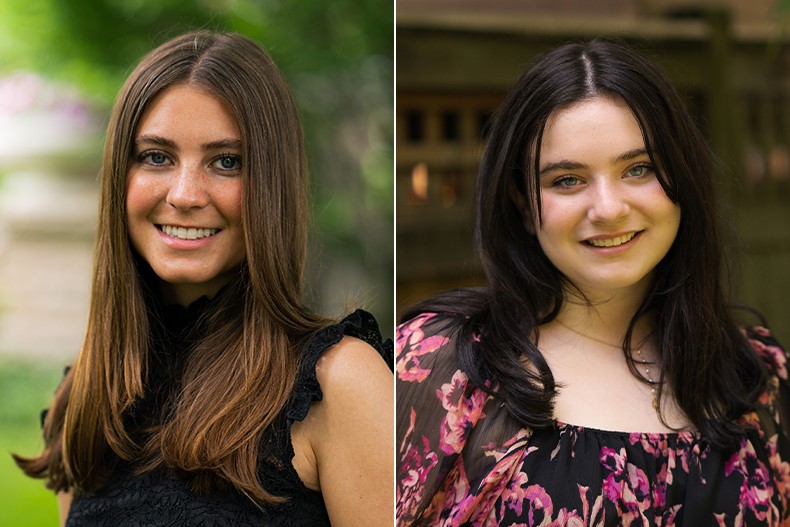
Two local teens win national recognition
Recipients of the annual Diller Teen Tikkun Olam Awards
Read more -

Celebrating six young award winners cultivating the community
Introducing young adult award winners
Read more -