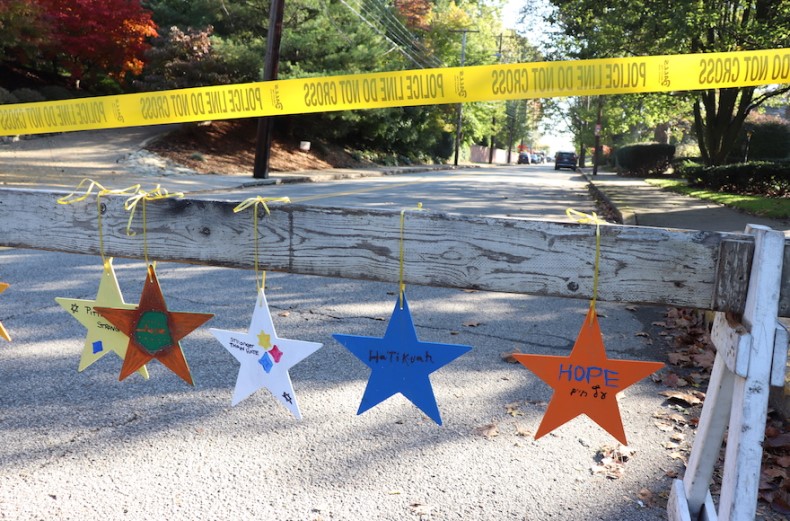
Jewish communities were left reeling after the massacre at the Tree of Life Synagogue in Pittsburgh. The overwhelming feeling, that the peace of Shabbat had been broken and the security of synagogue had been stolen, remained through the week.
By the following weekend, however, Jews in Chicago, across the country, and around the world were gathering together in synagogues once more for a Solidarity Shabbat, coordinated nationally by the Jewish Federations of North America and American Jewish Committee, and initiated as a local effort by JUF’s Rabbinic Action Committee and the Chicago Board of Rabbis.
Solidarity Shabbat was designed to reclaim the spaces and the holy day as a sign of togetherness and resilience.
“We have a lot of members connected to Pittsburgh, people who grew up there and have family there,” said Rabbi Ari Hart of Skokie Valley Agudath Jacob (SVAJ), an Orthodox synagogue. On Saturday morning, SVAJ was decorated in Pittsburgh colors, and Hart welcomed leadership from the Skokie police department before guiding the congregation in a “special prayer of gratitude and protection for police officers in Pittsburgh and around the country who protect us,” Hart added. Before singing Etz Chaim Hi , a traditional melody whose name corresponds to the name of the Pittsburgh synagogue, the congregation paused to recite the names of the victims.
In addition to these efforts from the synagogue’s members, SVAJ also hosted students from the Catholic Theological Union in Hyde Park, who joined the Jewish community in solidarity.
Rabbi Shoshanah Conover of Temple Sholom, a Reform synagogue, also experienced a positive response from the interfaith community. Upon returning from leading her congregation in prayer on the morning of the attack, Conover received text messages from clergy members of different religions, including Islam and several sects of Christianity.
“The interfaith community was immediately reaching out to us to say, ‘We’re with you,’ ‘We’re heartbroken,’ ‘We’ll show up for you anywhere,’ and ‘We want you to know that we’re standing with you in this moment,'” she said, and these messages brought her both consolation and inspiration.
As a parent, she was also encouraged by what her sons were learning from these messages: “For my children to experience that, it’s the message that they take away from this. Not only the message that anti-Semitism is alive and real and dangerous in our country and needs to be called out and spoken up against, but they also were seeing that we are not alone, and people care and are going to stand with us, and in the face of tragedy, there is always humanity.”
Conover was also heartened by the attendance at services–on Friday night, her congregation which usually averages 175 attendees, saw over 600. In a survey of Chicago synagogues, including Temple Sholom, the results were staggering: on Friday night services the week after the attack, there was a 438 percent increase in attendance, followed by a 95 percent increase on Saturday morning.
Even with other events like b’nai mitzvahs, baby namings, and more, these synagogues focused on remembering the 11 lives lost in the worst attack on Jews on American soil. At Anshe Emet Synagogue, a Conservative congregation, Rabbi Michael Siegel led 700 service attendees through a meaningful experience.
“Our sense was that we wanted to create an opportunity for people to remember those who were murdered in a way that really reflected their love of Shabbat and the Jewish tradition,” said Siegel, “so we consciously chose not to talk about anti-Semitism or politics. We focused on remembering them in a prayerful, thoughtful, meaningful way that reflected the best of Shabbat.”
Meaningful opportunities were also available that weekend for people unaffiliated with a synagogue. OneTable, a national organization providing Shabbat dinner experiences for people of all backgrounds in their 20s and 30s, hosted 25 dinners, at least 10 of which used their Together At The Table programming. This optional program guides participants through a conversation about recent events, including connections to historical and Biblical texts and options for steps to take going forward. Sixteen percent of these dinners were listed as open, meaning that the hosts welcomed all guests at their doors. In total, 269 young singles in Chicago gathered around the table for conversation and connection.
As a conclusion to a week of mourning, Solidarity Shabbat events in Chicago brought the city together to reflect on the past and look ahead to the future.
Other stories
-
Two local teens win national recognition
Recipients of the annual Diller Teen Tikkun Olam Awards
Read more -
Celebrating six young award winners cultivating the community
Introducing young adult award winners
Read more -