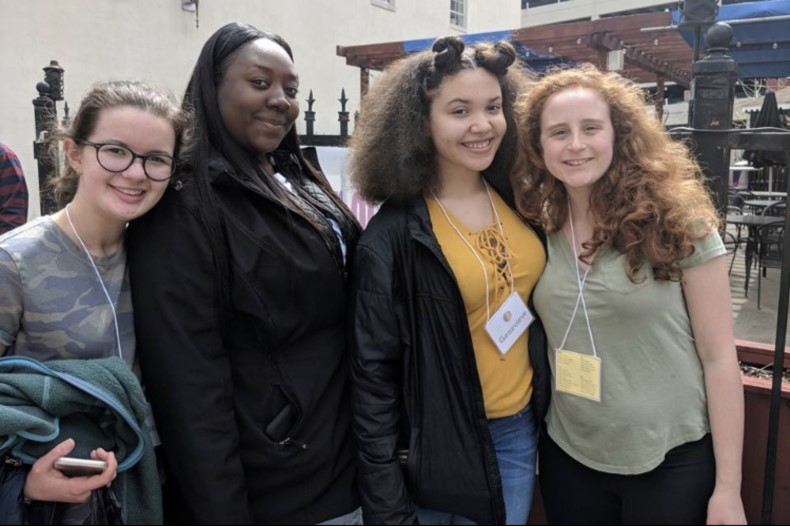
In March, 36 African-American and Jewish teens from Chicago traveled together to the nation’s South on a bus trip called “Let’s Get Together: An Interfaith Journey Toward Justice.” What follows are reflections from a Jewish student on the trip, as part of the Springboard school break program, a community initiative created with the support of JUF, the Jim Joseph Foundation, and a consortium of local funders. Read an African-American student’s reflections on the trip here .
I grew up reading books about the Civil Rights movement. At school we read about Dr. Martin Luther King Jr., his powerful speeches, and the legacy of his assassination. I read about the struggle to integrate public schools in Warriors Don’t Cry , by Melba Pattillo Beals. But I never thought I would one day visit the places where this history unfolded.
This year, as the Jewish people prepared to celebrate our own journey to freedom and as the country prepared to commemorate the 50th anniversary of King’s assassination, I prepared for my own journey.
Over the course of four days, I experienced the Civil Rights movement in a newly formed community of African-American and Jewish teens from Chicago. As we traveled from the Memphis hotel room where King was shot, to Little Rock Central High School, where the battle for school integration continued, each stop on our journey created greater understanding of ourselves and each other. After touring the high school, we dug deep into our own experiences and how they shaped our shared journey.
Our group split up into Jews and African-Americans to create a list of stereotypes about both groups. Creating these lists was supposed to make us feel uncomfortable–and it did. Many of the stereotypes were negative. As a Jew, I wondered why it was so easy to think of stereotypes, when my previous interactions with African-Americans had been limited.
When we came back together, something was evident. Each group generated a long list of stereotypes about African-Americans, while our lists of stereotypes about Jews were unequal. We learned that our African-American peers knew few stereotypes of Jews. Both communities have each experienced hardship and oppression. Yet anti-Semitism, while increasing around the world, has not created an impression on my African-American peers, in the same way that racism has left a strong impression on me and the rest of the Jewish teens.
Later that day we studied Jewish history, specifically the times Jews have experienced oppression and anti-Semitism. For many African-Americans on our trip, this was the first time they had heard the word anti-Semitism and learned about the Jewish people and our struggles. While acknowledging the many differences in our past, this time of learning shed light on some of the similarities.
After a day full of history, each night we broke into small groups to gain more personal insight. We shared our feelings and I learned that many of my new African-Americans friends have been told by role models and peers to “act white” in order to succeed. One friend told me that she thinks of the Jewish people as other successful white people in society, and asked for my advice on how she can overcome the stereotypes that hold her back. This question made me pause and consider how little adversity I have personally experienced. Her question still weighs on me.
But then night came. It was a time for fun; we put aside the many deep conversations, and a new tone was set. We packed into one hotel room and blasted the music. Our goal was to stay up as late as possible and to have fun. We danced, played loud rap music, and ordered food from anywhere that would deliver.
The last night on the trip, my roommates and I found ourselves locked out of our room. We had our keys, but the deadbolt had somehow opened inside the room. We had no clue how that happened and began to fear the worst. In that moment–black and white, Jewish and Christian faded as we faced the unknown together. The manager eventually broke the deadbolt and let us into the room, but for the rest of the night we joked about our safety in what we agreed was a haunted hotel.
The trip gave us a chance to begin to bridge a gap between two communities that share so much, including our separate histories of discrimination and oppression. Most importantly, it showed us the strength we hold when have each other’s backs.
Mia Strubel Iram is a sophomore at Niles North High School in Skokie.
“Let’s Get Together” was part of the Springboard School Break Program, made possible through a collaboration between Anshe Emet Synagogue, the Anti-Defamation League, Bright Star Church, Bright Star Community Outreach, Chicago Urban League, and JUF’s Jewish Community Relations Council.
Other stories
-
Two local teens win national recognition
Recipients of the annual Diller Teen Tikkun Olam Awards
Read more -

Celebrating six young award winners cultivating the community
Introducing young adult award winners
Read more -