“Thinking together” is a core value and practice of JUF’s Community Foundation for Jewish Education, whose mission is to advance imaginative, compelling, collaborative, and experiential Jewish education.
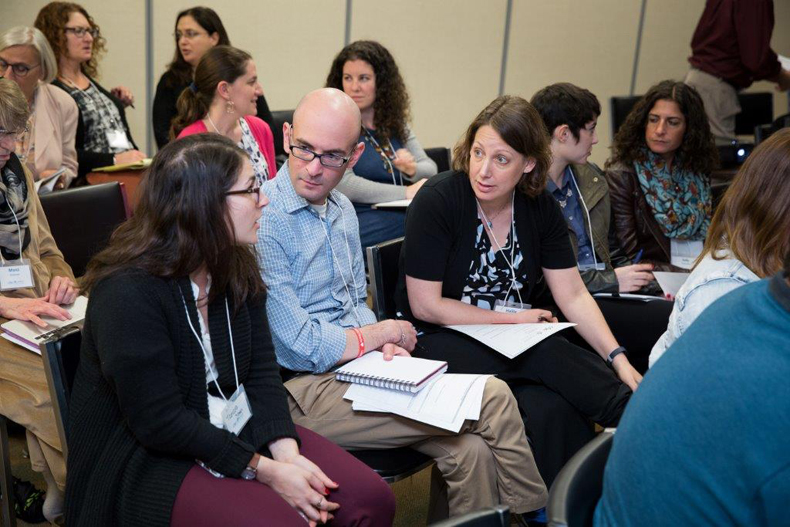
On May 23, CFJE convened more than 150 educators, clergy, and other Jewish community professionals and lay participants from around the Chicago area, as well as attendees from Pittsburgh and Milwaukee, to think together in “Community Conversations on Israel Education.”
“What is Israel education? Where and how do we start? How do we get students to form a relationship to this complicated place? How do we teach a love of a land that is part of our DNA — that sometimes makes us proud and sometimes is incredibly difficult?” said Rich Moline, CFJE Director of Israel Education, in introductory remarks.
Rabbi Dr. Scott Aaron, CFJE Executive Director, put the need for Israel education in stark terms: “How many of our teens can’t tell us what part of the world Israel is in, and what it’s like for it to be in that part of the world? What are its hopes and aspirations? That is our challenge as educators.”
To preview and stimulate ensuing group discussions, Dr. Alex Sinclair of the Jewish Theological Seminary of America presented “driving narratives” that engage students at the deepest level. He cited as examples stories that might foster identification, including the Israeli “experiment” (the story of Zionism), Israeli diversity (who and what constitute modern Israel), and Jewish “world makers” (figures who are change-makers).
Sinclair juxtaposed his driving narratives against what he termed “false gods” in Israel education, including Hasbara (dissemination of pro-Israel PR rather than providing the full, complex picture); Israel as “Startup Nation” (focusing on technology rather than on people and culture); Israel as safe haven (seeing Israel as a life raft rather than a vibrant society); and pro- or anti-occupation frame (reducing Israel to a political argument).
To identify and address specific elements within the broad context of the challenges Moline and Aaron outlined, participants divided into a variety of interest areas, with conversations facilitated by prominent educators, including Sinclair; Dr. Lesley Litman of Hebrew Union College-Jewish Institute of Religion; Zion Ozeri of the Jewish Lens Project; and Robbie Gringrass of Makom Israel. Moline and CFJE colleague, Ariel Lapson, Ta’am Yisrael Program Manager, also made presentations (Israel education as distinguished from Israel PR, and a refresher on 1967).
Its title — “How to do complexity in four easy questions” — notwithstanding, the session this writer attended exemplified the sophistication of approaches to Israel education participants learned about and discussed. In this presentation Gringrass explained a paradigm for addressing vibrant, complex, and sometimes disturbing dynamics both in Israel and in the American Jewish world.
The model’s purpose is to help educators connect students in simple ways to the complexity of Israel, and to grasp the complexity of Israeli society at a time when attention spans and bandwidth are shrinking. He showed participants ways to address politics, without “fetishizing” them; be open to all the facts, even contradictions; and to speak to both universal human and specific Jewish values. His model addresses a gamut of concerns, which he translated into Israel education four categories, covering security, identity, freedom and democracy, and territory.
“The Israel narrative is the ongoing story of the Jewish people trying to get better answers to these questions,” Gringrass said.
In remarks introducing the recipient of the CFJE award named in her honor (see accompanying story), Sue Pinsky reflected on the enormity of the job of educators in propelling that ongoing Jewish story.
“Learning is the development of character. For educators it isn’t a career choice; it’s the essence of their being,” Pinsky said.
Margie Pines, early childhood educator at JCC “Z” Frank Apachi in Northbrook, in receiving the third annual Sue Pinsky Award for Excellence in Jewish Education, responded: “What type of people do we want to see in our world? People who have the skills necessary to live in a democracy? Then we want to prepare children with the tools.”
In receiving the CFJEC Grinspoon Foundation Award for Excellence in Jewish Congregational Education, Andrea Raskin from Temple Jeremiah further reflected on the challenge: “Our task is to educate and inspire…. [Students must develop the] knowledge that their life matters and that they can and indeed must make a difference in this world.”
Other stories
-
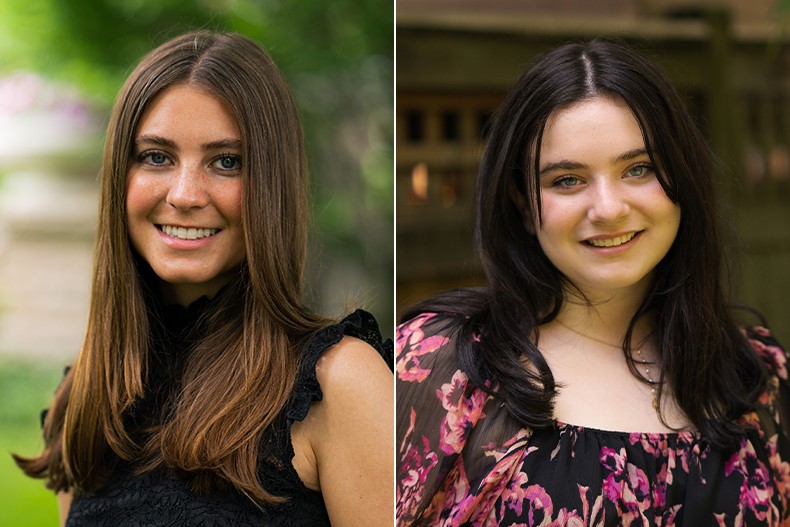
Two local teens win national recognition
Recipients of the annual Diller Teen Tikkun Olam Awards
Read more -
Celebrating six young award winners cultivating the community
Introducing young adult award winners
Read more -