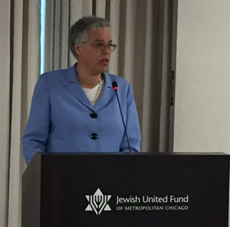
Illinois social service agencies are feeling the impact of the ongoing state budget stalemate in Springfield, but so are local governments and municipalities. Cook County, which includes 80 Federation-supported programs, is no exception. Cook County Board President Toni Preckwinkle made that much clear and more when she addressed more than 60 members of JUF’s Government Affairs Committee on June 14.
“These are difficult times for local governments, including our own,” she said.
Operating the second largest county in the nation, Preckwinkle continues to push forward on the county’s core policy agenda of public health, public safety and economic development.
Currently, the state owes the county $110 million for its public safety and public health programs not protected by court order or supplemental appropriations. Despite the financial burdens, Preckwinkle reported noticeable milestones: More than 160,000 people are enrolled in the County Care program, made possible through a Medicaid expansion waiver in 2012.
“County Care reduced taxpayer allocation to the Health and Hospital System from $400 million in 2010 to $121 million this year,” she said.
Public safety is another top priority for Preckwinkle, who is deeply committed to reforming the county’s criminal justice system. She has worked to lower the jail population by engaging stakeholders in changing how cases are handled in bond court by diverting non-violent offenders, including those who have mental health or substance abuse treatment needs, to appropriate community-based services. Since she took office, the number of general population detainees Cook County Jail has declined from 10,000 to about 7,500. With this reduction, the County hopes to reinvest more of its available funds in much-needed programs services, such as restorative justice, drop-in centers, and other violence prevention initiatives.
The county, like social service agencies, is questioning whether or not to continue its partnership with the state. “Although the county expects payment to its health and hospital systems,” says Preckwinkle, “we are now faced with the question of whether there are programs normally funded by the state that we can continue to support after June 30.”
Preckwinkle was joined by Kathe Dellacecca, vice president of behavioral health at Sinai Health System, who reported on the 10-month old Crisis Stabilization Unit at Holy Cross Hospital, a partner of Sinai Health System. With shrinking government dollars and the closure of city mental health clinics, Illinois has seen a 19 percent increase in emergency department visits for mental health-related issues and roughly 50 percent of the county jail population is diagnosed with a mental illness.
“The difficulties remain once the patient is back in the community with insufficient support to maintain a sustainable recovery,” Dellacecca said.
In response to need, Sinai implemented the CSU to provide immediate, targeted community-based care for people struggling to maintain their behavioral health care at home. Serving 914 patients since its July 2015 debut, the CSU caught the attention of Cook County Sherriff Tom Dart, who will transfer inmates to the CSU for assessment. The CSU was featured in the Chicago Tribune on May 31.
Peter Friedman, Government Affairs Committee vice chair for local government, said, “Although much of our focus this past year has been at the state and federal levels, we recognize the important role that the county plays in our work. “We value our strong relationships with elected officials at the county level, and commend the county and our affiliated partner agency Sinai Health System for their excellent work and continued commitment to serving the most vulnerable during these especially challenging times.”
The meeting concluded with an update from Suzanne Strassberger, JUF’s Springfield liason, who provided an update on the budget impasse. With each day, the state continues to grow deeper in debt, and programs continue to shut down. Although resolution options are in play and negotiations continue, a budget deal does not seem imminent.
Strassberger said she believes there are three things that might force a deal: 1) state employees stop getting paid; 2) K-12 schools do not open in August due to inadequate funding; 3) rank-and-file legislators revolt against the administration.
The Illinois General Assembly is scheduled to reconvene next week.
Other stories
-
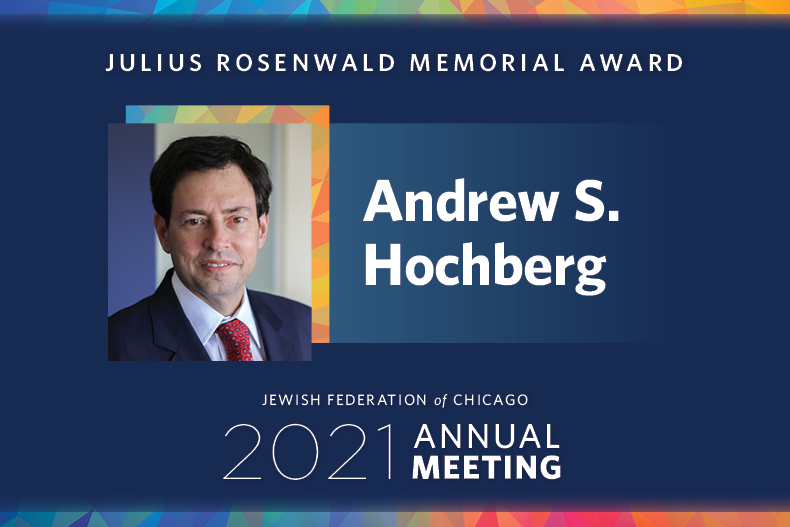
Meet Andrew S. Hochberg, 2021 Julius Rosenwald Memorial Award recipient
Celebrate Andy Hochberg at the virtual Annual Meeting on Sept. 14
Read more -

Two local teens win national recognition
Recipients of the annual Diller Teen Tikkun Olam Awards
Read more -

Celebrating six young award winners cultivating the community
Introducing young adult award winners
Read more