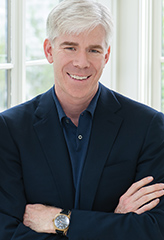
Three people in journalist David Gregory’s life motivated him to explore his Jewish journey: His wife, President George W. Bush, and, of course, Gregory himself.
When Gregory first mentioned to his wife, Beth, that he wanted to raise their future children Jewish, Beth-who grew up as a religious Protestant-said she was on board with the decision as long as he could first deepen his own understanding of what it means to be Jewish.
She told him if he plans to lead the family in faith, he first has to figure out what his faith, and being Jewish, means to him. “I know what you are,” she told him, “but what do you believe?”
Raised by a Catholic mother and a Jewish dad, Gregory had always identified with his Jewish cultural and ethnic identity, but didn’t possess any real belief until he was asked that question by his wife.
Later, as a White House correspondent covering the Bush administration, Gregory was asked by the president: “How’s your faith?” Gregory, who Bush was quite fond of, was startled by the question. After all, it was usually the reporter who was the one who asked the tough questions-not the other way around.
Finally, it wasn’t just others who asked Gregory the big questions. It was he himself-in part because he was in a place of deep gratitude for his personal and professional success-who was experiencing a spiritual longing and wondering what else is out there. Then, after being asked to leave his job as moderator of NBC’s Meet the Press news show in 2014, his quest for spiritual meaning deepened further. With the help of a modern Orthodox Jewish mentor, a woman named Erica Brown, Gregory has been able to use his inquisitive journalistic skills to explore his own Judaism.
The journalist, father to a 13-year-old son and 10-year-old twins (a son and a daughter)-will be discussing his new book, aptly named How’s Your Faith? (Simon & Schuster) when he speaks at a JUF event in the northern Chicago suburbs on April 18. In advance of his Chicago appearance, Gregory, now an analyst for CNN and Fox News, sat down for a phone interview with JUF News to talk about his Jewish journey.
JUF News: How’s your faith these days, and how has it changed since the first time President Bush asked you that question?
David Gregory: Immersing myself more deeply in prayer and faith…and study has changed me. I feel like it’s been a path-there’s a process of transition that happens almost daily.
The gift of the book…asking questions of myself, of God, and of faith leaders, has also opened up another path of discovery. For me, what’s changed since I was initially asked that question is that faith has really moved from a matter of my head to a matter of my heart. Knowing God, believing in God, has moved from mere study and questions of identity to a real sense of being closer to God, and more deeply grounded in faith.
Why is that question ‘How’s your faith?’ so important to you?
…It begs the questions what does it mean to be Jewish, what does it mean to be a person of faith? What does it mean to examine myself more deeply in a way that I think faith asks us to… Is my life deeper and is my life better because my faith is deeper? For me, the answer to these questions are [both] yes.
Did you know that this sense of spirituality was missing back when it was missing?
A big part of my initial search, which I write about, is a return to my teenage years and how I grew up. Erica (his Torah study partner) always says the spiritual journey begins by understanding the family dynamic. I do talk about an absence of faith growing up, an absence of belief, at a time when I really could have used it. Trust in God and faith are about understanding that things may not go as they hope you do, but, in the end, everything is going to be okay. That doesn’t mean there’s not pain and hardship and mistakes, but everything is going to be okay. I wish I’d had a sense of that during tough parts of my adolescence and I don’t really think I did. And so, understanding all of that, and wrestling where my mother was as an alcoholic and where my father was in his denial…learning to forgive and make sense of all that, the absence of faith was really what was striking.
What have your professional and personal challenges taught you?
When you go through something difficult, you say I’m glad I learned some of these lessons, but I could have done without learning it that way. I could have done without my mother’s alcoholism and her getting arrested and the shame, isolation, and anger and all of that. But there is a resilience that comes with that and that things don’t work out as you plan. It gave me a certain grit that served me well and in some ways did not serve me well. I do believe that hardship has a way of renewing your life. Like Psalm 23 says, God renews our life. And as we walk through the valley of death, it says that we don’t stay in the valley, but we walk through it. So it’s in the walking through that we find some renewal…
It’s very hard to examine yourself-to examine the questions ‘Who am I? Who am I really? What gives me a sense of identity?. It is, I think, hard to [examine those questions] purely out of a sense of gratitude, until you know some kind of pain, some kind of loss, some kind of personal failure, until you can find a way to take something that is broken and make it better.
You write that your identity used to be wrapped up in being a journalist. Are you in a different place now?
I strive to be. It doesn’t mean that the old impulses aren’t there-they are-but I think I work very hard through prayer, through faith to reset that… ‘Who am I?’ is a much deeper question. It gets to the fullness of my identity, whether I’m on television or not. I could be the manager of a hardware store and ask the same question about what gives me identity.
I’d be remiss if I didn’t ask you about politics. Have you ever seen anything like what’s going on with the current presidential campaign?
No, I really haven’t seen anything like it. The lack of decorum and the debasement of the process is really unsettling, as it is to so many people. I worry that we’re now part of a political culture that has accepted the complete vulgarization of our political discourse…I don’t mean to sound that prudish about it because we’ve had outlandish periods in our politics throughout our history so we’ll get past it, but it’s pretty low.
What’s your favorite Jewish ritual?
Shabbat! We have really developed a Shabbat ritual-dinner on Friday night with our children-that I think has matured into just a beautiful family time, separate from the rest of the week. I really think it’s holiness in time and space and it’s what Rabbi Abraham Joshua Heschel describes as “stopping time,” and having a chance to reflect. I’m always trying to go deeper into the ritual, to really feel the transcendence, through prayer, through the martini I have on Friday nights, through studying Torah, through the conversations we have around the table, and to just lose myself in the light of Shabbat.
David Gregory will be speaking at a synagogue in the northern suburbs on April 18 in the evening. For more information and to make a reservation, call Sandi Kaplan at (312) 444-2841 or e-mail: [email protected]. Advance reservations required to attend.
Other stories
-
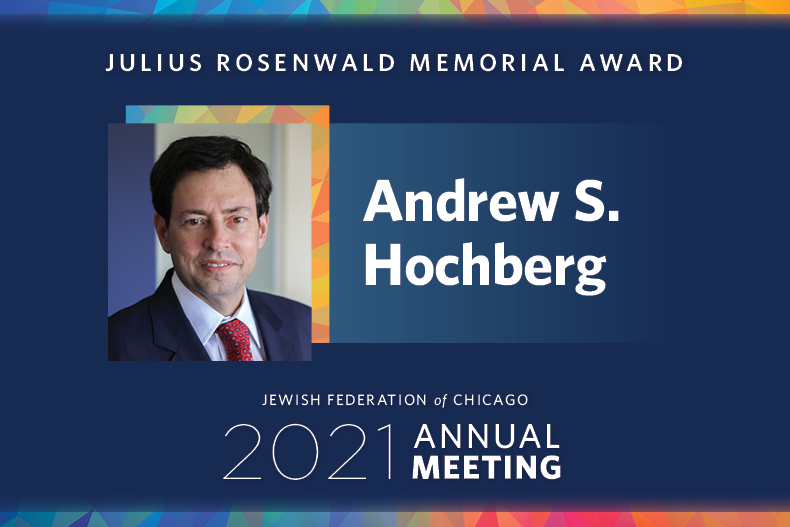
Meet Andrew S. Hochberg, 2021 Julius Rosenwald Memorial Award recipient
Celebrate Andy Hochberg at the virtual Annual Meeting on Sept. 14
Read more -
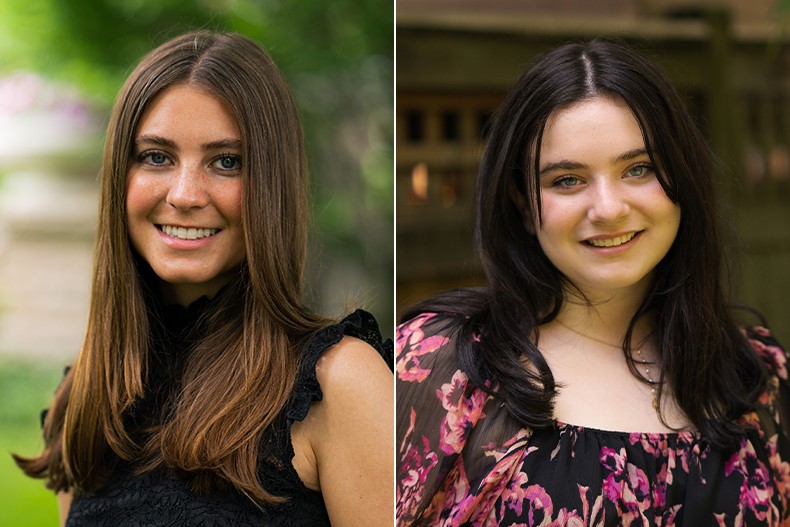
Two local teens win national recognition
Recipients of the annual Diller Teen Tikkun Olam Awards
Read more -

Celebrating six young award winners cultivating the community
Introducing young adult award winners
Read more