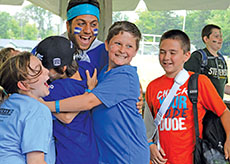
I’ve been in Jewish camping for the last 10 years. In that time, the role of idenitity at Jewish overnight camps has been investigated at nearly every Jewish camp I’ve talked to. I’ve seen camps across the board actively work and plan out how to maintain their Jewish identity with a camper population that is diversifying and growing increasingly secular. During the process, we’ve utilized some of the same tools and the same strategies in order to create an atmosphere and culture our campers can relate to and that we can be proud of.
We maintain identity through culture. A growing trend is the focus on Jewish cultural learning rather than, and in addition to, religious practices or Hebrew immersion programs. There are still camps that have these focuses, but what I see in the Midwest is a shift. Hebrew is used to name buildings, activities, or programs. For example, at JCYS Camp Henry Horner, a cabin is a bitka , free time is called chofesh , and the birkat hamazon is done after meals. One of the ways that our camp is incorporating the language without studying it. I call this process, “Hebrew by osmosis.” The campers are surrounded by the language and have no choice but to pick it up in bits and pieces without sitting down and studying it in a classroom.
We hire Israeli summer staff. I’ve seen an increase in Israeli staff and an increase in the same Israeli staff returning from summer to summer. This is due, in part, to the ease of access to Israeli staff as they finish their service in the Israel Defense Forces and the ease of the process through agencies worldwide. JAFI has been a great resource for us and we’ll likely find additional staff by starting to use Jewish Camp America for summer of 2016. The staff we find are young, enthusiastic, and provide campers a much different perspective on Israel and the IDF. The campers’ perspective changes from the images they see on the news or, more likely, on social media. During camp, they have positive role models year after year that they positively associate with Israel, which is a country in constant conflict and ever-growing tensions.
We have an increasingly diverse population. An important distinction is that camps are adjusting rapidly to the changing Jewish community of youth. Most Jews raise children in a very secular world. There is a huge number of mixed marriages and some of us live in communities where observant Judaism is the norm but we all have to constantly find new ways to engage them with Judaism while still being true to ourselves and our religion. This challenge is particularly relevant when we have increasing numbers of campers who are not Jewish. Many Jewish camps have opened doors to all campers. In doing so, we need to make sure that the cultural aspects are still as warm, welcoming, and educational as they are to our Jewish campers. Those of us that are open to all religions have created a space where campers who aren’t Jewish can be educated about Judaism and learn about our culture.
Not all Jewish camps have non-Jewish campers. I think the argument could be made that 100 percent Jewish campership means they’re strengthening the core Jewish network and the Jewish community. I would point out that the world we live in is not 100 percent Jewish and I’ve seen a normalization of Judaism among our non-Jewish campers. They know the prayers, a little language, a little of the culture, and are being invited to bar and bat mitzvahs and, later in life, Jewish weddings. By accepting all campers, we create good will and we are able to showcase our religion and culture to campers that, otherwise, might not have been exposed to it.
It is our responsibility as Jewish camping professionals to create this sense of Jewish identity for all our campers. What that means is different in each camp. JCYS has a different view from URJ, which has a different view from JCCA. And through this alphabet soup of acronyms, we find a common thread: we are finding ways to maintain our Jewish identity within a changing population. Recognizing that there are hundreds of Jewish camps and they address this issue in hundreds of ways, this is the common theme from camp to camp, summer after summer.
Isaac Brubaker is the Day and Overnight Camp Director of Jewish Council for Youth Services (JCYS) Camp Henry Horner.
Other stories
-
Meet Andrew S. Hochberg, 2021 Julius Rosenwald Memorial Award recipient
Celebrate Andy Hochberg at the virtual Annual Meeting on Sept. 14
Read more -
Two local teens win national recognition
Recipients of the annual Diller Teen Tikkun Olam Awards
Read more -
Celebrating six young award winners cultivating the community
Introducing young adult award winners
Read more