Advisor to prime ministers, Israel’s National Security Council speaks to JCRC
JESSICA HOCHBERG
There is a given reality that Dr. Dan Schueftan would like people to accept–that “peace” is not a feasible outcome for the conflict in the Middle East. Rather, there are structural problems that will persist and not allow for an effective diplomatic solution. Israelis must cope with the broken structural problems by strengthening the Israeli society and fostering a vital relationship with the United States.
On Tuesday, June 16, Schueftan, who was visiting Chicago, spoke about this reality on behalf of the American Society of the University of Haifa to several local Jewish leaders at a breakfast, sponsored by JUF’s Jewish Community Relations Council, held at JUF headquarters.
In his political career, Schueftan acted as an advisor to Israel’s National Security Council, and to former Prime Ministers Yitzhak Rabin and Ariel Sharon. Internationally, he has briefed senior political leaders and officials in the United States and Europe.
Schueftan is the Director of the National Security Studies Center at the University of Haifa, where he also serves as a senior lecturer at the university’s School of Political Sciences. He has also taught at the Israel Defense Forces National Security College and the IDFS Command and Staff College.
During his lecture, he highlighted that the problems in the Middle East cannot be solved with a new policy or with dialogue between nations. While these approaches are theoretically productive, they are ineffective, he said. The issues in the Middle East are structural, and will not be resolved with a focus on “peace” or the creation of a “solution.”
He said the inefficiency of diplomacy in that the area is “violent, unstable…a hatred of Israel, even if you have an agreement between Israel and some political elites, you have a very deeply felt resentment against Israel.” The fundamental sentiments of hostility would render the agreements between nations inconsequential. Schueftan added that the current Arab political culture in the Middle East does not allow for successful “solutions.” Israel’s focus, instead, should be on coping with the circumstances of the nation. Israel persists by effectively utilizing her assets, which include promoting a prosperous Israeli society and garnering support from the United States.
The Israeli society is a flourishing democracy, he said, with a successful economy that has one of the lowest unemployment rates in the world and lucrative innovations.
Another tenet of Israel’s success-in spite of its tumultuous circumstances-stems from the relationship between the United States and Israel. Without this friendship, Israel would not only struggle financially but, more importantly, struggle in an international context. The underlying causes of the successful relationship lie in the similar values the two countries possess and America’s political importance. The U.S. and Israeli governments have an ethical bond and share values. They both have resilience that propels them to persevere.
The Israeli and American mindset share five attributes: They are both “strong, stable, responsible, pro-American, and determined/resilient,” Schueftan said. Also, the U.S. acts as a crucial ally for Israel, and defends Israeli actions to many countries that may display hatred towards the country. America’s role as a strong international presence assists Israel in accumulating support for the country’s existence.
Jessica Hochberg is a 2015 Lewis Summer Intern.
Other stories
-
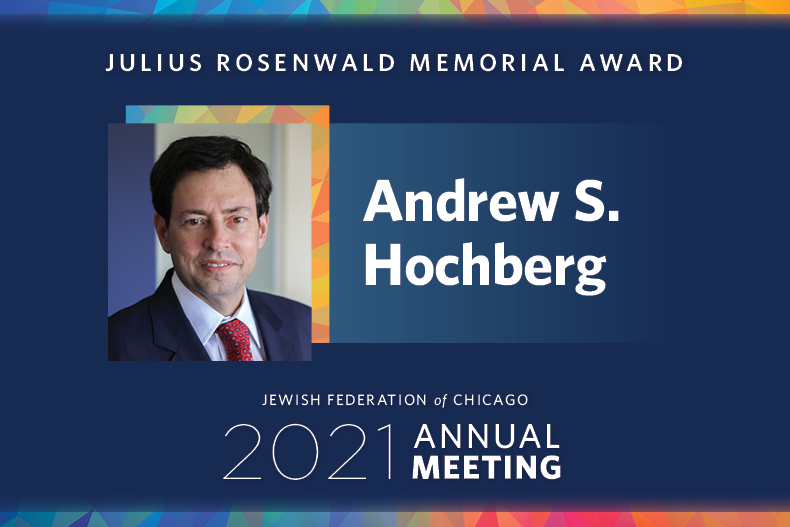
Meet Andrew S. Hochberg, 2021 Julius Rosenwald Memorial Award recipient
Celebrate Andy Hochberg at the virtual Annual Meeting on Sept. 14
Read more -

Two local teens win national recognition
Recipients of the annual Diller Teen Tikkun Olam Awards
Read more -

Celebrating six young award winners cultivating the community
Introducing young adult award winners
Read more