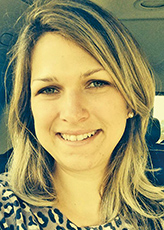
When Anna Hartman imagines the ideal Jewish preschool, images of light-filled spaces, art materials that inspire wonder, and a curriculum that centers on children’s evolving interests all come to mind.
“Whenever I see an example of that-and many Jewish schools do utilize a curriculum like that-I’m always blown away,” said Hartman, the new Director of Early Childhood Excellence at JUF’s Community Foundation for Jewish Education (CFJE). A former Jewish early childcare program director and consultant, Hartman is one of the founders of the Paradigm Project, a national, grassroots change initiative in Jewish early childhood education fostering excellent practitioners across the country. She will share her time between CFJE and the Paradigm Project.
From 2008 to 2012, Hartman served as the director and developer of the early education program at Atlanta Jewish Academy. “We built a deeply Jewish program,” she said, “that thought about Judaism with a lot of its big ideas around partnership, and covenant, and the sacred.”
Hartman said she hopes to find solutions for common issues faced by the community’s early childhood programs, including teacher recruitment and retention, leadership training, and adapting to the needs of Jewish young families. “The work is to look across Chicagoland at what’s happening in the Jewish early childhood schools, where are we meeting our potential and where is there so much more potential,” said Hartman.
“She consults all over the country, so she’s got a great context,” said Rabbi Scott Aaron, CFJE’s executive director. “But she knows that she can’t overlay what she knows on our city. Our city has to be learned from scratch. So she’s really working on that.”
Hartman discovered that early Jewish childhood education is “sort of helmed” by many different systems in Chicagoland- including the Jewish Community Center system, Jewish Council for Youth Services, and the Board of Jewish Education, among others. This situation is different than in other cities, Hartman said.
“The first thing she has to do here is get our early childhood community talking to each other around a common table with common reference points,” said Aaron. “So she’s spending a ton of time right now building relationships, visiting schools, learning about different programs.”
“I’m meeting such great people and I’m getting to see incredible schools, incredible systems,” she said, but since they all run separately from each other, there is almost no place for leaders to get together, or teachers to study together, or for systems to offer joint professional development. “There needs to be a dozen ways that all of those systems are interconnected,” she added.
“I took the job here [because] I believe that Chicago is ripe for this,” Hartman said. “What might happen if we all worked together a little more closely? What could we do together that would make each of us stronger?”
Hartman said that she has been inspired by Italy’s Reggio Emilia approach, which encourages children to wonder and be active learners. Curricula are often based on children’s interests. This approach to early childhood education is a feature of some Jewish early childhood schools in the Washington D.C. area, where she originally started her career as a teacher.
Also inspiring for Hartman are Hebrew immersion programs and schools where children develop a kinship with nature. The ideal school would also be responsive to the needs of parents, she noted.
Hartman lives with her husband, Noah Hartman, the new head of school at Bernard Zell Anshe Emet Day School, and her three children, a baby and two school-age kids who attend that school.
For the Hartmans, Jewish education is the family business.
Joanna Broder is a freelance health and features journalist living in Maryland.
Other stories
-
Meet Andrew S. Hochberg, 2021 Julius Rosenwald Memorial Award recipient
Celebrate Andy Hochberg at the virtual Annual Meeting on Sept. 14
Read more -
Two local teens win national recognition
Recipients of the annual Diller Teen Tikkun Olam Awards
Read more -
Celebrating six young award winners cultivating the community
Introducing young adult award winners
Read more