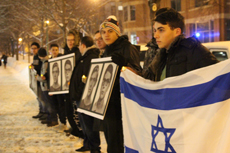
As the Executive Director of JUF’s Israel Education Center, I’ve been thinking a lot about the reality that our Jewish college students live in today and the association I keep returning to is George Orwell’s book 1984.
“Doublespeak,” is a close cousin of the book’s concept of “doublethink.” Right is wrong, wrong is right and up is down. The Israeli-Palestinian conflict is happening in doublespeak, especially on college campuses. In what world could we imagine Jewish college students being accused of sympathizing with genocidal murderers and racist apartheid supporters?
When did it become acceptable to host a fundraiser for a convicted terrorist at an institution of higher learning like the Students for Justice in Palestine event for Rasmea Odeh at DePaul University and coming up at Loyola? Odeh was convicted of murdering two Hebrew University students in 1969 in Israel, released in a prisoner exchange and then lied on her immigration papers to enter the United States. Is that really the person that Students for Justice in Palestine should lift up as role model? When did we turn the page on lauding violence over non-violence? When could we imagine anti-normalization/anti-dialogue would be the standing policy of a student group?
Isn’t college exactly the place to encounter and wrestle with opinions different from our own? In this Orwellian world, some LGBT, Latino, and black student communities have chosen to align themselves with anti-Israel campus organizations rather than forming their natural affiliation with student organizations like Hillel that support the country that has the most progressive agenda in the Middle East. At Northwestern University recently, we saw this new dynamic play out in a very sophisticated divestment campaign in Student Government that our Jewish students lost by a vote of 24 to 22 with three abstentions. Jewish students were portrayed as “white, privileged, and in power” and, therefore, the “oppressor” and against human rights, whereas anyone from an “oppressed” minority was seen as the natural ally of the Palestinians and, therefore, in favor of human rights.
These current realities on campus don’t exist in a vacuum. They are representative of national and international trends. Following the latest round of violence in Israel this summer and the more recent events in Paris, IEC saw an uptick in anti-Semitic activity on campuses nationwide despite the fact that Jews were the victims of this violence rather than the perpetrators. Swastikas were graffitied on Jewish fraternity houses, a Jewish student at Temple University was assaulted by a member of SJP, and Steven Salaita felt no shame in openly demonizing Israel and her supporters via Twitter. To many Jewish students and Israel’s supporters it feels as though we have entered an alternate reality. So what is the IEC doing about it?
The good news is that many non-Jewish students are turned off by pictures of dead babies and one-sided talking points during divestment campaigns. Gallup’s poll in February of 2014 told us that 62 percent of Americans overall support Israel. But to achieve this support requires consistent work.
Jewish college students do not go to university to become warriors for Israel. They want to experience the totality of college life. While the attacks on campus have become more radical—the unintended outcome has largely been rejection by the overall campus community and the galvanization of the Jewish student body. The extreme tactics used by Israel’s detractors have had the effect of mobilizing Jewish students to defend Israel and the Jewish people.
IEC’s approach is to win the majority through educational conversation and initiatives that focus on values and coalition building. IEC’s Israel Interns are trained to build partnerships with Jewish and non-Jewish student groups and campus influentials, but as we witnessed at Northwestern we need to do more. IEC partnered with national organizations to build the Chicago Israel Council which brings together student leaders once a month to discuss trends and best practices and learn from one another’s work. Hillel acts as a convener for a diverse array of Israel-related groups. And together we stand against the false accusations that pervade campus discourse about Israel.
We take the long-term view, but immediate and strategic responses to anti-Israel activity are necessary. No claim of apartheid, genocide, or oppression goes unchecked. IEC employs various strategies based on the particular incident and campus. IEC remains committed to ensuring Jewish students feel pride in their identity and in supporting Israel. Crisis mode is neither sustainable nor a winning strategy.
Consistent accusations of genocide, support of apartheid, and colonialism can take their toll on any student, especially ones with only a cursory knowledge of Israel’s history and their own Jewish identity. IEC’s most important job is to ensure that Jewish students, in an effort to empathize with their “friends,” do not end up feeling guilty for supporting Israel.
That is where JUF’s Hillels and IEC play a critical role. Investment in long and short-term travel programs like Taglit Birthright Israel, Onward Israel, and MASA help stem the tide against the distancing of our Jewish college students from Israel. Combined with Hillel’s and IEC’s 24/7 commitment to strengthening Jewish knowledge and leadership training, we have the right formula. IEC will not allow our colleges to become like Orwell’s “Ministry of Truth.”
With the help of a committed Jewish community and our generous donors, IEC and Hillel are producing the next generation of Jewish leaders who, while learning to stand up for Israel today, will be confident advocates for themselves and the wide array of Jewish needs in the future. We are making a difference.
Emily Briskman is the Assistant Vice President of Campus Affairs and Executive Director of JUF’s Israel Education Center.
Other stories
-
Local campus administrators convene on hate speech, bias
JUF and ADL brought together 17 student safety, diversity and inclusion and student affairs administrators and Hillel representatives from various Illinois campuses to discusses issues of hate speech and bias.
Read more -
Engaging students about Israel on campus
Too often we hear about difficulties facing Jewish college students on Illinois campus, but to focus solely on the politics gives only one piece of the complex narrative that is Jewish life on campus.
Read more -
Hillel International launches fellowship initiative to train young Jewish professionals
The Springboard Fellowship will train cohorts of young Jewish professionals in highly-valued skillsets and place them at local Hillel campuses for two years.
Read more