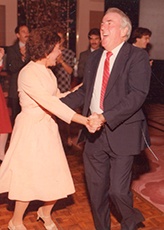
Abner Mikva—congressman, federal court judge, and advisor to presidents—dies at 90
PAUL WIEDER
One of the most-told stories in Chicago involves a law-school student who tried to volunteer for then-gubernatorial candidate Adlai Stevenson. “Who sent you?” the ward boss challenged him. “Nobody,” admitted the student. The boss famously replied, “We don’t want nobody nobody sent.”
That student later became The Honorable Abner Mikva-and nobody’s “nobody.” In fact, he “sent” many other people on their way to becoming somebodies. Mikva mentored Chicago Mayor Rahm Emanuel, Congresswoman Jan Schakowsky, and Supreme Court Justice Elena Kagan. And Mikva has mentored President Barack Obama since Obama was an Illinois state legislator.
Mikva spent his life in public service. He served his city as a U.S. Congressman for nine years. He served his state as assemblyman for five terms. He served his country as the chief judge of the U.S. Court of Appeals for the District of Columbia. He served his profession by practicing law and teaching it.
In 1994, President Bill Clinton made him White House counsel. In 2014, President Obama bestowed him with the Presidential Medal of Freedom, the highest American civilian honor. Ultimately, he became one of the few people in American history to serve in every branch of government.
Judge Mikva died July 4, at 90. The son of Yiddish-speaking Ukrainian immigrants, he would one day monitor a Ukrainian national election.
Over the years, Mikva was very supportive of JUF’s work. He shared his knowledge and insight with everyone from the Women’s Board of the Young People’s Division (now YLD) to JUF’s Board of Directors. He participated in the Walk with Israel, and addressed the 1981 Festival of Hope for Soviet Jews. As U.S. Congressman, he corresponded regularly with JUF leadership regarding issues from English-language training for refugees to housing for the elderly.
“Abner Mikva was a great public figure,” said retired State Senator Arthur Berman. “He fought for positive policy for all people, and set a great example of being an outstanding citizen.”
“I found him to be a dedicated public servant, and brilliant,” agreed State Senator Howard Carroll. “He had a wonderful relationship with those coming behind him, and was a symbol” for them.
Mikva was born in Milwaukee in 1926 and grew up in the Great Depression. During World War II, he enlisted in the Army Air Corps; the war ended the day before he was deployed. But he was eligible for the GI Bill, and attended Washington University in St. Louis, where he met his wife, Zorita “Zoe” Wise. They would be married for nearly 70 years.
Mikva earned his law degree in 1951 from the University of Chicago Law School, where he would teach decades later. He went on to clerk for Supreme Court Justice Sherman Minton. Back in Chicago, he practiced law, at Goldberg, Devoe, Shadur & Mikva.
Mikva was elected to the Illinois House of Representatives in 1956; his Springfield roommate was future senator Paul Simon. Mikva became a member of Congress in 1969, serving Illinois’ 2 nd and 10 th districts during his five terms in the House of Representatives.
In 1979, President Jimmy Carter appointed him as a judge on the U.S. Court of Appeals for the District of Columbia. He served for 15 years, including five years as chief judge, a level to which he was raised by Clinton. As chief judge, Mikva struck down the Pentagon ban against gays serving in the U.S. military-and played a Supreme Court Justice in the comedy movie Dave .
His daughter, Rabbi Rachel S. Mikva, Ph.D., is the Herman Schaalman Chair in Jewish Studies at the Chicago Theological Seminary. She spoke of her father’s “longstanding commitment to Israel” and noted that his congressional campaigns, which emphasized direct voter contact, “involved tremendous numbers… of the Jewish community in the political process.”
His “capacity to inspire others to work for the betterment of the community is a great legacy,” she added, “now continuing through the Mikva Challenge, which he spearheaded with my mother. His lifelong partnership with her contributed greatly to his success.”
The Mikva Challenge, a non-profit organization encouraging teens to become active in politics, was founded in 1997 by Mikva and his wife; there are now chapters in Los Angeles and Washington, D.C.
“My father was the primary caretaker for my mother from the time she had her first stroke seven years ago until just weeks before he died,” said his daughter Laurie, a clinical assistant professor of law at Northwestern University. “He was a very devoted husband… and father and grandfather.”
In 1998, Mikva received the Chicago History Museum’s “Making History” award. In 2006, Illinois Governor Rod Blagojevich named Mikva chair of the Illinois Human Rights Commission.
Besides his wife, he is survived by their daughters- Judge Mary Mikva, Professor Laurie Mikva, and Rabbi Rachel Mikva-and seven grandchildren. There will be a public memorial in August.
Other stories
-
Meet Andrew S. Hochberg, 2021 Julius Rosenwald Memorial Award recipient
Celebrate Andy Hochberg at the virtual Annual Meeting on Sept. 14
Read more -

Two local teens win national recognition
Recipients of the annual Diller Teen Tikkun Olam Awards
Read more -

Celebrating six young award winners cultivating the community
Introducing young adult award winners
Read more