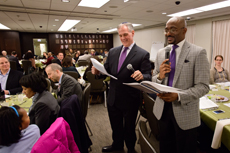
African-Americans and Jews celebrate and discuss modern plagues at JCRC Freedom Seder
MIKE GREENSTONE
Nearly 100 members of Chicago’s African-American and Jewish communities, including more than a dozen pastors and rabbis, took part in JUF’s Jewish Community Relations Council’s Freedom Seder in late March, where they discussed “modern plagues” including poverty, violence, anti-Semitism, racism and genocide.
For the second year in a row, the Passover Seder was hosted by JCRC in partnership with Rabbi Michael Siegel, of Anshe Emet Synagogue in Lakeview, and Pastor Chris Harris, of Bright Star Church in Bronzeville.
A traditional Seder asks, “Why is this night different from all other nights?” as different symbols such as matzoh, bitter herbs, and a roasted shank bone are discussed. However, attendees at the Freedom Seder experienced a mixture of traditions through the symbols of the Seder, including a traditional Passover Seder meal. Harris remarked, “While we come from different communities, on different sides of the city, events like this one build our relationships.” Siegel similarly implored attendees to “commit ourselves to build a stronger bond to go forward and fight for a new day of freedom, equality and acceptance for all people.”
Harris and his daughter, Chrystal, a music teacher, led the community in traditional African-American spirituals such as “Glory Hallelujah,” “Go Down Moses,” and “We Shall Overcome.” There was no shortage of traditional Jewish music either, as Siegel and fellow rabbis led the community in “Dayenu,” “Kol Ha’Olam Kulo (The Whole World),” and “Oseh Shalom,” as well the Hebrew blessings over the food and symbols.
Following along in the Haggadah, participants pledged to “hear and respond to those who suffer” from modern plagues. At each table, participants read statistics about global terrorism, hunger, economic inequality, among other plagues, and participants shared their thoughts on how to work together toward solutions. The Seder, supported in part by a generous grant from the Jewish Council on Public Affairs, provided an opportunity for meaningful dialogue between the African-American and Jewish communities.
While attendees grappled with difficult issues, the program demonstrated the power of our communities working together. Yvette Stone, who attended the event for the first time, said, “It was truly a privilege for us to participate in such a forward thinking project.” Pastor Torrey Barrett, Executive Director of KLEO Community Family Life Center, remarked that this event was “the start of something great…I can feel it in my soul!” Barrett’s participation in the Seder was especially meaningful, since his organization has taken groups of African-American youth to visit Israel.
Participants also heard from Safari Bahanuzi, a refugee from the Democratic Republic of Congo, who shared his story of survival, comparing it to the Jews’ exodus from Egypt. He stated, “Freedom means not having to worry and being able to do something on your own,” referring to his solo journey across several countries in Africa to find a safe place and reunite with his wife. Bahanuzi was resettled with the help of RefugeeOne, one of 10 partner agencies funded through the statewide Refugee Social Services Program administered by the Jewish United Fund, and now works for RefugeeOne as an Intensive Case Manager.
Rabbi Capers Funnye of Beth Shalom B’nai Zaken Ethiopian Hebrew Congregation said that this event is an opportunity to give “a face to Israel’s message and give a broader perspective.” Rabbi Funnye treated participants to a special blowing of the shofar by members of his congregation.
As for the future, Harris hopes that events like this are “not just once a year pleasantries, but taking it to the next level.” Siegel urged attendees rather than resting on the 50 year old history of African Americans and Jews working together, to continue that work today. Emily Sweet, Executive Director of the JCRC, remarked that “events like this Seder are what the JCRC is all about-bringing people of different backgrounds together seeking social justice.”
Harris, Siegel, and the JCRC are dedicated to strengthening these relationships and invite all community members to join in this effort.
For more information about similar programs, please call 312-357-4770 or email [email protected]. For more frequent updates, follow @ChicagoJCRC on Twitter.
Mike Greenstone is a 2014-15 Masa-Israel Action Network Fellow.
Other stories
-
Meet Andrew S. Hochberg, 2021 Julius Rosenwald Memorial Award recipient
Celebrate Andy Hochberg at the virtual Annual Meeting on Sept. 14
Read more -
Two local teens win national recognition
Recipients of the annual Diller Teen Tikkun Olam Awards
Read more -
Celebrating six young award winners cultivating the community
Introducing young adult award winners
Read more