After paths cross in Holocaust's aftermath, a Canadian family seeks answers
Hillel Kuttler
The letter sent by Veterans Affairs Canada remains lodged in the memories of Patricia Traill and her son Robert.
Patricia’s father, Marwyn Crane, a retired railway worker who had fought for Canada in World War II, opened the envelope at his Toronto-area apartment in 2001. Handwritten in English and sent from Israel, the letter inside-which the VAC had received and forwarded-mentioned Crane’s having assisted a Holocaust survivor at war’s end by giving the young man his army beret. The person writing the letter was one of the survivor’s children or grandchildren, since the survivor had since died. The family wanted to thank Crane for his kindness and to return the beret. The beret itself was not sent.
“I was in shock,” Patricia Traill said of reading the letter.
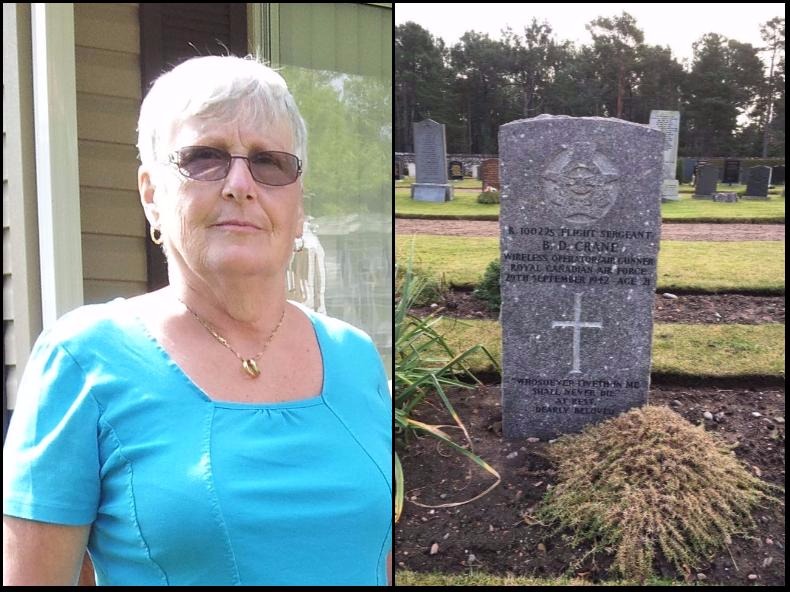
Not long afterward, Crane passed away at age 84, on Oct. 27, 2001. In his eulogy, Robert Traill evinced pride in an incident his grandfather never mentioned, just as he’d long avoided speaking about his military service. Patricia knew from her uncle, George Farrow, that Crane had fought in the Battle of Montecassino, in Sicily. Crane’s younger brother, Beverley, was an Air Force gunner killed in battle at 21 on Sept. 29, 1942, and buried in a commonwealth military cemetery in Lossiemouth, Scotland.
Patricia remembers being about eight years old and taking a drive with her father when a bird struck the windshield. Crane, “out of respect for the bird,” buried it, she said.
“We were quite touched,” she continued. “He was more comfortable with animals and kids.”
In seeking the Israeli family, Patricia wrote to The Times of Israel newspaper, which contacted me. The Traills are bursting with questions about the episode: Who was the young survivor? In what concentration camp did Crane, a private, encounter him-and was it in a concentration camp after its liberation or near one-or was it somewhere else? What did Crane do that was so crucial? What did the survivor tell his family about Crane’s role? Did Crane and the survivor even learn each other’s names?
If the correspondence survived, of course, the Traills likely would have gotten answers long ago. But when Patricia returned to Crane’s apartment the next day, the letter and envelope she’d read hours earlier were gone. Crane threw it out, she figures. While she and her son don’t remember the most crucial information, they did read in the letter that Crane’s proffered beret helped the man search for relatives who’d survived the Holocaust.
Crane’s eagerness to forget the war extended to military honors he earned. But in a visit Robert Traill and his then-wife made in the late 1990s, Crane opened up somewhat. He acknowledged fighting in Italy and then being dispatched to northern Europe.
That conversation indirectly led to the Israeli letter finding him in 2001.
“He mentioned that he was entitled to medals for his service, but didn’t receive them. I said, ‘You should get them, because it helps everybody to remember the past. To forget is a big mistake,’ ” Robert, who works in computer systems, told him.
Thus cajoled, Crane applied for his medals and soon received them. According to Crane’s VAC records, filled out upon his discharge on Dec. 14, 1945, and stamped with a bar code on Jan. 26, 1999 (perhaps the date the VAC mailed the records and medals to Crane), he earned six awards: the 1939-45 Star, the Italy Star, the France and Germany Star, the Defence Medal, the Canadian Volunteer Service Medal and the Clasp War Medal 1939-45. Patricia’s brother Bob now has them.
Crane “just left them sitting in an envelope when they came in. They were probably a reminder of what he went through,” Patricia said, adding that she “was very proud” of her father’s medals.
The Traills think that the medals didn’t arrive decades earlier because Crane didn’t provide the VAC with a current address. Born in 1917 in Raymore, Saskatchewan, Crane, a Baptist, worked as a truck driver and a miner in Flin Flon, Manitoba, when he began part-time training with the Queen’s Own Cameron Highlanders, a military reserve unit, on Nov. 22, 1940. He entered full-time service in Winnipeg on May 20, 1941, as a truck driver. From November 1941 to December 1943, by then with the Royal Canadian Army Service Corps, he was posted to England, then transferred to Allied command in Italy. He served there through Feb. 17, 1945; from then until about March 31, Crane participated in the WTO – the Western theater of operations.
Roger Sarty, a history professor at Western Laurier University, in Waterloo, Ontario, explained that Canada’s I Corps – to which Crane’s transportation unit belonged – advanced from northern Italy to France, then moved further north to join the rest of the First Canadian Army in the Netherlands.
The records “strongly suggest” that Crane “was indeed in the Netherlands and Germany in April-May 1945, and possibly some months longer,” Sarty told me by telephone.
Crane’s encounter with the Holocaust survivor, then, might have occurred at the Amersfoort concentration camp ,
which the First Canadian Army officially liberated on May 7, 1945, several weeks after the International Red Cross took responsibility for it when German soldiers fled.With Crane applying for his medals in 1999, the VAC had an address to forward the letter from the survivor’s family; it’s unknown when the VAC had received it. From what the Traills remember, the VAC matched the letter to Crane because the Israeli family provided the digits stitched or written inside the beret: H65083, Crane’s regimental ID number with the RCASC’s 10th District Depot.
A Yad Vashem spokesman told me that no one had donated the beret to the Israeli museum that commemorates the Holocaust.
Patricia called her father’s assisting the survivor “wonderful and very humane.”
“That’s my typical dad: He helped a young man who’d gone through hell.”
Hillel Kuttler is an award-winning editor/writer for companies, non-profit organizations, and many of America’s leading publications. His feature articles on history’s role in contemporary people’s lives have appeared in The New York Times, The Washington Post and The Wall Street Journal.
Other stories
-
Meet Andrew S. Hochberg, 2021 Julius Rosenwald Memorial Award recipient
Celebrate Andy Hochberg at the virtual Annual Meeting on Sept. 14
Read more -

Two local teens win national recognition
Recipients of the annual Diller Teen Tikkun Olam Awards
Read more -

Celebrating six young award winners cultivating the community
Introducing young adult award winners
Read more