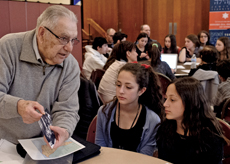
They came to share their stories, six local Holocaust survivors who wanted to ensure that their vital history would live on. In partnership with Holocaust Community Services (HCF), 44 Bernard Zell Anshe Emet Day School students met with them, eager to hear about their lives in Europe before and during the Holocaust, as well as how the experiences impacted the rest of their lives.
The students sat with rapt attention at small tables and listened to the poignant words of Leonid Spivak; Sura and Matvey Vaysman; Matux Stolov; Ida Kersz; Agnes Schwartz and Alice Fink-each group hearing the complex history of one survivor. From those old enough to remember, there were words of life before the Holocaust: “We spoke Yiddish in our home. My grandfather had a shofar and liked to make the sounds.” “My father was a tailor and could sew anything.”
And from them all, the harrowing words of life during the Holocaust: “There was no electricity, no food, anything you can find, you can keep-if you didn’t find anything, you were out of luck.” “I was 2 years old when I was put into the ghetto.” “We would cut a potato and put oil on it, and that was our light source.” “My youngest brother died from starvation at age 2 and we stopped to bury him.”
Students then heard how these unthinkable experiences influenced the remainder of their lives, bringing both uncertainty and trauma, “For 36 years, I didn’t know if any of my siblings had survived.” “When the war ended, our home and city was destroyed. There was no one left.” And, importantly, stories of resilience and hope for a new life: “In England, I trained to be a nurse.” “I met my husband at the DP camp.” “I received an engineering diploma in 1967.” “My brother helped us start a new life. Now I have five grandchildren.”
After their conversations with the survivors, the students stood in front of the entire group and conveyed the story of the survivor with whom they had met. In doing so, the students became more than listeners-they became ambassadors for this sacred history, able to share not just the story of six million, but of the individuals who lived through this tragic chapter-and to help ensure that it never happens again.
This Bernard Zell Anshe Emet Day School program was created in collaboration with JUF and is part of Dr. Jeff Ellison’s eighth grade project, The Other. Too often, individuals or groups are labeled as “the other.” The effect of this label can be disastrous for the individual or group as it may lead to ridicule, ostracism, or in its most radical and virulent form, genocide. As part of this project, students will be exploring many essential questions including why individuals, communities and nations create “the other” and exclude them from their moral universe of obligation.
Holocaust Communit Services is a collaborative effort of Jewish Child and Family Services, CJE SeniorLife, and the Jewish United Fund of Metropolitan Chicago, in partnership with HIAS Chicago.
Karen Goodman Minter is Director of Marketing and Communications for Bernard Zell Anshe Emet Day School.
To learn more, visit www.bzaeds.org.
My conversation with Ida: What an 8th grader learned from a survivor
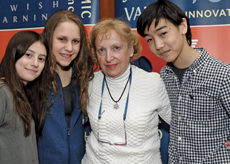
Holocaust survivor, Ida Kersz, with 8th Grade BZAEDS students Hannah Korach, Clara Aeder, and Inbo Gottlieb Fenves.
By INBO GOTTLIEB FENVES
Ida Kersz is quite different from my grandfather. I mention this because both Ida Kersz and my grandfather, Steven Fenves, are both survivors of the Holocaust. My grandfather and his family were rounded up by Hungarian Nazi collaborators and deported to Auschwitz.
Ida’s story is different. She was smuggled out of the ghetto in Sosnowiec and raised by a Polish Catholic family. Although she was herself Jewish, had been in a ghetto, and had parents who spoke out against persecution, Ida was influenced by the Nazi culture and propaganda that wanted to kill people like her and her parents. So, ironically, as a young girl, Ida herself hated Jews. Hearing this made me realize how malleable people are, especially at a young age.
Survivors have all had different experiences and tell different stories. I think it is important to pay attention to these differences. While the Holocaust changed people, it did not erase their personalities or the core of who they are.
Sometimes TV shows and movies present Holocaust survivors in ways that seem more about the idea of the Holocaust than about the actual individuals who survived it. Instead of people with very different characters and interests, we see a type: someone who is brooding, quiet-spoken, and sad.
While I think it is important to recognize and remember the awful history of the Holocaust, it is equally important to remember that the survivors are also individuals with unique personalities who have been affected differently by what they went through. For example, as an adult, my grandfather avoided Hungary and disliked speaking Hungarian, while his sister enjoyed traveling there and speaking the language.
I loved speaking with Ida and learned a lot. Besides the obvious things you would draw from meeting with someone who has been through so much—be grateful for what you have and speak out against injustice (you’d have to be pretty apathetic in order to not think about these things when meeting with a survivor)—I think I learned a lot about how humans cope with both grief and the pressures around them.
Ida saw her mother commit suicide, lost her family and everything she knew, and lived with an abusive Catholic step-grandfather. Yet when I met her, she shared not only her experiences of the Holocaust, but also a number of fun and happy memories. In our conversation, I learned some of the details of her life, but I also started to get to know her through her laughter and her humor. Her story also made me think about how people who are good at heart can be easily influenced by the people and culture around them.
Inbo Gottlieb Fenves is an 8th grader at Bernard Zell Anshe Emet Day School.