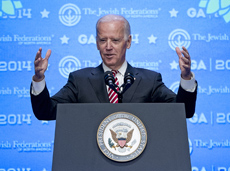
There was the vice president of the United States, two Supreme Court justices, and an Academy Award-winning actress with a compelling Jewish story. There were Jewish professionals, lay leaders, clergy and recent college graduates. The West Point cadets’ Jewish choir performed. The Israeli prime minister appeared via satellite from Jerusalem.
Part pep rally, part training and part family reunion, this week’s annual General Assembly (GA) of the Jewish Federations of North America drew some 3,000 people to a conference center outside Washington, National Harbor, Md., to cheer federations’ philanthropic work, listen to presentations ranging from European anti-Semitism to crowdfunding, and to schmooze.
As usual, much of the talk at the General Assembly was how to bolster North America’s 153 Jewish federations.
“We can go beyond exchanging ideas to actually exchanging services,” Jewish Federations CEO Jerry Silverman said in a speech at the closing plenary. “JFNA expanded the resources of our consulting and community development department, but what if we also leverage and share the resident expertise in this room and across our federations?”
The federation movement faces an uphill battle at a time when studies show younger American Jews are less affiliated than previous generations with Jewish institutional life and less likely to give to Jewish causes. Last year’s Pew Research Center survey of U.S. Jews found that 43 percent of non-Orthodox Jews ages 30-49 donate to Jewish causes — in contrast to their counterparts ages 50–69, some 60 percent of whom give Jewishly.
At the conference, the answer to these trends was twofold. One, organizers showcased dozens of federation programs that are piloting new models for programming and outreach. Billed by organizers as “fedovations” — a mashup of the words “federation” and “innovation”—they included case studies in reaching younger donors, providing services to the elderly, planning profitable events, and finding ways to engage and excite unaffiliated community members. Jewish Federations plans to share these success stories in a federation-wide online database to be deployed in the coming weeks.
The second answer was for federation leaders—and some of the plenary speakers from outside federation, including the actress Marlee Matlin—to drive home the message of the importance of collective action in the Jewish world.
“We do have the intellectual and financial potential to effectuate substantive change, but only if we work together,” Jewish Federations board chairman Michael Siegal said in a plenary address at the conference. “Federations must lead this charge and convene the necessary organizations and thought leaders because, simply, we have the reach that others do not.”
Vice President Joe Biden affirmed the Obama administration’s “ironclad” commitment to Israel’s security and talked about his experience taking each of his kids to the site of the Dachau concentration camp when they were 15 to teach them about the “incredible resilience and indomitable nature of the human spirit.”
Biden also called Israeli Prime Minister Benjamin Netanyahu a “really great friend.” Netanyahu, speaking to the assembly at the conference by video link, focused on Iran.
“Iran is not part of the solution, it’s a huge part of the problem,” Netanyahu said, referring to reports that the United States may be coordinating with Iran in their shared battle to crush the ISIS jihadist group in Iraq and Syria. “The Islamic state of Iran is not a partner of America, it is an enemy of America and it should be treated as an enemy.”
Natan Sharansky, the chairman of the Jewish Agency for Israel and the most famous Soviet refusnik, helped close out the GA with rousing remarks.
In another plenary, NPR correspondent Nina Totenberg got U.S. Supreme Court Justice Stephen Breyer to discuss the Jewish values that drive his work (tzedakah) and Justice Elena Kagan, who grew up Jewish on the Upper West Side, to reveal that she has become a duck hunter since joining the nation’s highest court.
Rabbi Jonathan Sacks, Britain’s former chief rabbi, gave a rousing plenary address about the importance of Jews’ commitment to each other despite their differences.
“I don’t need you to agree with each other; I need you to care about one another,” he said.
For the first time, the American Jewish Press Association’s annual meeting was merged with the GA. Seventy journalists in Jewish media attended both the GA and a separate track of editorial and business sessions during the two days of the larger conference. The journalism meeting included sessions on Jewish ethics in journalism, a discussion on the role of Jewish newspapers in today’s world, and the Israel and Palestinian conflict featuring remarks by the Washington Institute’s David Makovsky, a former advisor to Sec. of State John Kerry.
Journalists also attended the 33rd Annual Simon Rockower Awards for Excellent in Jewish Journalism, where Chicago’s JUF News/Communications department won first place in the large circulation category for Outstanding Digital Outreach on “Double Chai in the Chi: 36 Under 36.”
The Windy City goes to Washington
Some 40 Chicagoans, both professional and lay leaders in the Jewish community, traveled to the GA, where Chicagoans sat on many panels at conference breakout sessions.
”The GA, as always, provided a special opportunity to help advance the critical work done by our national federation system, a place where Chicago often takes the lead. It was also wonderful to spend time with our fellow Chicagoans and to renew our ties with friends from around the country,” said Andrea and Alan Solow, the Chicago GA chairs.
Dr. Rebecca Schorsch, director of Jewish Studies at Chicagoland Jewish High School in Deerfield, was one of three recipients honored with The Covenant Foundation’s 2014 Covenant Award, and recognized at the GA’s 2014 Covenant Awards Gala. At CJHS, Schorsch oversaw the merger of the school’s Bible, Talmud, and Jewish Thought departments. “Every day I feel blessed to do what I love, something at once meaningful and critical to building the world that we wish to inhabit,” she said.
The Covenant Foundation is a program of the Crown Family Philanthropies and members of the Crown family—including Keating Crown, Renée Crown, and Lester Crown—presented the award to the three recipients, Schorsch, Alison Kur, of Wellesley, Mass., and Rabbi Yisroel Boruch Sufrin, of Beverly Hills, Calif.. Each of the 2014 recipients received $36,000, and each of their institutions, $5,000.
Rabbi Jordan Bendat-Appell, of Chicago, was also one of five people to receive The Covenant Foundation’s 2014 Pomegranate Prize honoring emerging Jewish educators. Bendat-Appell is co-founder and director of the Center for Jewish Mindfulness in Chicago and co-founder of Orot: Center for New Jewish Learning in Chicago.
Jimmy Sarnoff and David Goldenberg (not in attendance at the GA) — who received the 50th annual Davis, Gidwitz, and Glasser Young Leadership Award at the Chicago Federation’s Annual Meeting in September for demonstrating exemplary dedication to the Chicago Jewish community — were honored alongside other young leaders at the National Young Leadership Award’s Reception.
“Where else can you impact virtually every corner and facet of Jewish life? Where else can you collectively build and strengthen our community? Where else can you have so many diverse experiences like me, yet a common thread and contributor throughout?” Goldenberg said in his acceptance speech. “ …JUF’s commitment to building a Jewish community is second to none.”
“It was such an honor to be recognized along with all of the other young leadership award winners throughout the country,” Sarnoff said about the GA reception. “I left Washington D.C. inspired by the amazing impact that our generation is having on the future of our people.”
Visit here for more on the JFNA General Assembly.
Cindy Sher contributed to this report.
Other stories
-
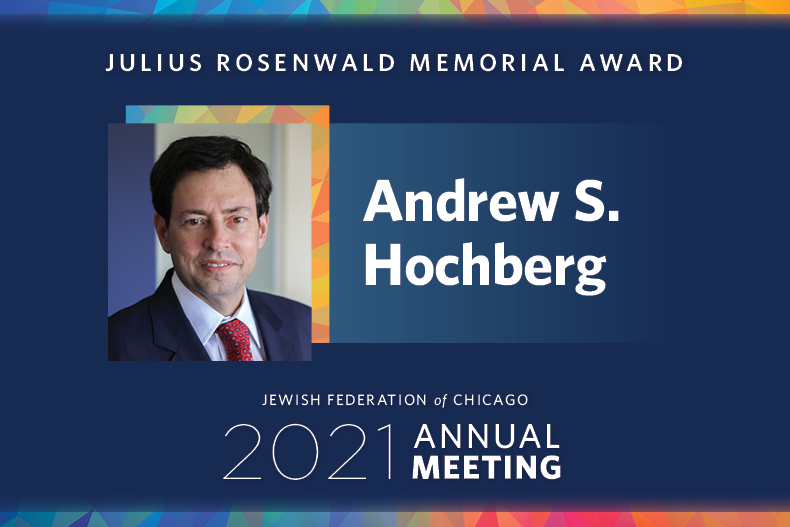
Meet Andrew S. Hochberg, 2021 Julius Rosenwald Memorial Award recipient
Celebrate Andy Hochberg at the virtual Annual Meeting on Sept. 14
Read more -
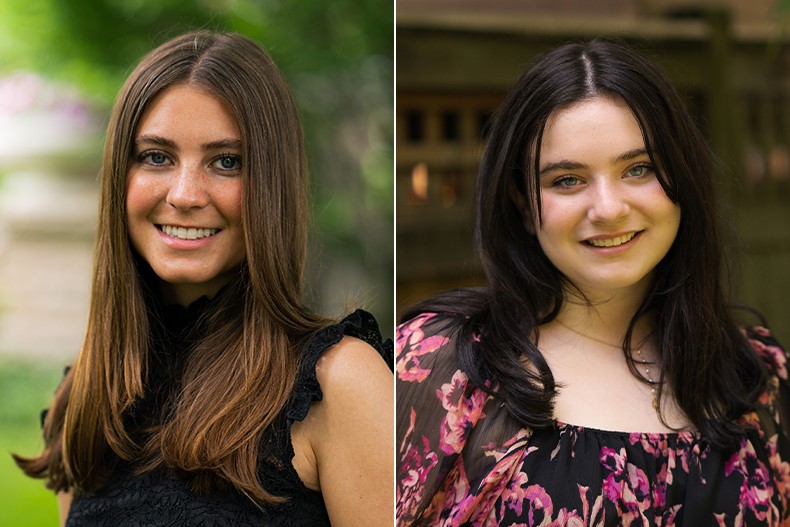
Two local teens win national recognition
Recipients of the annual Diller Teen Tikkun Olam Awards
Read more -
Celebrating six young award winners cultivating the community
Introducing young adult award winners
Read more