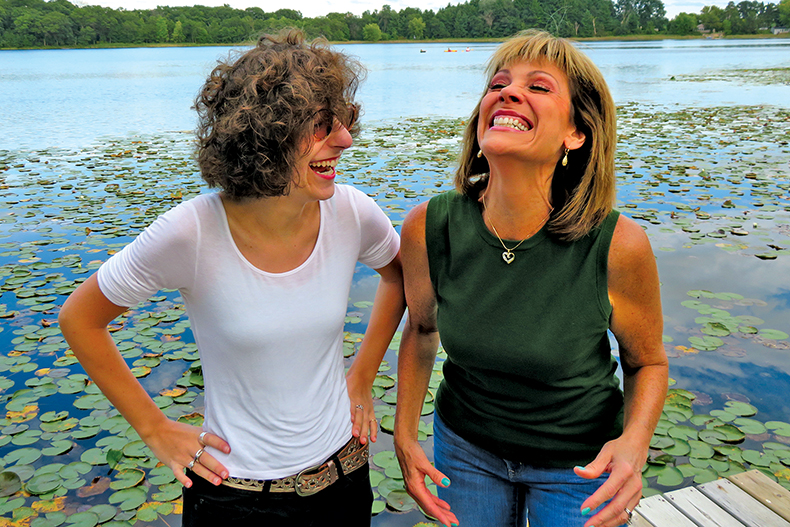
I didn’t need a doctor to tell me something was terribly wrong.
It was the summer of 2006. My husband, 10-year-old daughter, and I had just begun a dream vacation in Greece. I found the lump, under my arm while in the shower. It was a surreal moment-your gut tells you it’s a tumor, yet you pray with all your might it’s anything but. We tried to make the most of our vacation, deciding to see the doctor first thing when we got home.
That week was a blur-from bad news to worse, to the unthinkable. By the end of the week, tests showed I had Stage IV metastatic breast cancer. I was too emotional to go back to work. I prepared a statement the ABC7 morning team read on the air, letting viewers know I was going to fight this disease like a true warrior, promising a quick return!
Getting over the shock of the initial diagnosis is the first hurdle. The most challenging part of dealing with breast cancer was not the chemo, not thoughts of my mortality, but thoughts of my 10-year-old daughter growing up without a mother. It gave me a strength I didn’t know existed to fight the good fight.
Sara is my only child; we’ve always had a special mother-daughter bond. Once my cancer treatments started showing positive results, I started reprioritizing. I hadn’t had a bat mitzvah as a teen-it was something I always wanted to do as an adult, but never seemed to have the time. Now I would MAKE the time! And what better time than 2 years before Sara’s bat mitzvah?! I approached Sara first, to see how she’d feel about a “double!” I didn’t want to take away from her special day. Her response, “I think that would be great, Mom! I know it’s something you’ve always wanted to do, and besides, if I get nervous on the bima (pulpit) and forget something, you’ll be there to help!” I love that kid to the moon and back!
Next step, actually seeing if I could learn everything in two years, from the Aleph Bet to the Haftarah. I met with Rabbi Gary Gerson at Oak Park Temple, who had no doubt I could pull it off! He set me up with congregation member Berit Engen for Hebrew studies and that was the start of reconnecting with my Jewish faith.
I met with Berit once a week for two years, learning to read Hebrew, sing prayers, and chant Torah. The feeling I had during those study sessions was therapeutic. I was so focused on not just learning, but understanding the meaning behind my faith, it put me in a safe space-free of cancer worries. I continued treatment during my studies. Call it what you will, but seven months after diagnosis all tumors were gone; I was in total remission.
On Oct. 11, 2008, Sara and I became B’not Mitzvah, with a lovely ceremony surrounded by family and friends. I was so overcome with emotion, the Rabbi’s joked that I used up all the Kleenex on the bima, and hopefully someone in the congregation had more!
Being a part of the congregation felt like home to me. I wanted to participate more. I joined the amateur choir. Sara and I went to Israel with members of our synagogue several years later. When Rabbi Gerson retired, Sara and I joined synagogue members on a trip organized by our new Rabbi, Max Weiss touring the “Jewish Deep South!”
When I had a new bout of Stage Zero breast cancer in fall of 2013, it was Rabbi Weiss who reached out to me (through Facebook, of all places) offering along with Cantor Julie Yugend-Green to pray for my health on the bima in front of the opened Ark. It was overwhelming, yet comforting.
After a lumpectomy, followed by radiation, I was once again in full remission.
The reconnection with my Jewish community has become a strong part of my identity. While breast cancer is still a part of my life, it does not define me. It’s more of a blessing in disguise.
Roz Varon, a 2006 breast cancer survivor, is an Emmy Award-winning Traffic/Transportation Anchor at ABC7 Chicago, and the first TV traffic anchor in the country to bring rush hour traffic reporting to the morning news.
October is Breast Cancer Awareness Month
The statistics are sobering: In 2016, about 300,000 women in the United States will receive a breast cancer diagnosis. About 1 in 8 Jewish women will receive a breast cancer diagnosis at some point in her lifetime. While the overall breast cancer risk for Jewish women is about the same as the general population, about 1 in 40 Ashkenazi Jewish women carry a BRCA1 or BRCA2 mutation, a rate more than 10 times higher than in the general population. These mutations place them at higher risk for certain hereditary forms of breast cancer (as well as other cancers). Women with those forms of breast cancer may face diagnosis at an earlier age, and a more aggressive form of the disease.
Jewish women seeking support-as a person at-risk, as a current patient, or as a breast cancer survivor-have many resources they can draw upon.
Here in Chicago, the Norton & Elaine Sarnoff Center for Jewish Genetics (formerly the Center for Jewish Genetics) offers educational programming and other resources to educate the Jewish community about the risks associated with the BRCA mutations. The Center also provides community members with access to a genetic counselor who can answer general questions about cancer risk and help community members identify resources for counseling and clinical care. The Norton & Elaine Sarnoff Center is supporting foundation of JUF. (www.jewishgenetics.org)
Nationally, Sharsheret (Hebrew for “chain”) offers a wealth of resources and access to a wide spectrum of support resources for Jewish women with breast or ovarian cancer, as well as their families and caregivers. Sharesheret specializes in providing culturally-appropriate support services to persons of all Jewish backgrounds, and includes a peer support volunteer network with strong representation in Illinois. (www.sharsheret.org)
Bright Pink focuses on early detection of breast and ovarian cancer in young women. While not an explicitly Jewish organization, Bright Pink particularly targets young women in high-risk groups such as those with BRCA1 and BRCA2 mutations. Bright Pink also has strong ties to the Chicago Jewish community through its founder, breast cancer survivor Lindsay Avner. Bright Pink offers a wealth of risk assessment and educational resources, and supports both one-on-one and peer support options in Illinois and around the country. (www.brightpink.org)
Not Just a Women’s Issue
Breast cancer is not a Jewish women’s issue; it is a Jewish community issue. While we often think of Jewish men and breast cancer in the context of caregivers and partners, that doesn’t tell the whole story. While male breast cancer is rare, the risk is somewhat higher for BRCA1 carriers and substantially higher for BRCA2 carriers. Ashkenazi Jewish men, particularly those with a family history of breast or ovarian cancer, should consider taking action to learn more about their risks. More information about BRCA and men is available both through the Norton & Elaine Sarnoff Center for Jewish Genetics and through Sharsheret.
Other stories
-
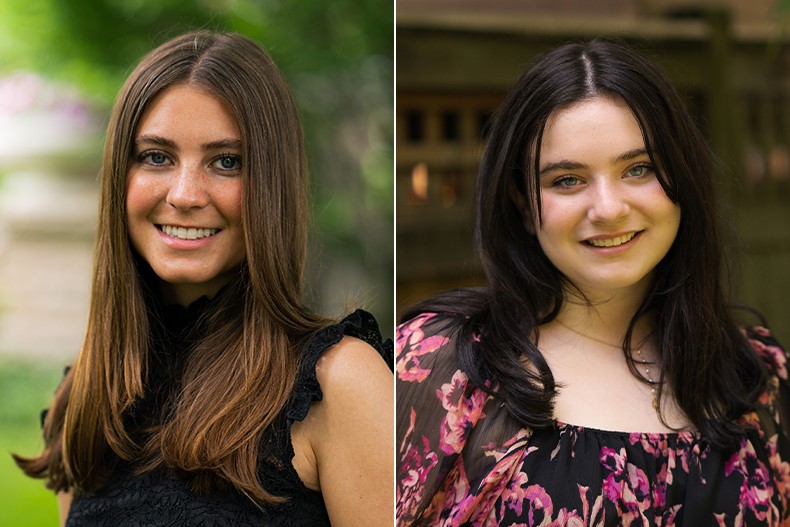
Two local teens win national recognition
Recipients of the annual Diller Teen Tikkun Olam Awards
Read more -
Celebrating six young award winners cultivating the community
Introducing young adult award winners
Read more -