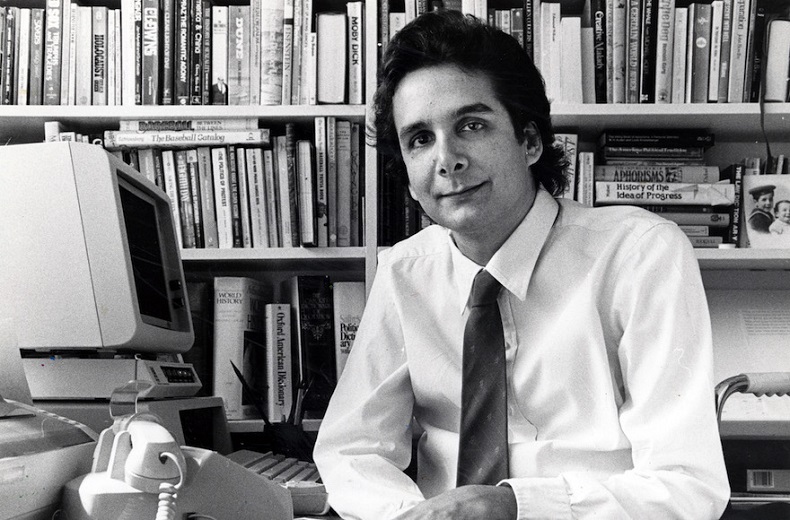
Charles Krauthammer, Jewish neoconservative and Pulitzer Prize-winning columnist, dies at 68
Cindy Sher
When Charles Krauthammer announced a couple weeks ago that he didn’t have much time left to live, I dug up an old interview I’d done with him, in advance of his appearance at a JUF Trade dinner in 2007.
A longtime commentator and Pulitzer Prize-winning columnist, later known for his neoconservative ideals, Krauthammer died of cancer on June 21 at age 68.
He started his professional career as a psychiatrist. His scientific papers, including his co-discovery of a form of bipolar illness, are often cited in psychiatric literature. During his freshman year at Harvard Medical School, in 1972, he was paralyzed in a diving accident, but he still managed to graduate on time with his class.
Several years later, Krauthammer quit his medical practice and came to Washington, D.C., to direct planning in psychiatric research for the Carter administration and, later, he became a speechwriter for Vice President Walter Mondale. After working for the Carter administration, he switched political parties and became a neoconservative, an identity he would be known for the rest of his life.
In 1981, he joined the staff of The New Republic , where he was an essayist and editor, and then in the mid-80s began writing a monthly column for Time magazine and a weekly syndicated column for The Washington Post . He also contributed regularly to Fox News , is a weekly panelist on Inside Washington, a contributing editor to The New Republic and The Weekly Standard .
He published Things that Matter: Three Decades of Passions, Pastimes, and Politics , the 2013 collection of his essays, which stayed on the New York Times bestsellers list for 38 weeks.
He is survived by Robyn, his wife of more than 40 years, and their adult son, Daniel.
In our 2007 phone interview, Krauthammer shed light on how his Jewish identity colored his worldview, switching political parties, and “Krauthammer’s Law.”
JUF News: How does your own Jewish identity affect your worldview?
Charles Krauthammer: It’s impossible to be raised and identify Jewish without having a tragic sense of history. That means being constantly aware of the contingencies and dangers. American Jews have lived a very sheltered and blessed life in this country, which is totally unique not only in the world but in history-my generation certainly has. Being steeped in Jewish history carries the knowledge that history-not just Jewish history, but history in general-is tragic and the unimaginable is possible.
What was your Jewish upbringing like in Montreal?
I was raised in a Modern Orthodox home. I went to Hebrew day school right through the end of high school. By the time I graduated, I was fairly fluent in Hebrew and quite conversant in Jewish history, literature, liturgy, and sacred text as well.
Have you tried to impart that same strong sense of Jewish identity to your son?
My father once said to me when I was growing up, “I don’t demand or even ask that you be observant the way I am when you grow up. But if you’re ignorant, you’ll never know who you are, so the one thing I do demand, in which you have no choice, is that you learn.” My son did not get the same kind of education I did-more after-school than day-school Jewish education-but he grew up in a Jewish home with a good awareness of his identity.
I read a column in which you write about “Krauthammer’s Law,” which states that “everyone is Jewish until proven otherwise.” What did you mean by that?
It was half tongue-in-cheek. I wrote it when [former Virginia governor] George Allen discovered he was Jewish, and this was after John Kerry discovered a couple of Jewish grandparents. Even Hillary Clinton found somebody and Madeleine Albright [revealed that] her family was Jewish, and Wesley Clark, too. It’s quite fascinating that so many people of distinction either are Jewish or have Jewish origin. It does [speak to] the incredible cultural accomplishments of Jews ever since they left the ghetto during the dawn of the Enlightenment. Within a few generations, they made an impact on Western culture that is amazingly out of proportion to their numbers-that’s a known historical fact. Many people, including Winston Churchill, among others, have wondered about it.
The other more tragic part of what I wrote in the column is that during the same period of Jewish accomplishment, there was also the rise of modern anti-Semitism. During the Holocaust and many other persecutions, so many Jewish people have had to either hide their identity, consciously or even unconsciously, and some of them hid it even from their children. So, what you have is this phenomenon of people who have grown up in the public eye very accomplished, who discovered late in life their Jewish origins-not only because of a great expression of excellence that you see among Jews ever since they left the ghetto, but also because of the need to conceal.
You talk a lot about this tragic sense of Jewish history. There is so much hatred toward the United States and Israel. Do you think that ultimately the light will vanquish the dark?
There is hope for Israel. I think we will not live to see the light vanquishing the dark, but we can spend our lives doing our best to try to keep the darkness at bay. In many ways, in trying to protect America and advance American interest, which is the interest of freedom in the world, there are a lot of darknesses to be kept at bay. The same is true with the people who believe not just in the justification, but in the glory of the Zionist ideal and of a Jewish state and have watched how its enemies have worked against it for so many decades. The good things in life and the good things in history require great vigilance to be protected and defended-they don’t just defend themselves. When I talk about the tragic sense of history and the sense of how there is evil in the world, it’s very powerful. It arises in different shapes and forms and ideologies in different generations. It is always a constant in human history and it has to be recognized and it has to be fought. It will not go away on its own in the same way that good and right is not self-defending.
After your diving accident, what gave you the strength to persevere?
When something like that happens, you have two choices, and only one of them makes sense-I took the only road I could take. I don’t make a big deal out of it or talk about it a lot. The fact is that I was going to give up or I was going to continue my life and I decided to continue my life, so I stayed in my class and finished medical school. It seemed like the only thing to do.
Why did you switch political parties?
My short answer is I was young once. Winston Churchill [is reputed to have] said something like “To be young and not a Democrat you haven’t a heart. To be old and not a Republican, you haven’t a brain.” I started out as a “Great Society liberal.” Great Society liberals were always pretty tough on foreign policy… The fact is that the Democratic Party has no room for that kind of national security hawk [anymore]… That whole tradition has died out. People have to choose because the Democrats went a different direction in foreign policy. That’s when I tended to move away from the Democrats. I was always a hawk on foreign policy, particularly during the Cold War era. I watched the Democratic Party drift away from that and Ronald Reagan pick up the banner and that helped to make my transition.
Do you ever miss psychiatry?
No-I like what I do. It’s a lot of fun. The issues that I deal with and the policies that I’m I trying to influence are very important. I have a lot of respect for psychiatry and for psychiatrists and for my former colleagues, but it’s not what I was meant to do.
Who do you admire most and why?
Politically, my great hero is Winston Churchill. He helped save civilization in the 20th century and I don’t think that’s an exaggeration. He also liked living life in the full as a young man, as a politician, and-later in life-as a great writer. No one lived a fuller life than he did.
Other stories
-

Two local teens win national recognition
Recipients of the annual Diller Teen Tikkun Olam Awards
Read more -

Celebrating six young award winners cultivating the community
Introducing young adult award winners
Read more -