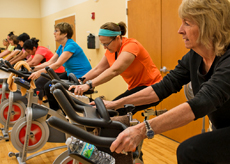
Does working out with other Jews keep you Jewish? The role of JCC fitness centers
MAAYAN JAFFE
For Daphna Krupp, her daily workout (excluding Shabbat) at the Jewish Community Center of Greater Baltimore has become somewhat of a ritual. She not only attends fitness classes but also engages with the instructors and plugs the J’s social programs on her personal Facebook page.
“It’s the gym and the environment,” says Krupp. “It’s a great social network.”
Krupp, who lives in Maryland, is one of an estimated 1 million American Jewish members of more than 300 Js around the country. Each J-in line with the bylaws of their umbrella organization, the JCC Association of North America (JCCA)-has a fitness center that serves as one of its core businesses. Often, the fitness center can be perceived as a for-profit enterprise of the J, with thousands of dollars invested annually in facility maintenance and gym advertising.
But Steve Becker, vice president of health and wellness at the JCCA, says that is a myth. “JCCs are not fitness centers, we are engagement centers,” he tells JNS.org . “All fitness-related programs are structured to be relationship-building activities.”
The institution of the J was founded in 1854 as the Young Men’s Hebrew Association (YMHA), to provide help for Jewish immigrants. A Young Women’s Hebrew Association was first established as an annex to the YMHA in New York in 1888. The first independent YWHA was set up in 1902. In 1917, these organizations were combined into a Jewish Welfare Board, and were later renamed Jewish Community Centers.
“After World War I, the Jewish Welfare Board morphed into an organization to meet the cultural, intellectual, physical and spiritual needs of the Jewish community,” says JCCA Communications Manager Marla Cohen, noting that physical needs were always part of the equation.
The much-debated 2013 Pew Research Center study of the American Jewish community found that a strong majority of Jews (62 percent) say being Jewish is mainly a matter of ancestry and culture, rather than religion. The study showed a decline in non-Orthodox individuals involved with the organized Jewish community. As such, Jewish communal leaders-from award-winning author and lecturer Dr. Erica Brown to Jewish Agency for Israel President and CEO of International Development Misha Galperin-have been calling for increased “low-barrier, high-content” programming to meet Jews where they are. This, says Cohen, is a niche the J can fill.
“For some people, aside from High Holiday attendance, working out at the J is probably the only flavor of Judaism they have. The J could be a very big part of these people’s Jewish identity,” Krupp says of some of the members she has met in the gym.
“These individuals are not choosing between the JCC and synagogue. They are choosing between everything else-the mall, soccer, snowboarding, you name it-and the J,” says Cohen.
Statistics support Cohen’s assertion. According to a 2013 JCCA benchmarking survey of JCC members across the country, 62 percent say JCCs have helped them develop a broader perspective of the Jewish community, 54 percent say the JCC has helped them develop a greater appreciation for Jewish values, and 60 percent say JCC membership has led to them to feel a deeper connection to their Jewish identity.
Krupp sees the J as a community-building tool. “I think when you work out together, you realize you are more alike than different. We are all dealing with the same struggles-to get there on time, to deal with snow days, with our eating, our weight, our children. It brings the community together,” she says.
Working out is a Jewish principle, Becker says, referencing the Jewish value of shmirat ha’guf , sustaining one’s body.
The representatives of JCC Chicago concur. “There’s no question that taking care of one’s body is a core Jewish principle, and that is one of the most important reasons that fitness and wellness are central to JCCs,” said Todd Braman, assistant general director and Chief Operating Officer of JCC Chicago. “But we can’t overlook the potential a fitness center has to bring large numbers of new people through the doors of a JCC who will then attend a JCC holiday celebration, a cultural arts event, or send their children to our preschools and camps. There are very few places where Jews of all ages and denominations come together several times a week. Fitness is a key piece of why this happens at a JCC.”
Other stories
-
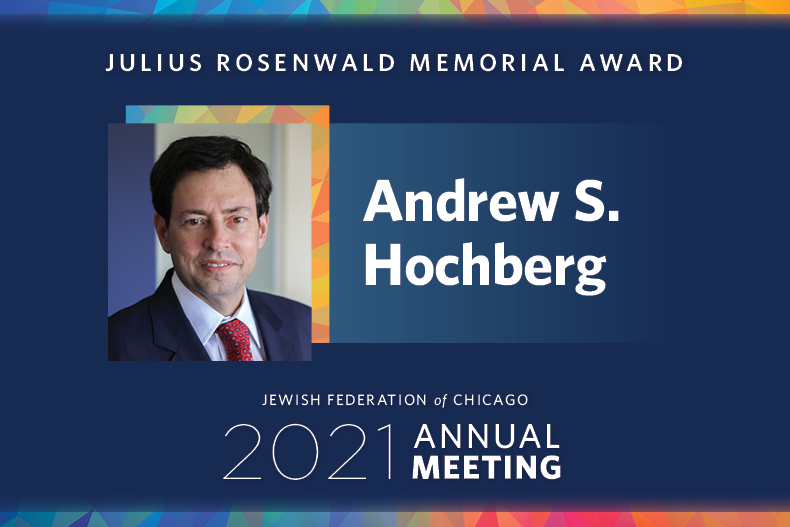
Meet Andrew S. Hochberg, 2021 Julius Rosenwald Memorial Award recipient
Celebrate Andy Hochberg at the virtual Annual Meeting on Sept. 14
Read more -
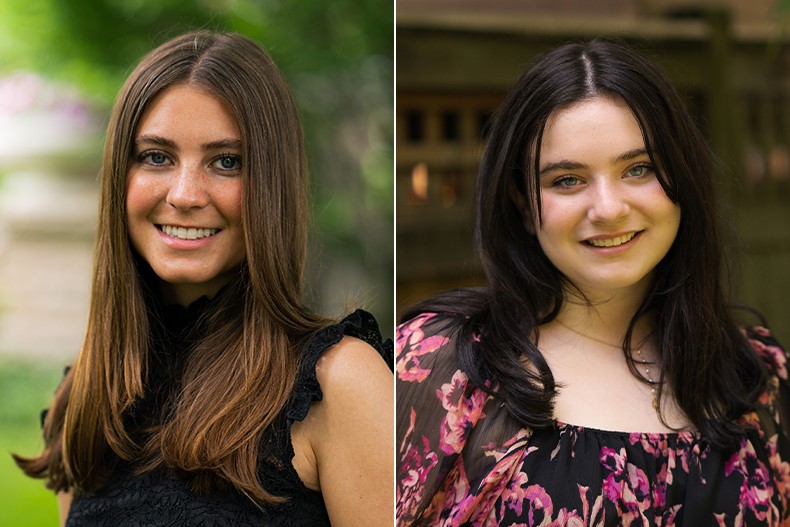
Two local teens win national recognition
Recipients of the annual Diller Teen Tikkun Olam Awards
Read more -
Celebrating six young award winners cultivating the community
Introducing young adult award winners
Read more