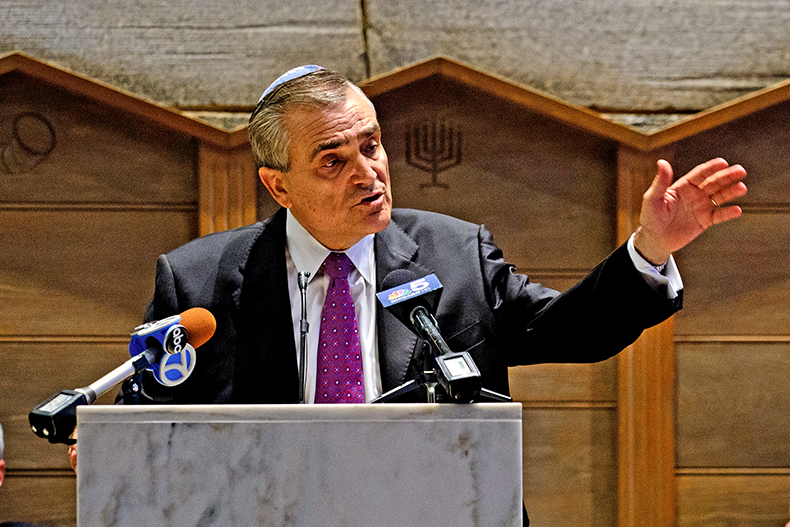
As Jewish Chicago celebrates Steve’s 40-year tenure as President of the Jewish United Fund/Jewish Federation of Chicago, JUF News took the opportunity to speak with Steve about some of the extraordinary moments in modern Jewish history to which he has born witness-and in which he often played a pivotal role.
In the 1980s and 1990s, Steve played a critical part in galvanizing Chicago’s Jewish community-and federations nationwide-in the fight to free Soviet Jewry. He believes this was a defining moment for the U.S. Jewish community, which he holds as one of the highlights of his life’s work:
I remember Freedom Sunday, that day in November 1987, when hundreds of thousands of us rallied on the National Mall to demand freedom for Soviet Jews. Gorbachev was meeting with Reagan. It was an extraordinary moment of peoplehood; of solidarity. Then, of course, the gates came swinging open, followed by the Operation Exodus program and the resettlement of more than a million Jews in Israel, which really transformed Israeli society. And we resettled over 30,000 in Chicago, which was an extraordinary thing.
This is perhaps the most significant event since the establishment of the State of Israel. For 20 years or more, we’ve been talking about freeing Soviet Jewry and moving Soviet Jewry, and suddenly the opportunity really is now.
None of us who were participants in that were heroes; we had a U.S. passport. We could leave any time we wanted. The heroes were the people we visited-God, they were such heroes!-Slepak and Lerner and Yosef Begun and Ida Nudel, the Sharanskys, and many more. These were the former Jews of silence taking on the mighty and evil empire.
If you don’t think we’re an eternal people, take a half a step back and think about this period of 50 years and what was achieved!
Steve also was a key architect of Operation Moses in 1984, which rescued 8,000 Ethiopian Jews to Israel, and of Operation Solomon in 1991, the dramatic aliyah of some 14,000 Ethiopian Jews in 18 hours. His first fact-finding mission to Ethiopia was eye-opening:
We’re in Gondar and we go to our first village. And they had a Torah and they were very proud of that Torah. I go to look at the Torah and I glance and-of course-it’s exactly at the point that I left off [in shul] three days ago. That was my first kind of “aha” moment. It grabbed me in a pretty significant, visceral way: These really are our brothers and sisters.
And in one such village, I had my second “aha” moment. A young man came up to me and spoke in English, good English actually. After the introductions, he very quickly asked me: “Is it safe for me to go?” So I’m in Gondar, and this-I don’t know, 20-year-old person, maybe?-is asking me a question and my answer, actually, may make a difference in terms of the life and death of this individual. I never had had a moment like that, ever. It was kind of searing in terms of the importance of the work that we all do. We say we’re all brothers and sisters and Klal Yisrael Arevim Zeh b’Zeh , but there’s true reality to it. In this case, it was very personal.
Throughout his 40-year tenure, Steve has been driven by an unwavering belief that the American Jewish community must remain committed to collective responsibility-and that the Jewish Federation system at its best is the ultimate vehicle for collective action:
Chicago by itself doesn’t make a Soviet Jewry Movement. Chicago by itself doesn’t move 120,000 Ethiopian Jews. We have to do that with all of Israel. This Federation has to be that table where all Jews feel comfortable-Reform, Orthodox, right wing, left wing, in the middle-we all must be a part of this. If we, God forbid, were to lose a piece of that big table, we’d be losing a lot. It’s important to have that kind of diversity, that kind of engagement together. So I’d like to think that that concept of collective activity, of doing things together, of doing on behalf of a collective, is deeply rooted in the Chicago experience.
An ardent Zionist, Steve believes the identity and destiny of the Jewish people worldwide is inextricably linked to Israel-and he strives to ensure that younger generations do not take Israel for granted:
I never get over the wonder of having a Jewish country, the Land of Israel-and what an extraordinary place it is. What a source of pride, in terms of the achievements that they’ve made-and made while grappling with challenges that no country in the world really has faced, much less with the sense of democracy and ethics that Israel has.
I also understand that for people of generations behind me, who have never known a time where there wasn’t an Israel, that maybe to a certain extent, Israel is taken for granted. I think it’s very, very dangerous to ever take the existence of Israel for granted. Very, very dangerous. And I think it’s incumbent upon us to teach our children that it’s okay to disagree-you know, you don’t have to be in agreement on everything; are you in agreement with everything that our government does? Of course not. And that’s why it’s a democracy and there’s a free flow of ideas-but don’t take it for granted. And do understand how unique and privileged we are to live at this time and how important it is for the future of the Jewish people for Israel to always be strong and secure. I think those are key lessons and that’s why we do spend all this time, effort, and money in helping young people get to Israel at an early age.
Looking to the future, Steve is excited about the opportunities that lie at the intersection of Jewish life and American life:
This concept of normative American activities, as being a vehicle for holding tight to our Jewish particularism, is an important one. I think in America, it’s normative for children to go to preschool before they begin formal education. So, for the Jewish community, how do we make sure that preschool is a Jewish preschool? I think it’s normative in America for young people to go to day camp and overnight camp; so okay, then the community has to help make that experience a Jewish experience. Go to Jewish day camp. Go to Jewish overnight camp.
It’s normative to study a language. Spanish and French and German and Chinese, they’re all wonderful languages and they should be studied. Hebrew is a really good language, too. And we need to do more in terms of the study of Hebrew language.
It’s normative for kids in college during break to go off with each other to exotic places. The Birthright concept is genius in terms of taking that period of time and making sure that that place that they go to is the land of Israel.
Throughout his tenure, Nasatir has pioneered outreach opportunities that meet community members where they are, literally and figuratively, to engage them in Jewish life and strengthen Jewish identity in the Next Generation:
Our engagement platform starts when the baby is born and JUF reaches out through JBaby Chicago, really welcoming in the young couple into a Jewish community. I’m proud of our PJ Library program, which is a national program, and I’m delighted to say we’re the largest in the country. The JUF Right Start program that offers gift vouchers for Jewish preschool, the Ta’am Israel program that sends 8th-graders on peer trips to Israel-these are pioneering outreach efforts.
Our 19 Jewish Day Schools play a key role, as do our informal education programs-Birthright and MASA and Onward Israel and Jewish day camp and Jewish overnight camp.
We’re a unique Federation, in that we are responsible for the Hillels of Illinois. Those are our buildings. Those are our professional colleagues that run them. We thought that Jewish life on college campus was so important that we wanted to be fully in control of doing all that we could do to make that fulfilling. The new concept of Base Hillel, of people coming together with rabbinic leadership to engage Jewish life-to come to a welcoming house for Shabbat and learning and studying-we’ve had great success with all of these engagement concepts and many more. We’re going to be doing even more in these areas.
We needed to shift our thinking so the issue isn’t what do we have to do in order for the young person to do something Jewish? It should be just the opposite. That Jewish life is so rich, so open, that why wouldn’t every Jewish child take advantage of these extraordinary opportunities?
At a time when some Jews lament the challenges of change, Steve Nasatir is optimistic. He continues to see America as a land of opportunity for Jewish renaissance:
You can tell from the way I’m talking, I continue to be really excited about outreach to the next generation because I think this is the future. It’ll be different, but it’ll be good. It’s going to be very good. If we fulfill our obligations and responsibilities now, there will continue to be a vibrant, strong, and engaging Jewish community in Chicago.
Other stories
-
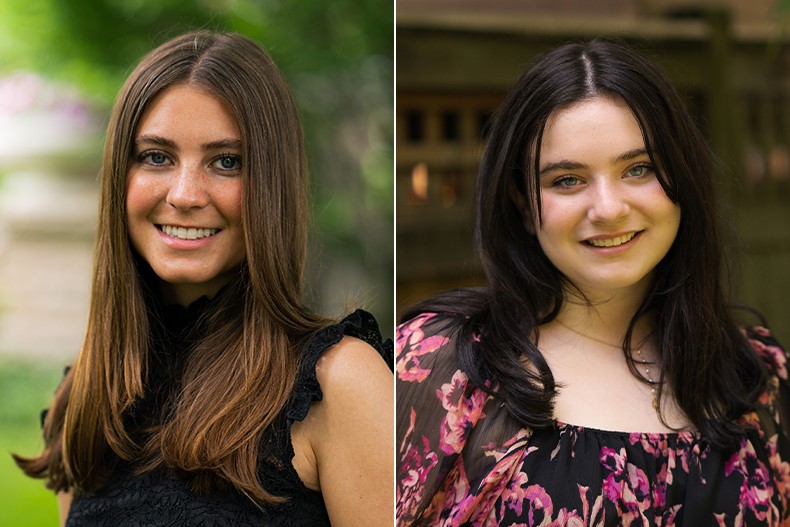
Two local teens win national recognition
Recipients of the annual Diller Teen Tikkun Olam Awards
Read more -

Celebrating six young award winners cultivating the community
Introducing young adult award winners
Read more -