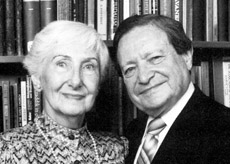
World War II refugee. Reform camping advocate. Interfaith pioneer. Confidante of Cardinal Joseph Bernardin. One of Edgewater’s Living Treasures. Great-grandfather.
From his traditional Jewish upbringing in Munich to his rise as a respected interfaith leader, Rabbi Herman Schaalman’s remarkable life has been punctuated by creativity, integrity, and diplomacy.
On May 31, Emanuel Congregation-where Schaalman served as rabbi from 1956 to 1986-celebrates his 99th birthday and his wife Lotte’s 100th birthday. David N. Saperstein, U.S. Ambassador-at-Large, is expected to deliver opening remarks at the Birthday Gala honoring the Schaalmans’ legacies.
“Rabbi Schaalman is … one of the true shapers of liberal Judaism in America and around the world,” said Michael Zedek, Senior Rabbi of Congregation Emanuel.
One of Schaalman’s major contributions to Reform Judaism is his role in establishing the first camp for Jewish youth. Since the Olin-Sang-Ruby Union Institute opened in Wisconsin in 1952, it has expanded into 18 camp programs across the United States and Canada.
Schaalman was president of the Conference of American Rabbis when it wrestled with major questions of who should be considered a Jew. Ultimately, the Reform Movement accepted a child of a Jewish father, regardless of the mother’s identity.
“That was a major bone of contention with traditional leaders. I was initially against it, but my wife always opposed me,” he said. “There would be hundreds of Jews who would not be Jews today if we had rejected them.”
How did an Orthodox Jewish boy from Munich transform from a rebel against Reform Judaism to being one of its most influential voices?
In 1935, when Schaalman was a seminary student in Berlin, the Holocaust was looming in the background. A Hebrew Union College-Jewish Institute of Religion scholarship opened a door and he walked through it.
For the 19-year-old refugee who spoke no English, his first days in Cincinnati were a culture shock. On his first Shabbat, the rabbi’s wife picked him up in an automobile. “I was thrown into this environment, and it was such an enormous change to how I had lived as a Jew,” he recalled. “We walked on Shabbat. We never traveled.”
Schaalman begged his father Adolf to leave Germany, but Adolf refused. When Adolf ended up in a concentration camp outside Munich, an aunt in Brazil secured emigration papers for Schaalman’s father, mother, and two brothers. In 1938, one week before World War II began, Schaalman’s family arrived safely in Brazil.
On May 24, 1941, he was ordained as a rabbi; the next day he married Lotte. The Schaalmans spent eight years at Temple Judah in Cedar Rapids, Iowa. That period would lay the foundation for his interfaith work. He became Vice President of the Ministerial Association, spoke in churches, and taught at a Methodist college.
In the 1950s, when the horrors of the Holocaust came to light, Schaalman found himself in the dark when it came to God. Influenced by Elie Wiesel and his friend and Jewish philosopher Emil Fackenheim, he eventually came to believe that God suffered in the camps along with his people, and that he escaped the Holocaust to help God create a more peaceful world, according to his biographer Richard Damashek.
In Cardinal Joseph Bernardin, Schaalman found a friend and kindred spirit devoted to the same mission: interfaith dialogue. “In Germany…when my father and I would go on walks, he would never even pass by the door of a Catholic Church,” he recalled. “Here, I became the best friend of the Roman Catholic leader of one of the most important Catholic communities in the World.”
Yet, as remarkable as Schaalman’s life has been, he takes nothing for granted: he and Lotte have been married for 74 years. They have two children, Susan and Michael; three grandchildren, Johanna, Keren, and Jeremy; one great-grandchild and two more on the way, at the time of this interview.
“My wife and I almost talk daily about the miracle that we are still alive and still together,” he said during an interview from his Edgewater home. “She’s become the best rebbetzin that ever was,” he said. “To this day, she is generous, caring, extraordinary-just beautiful.”
When Schaalman reflects on the milestones and blessings, he wonders, “How do all these things happen to one person? It’s simply astounding.”
Jennifer Brody is a former associate editor at JUF News and a freelance writer living in Chicago.
Other stories
-
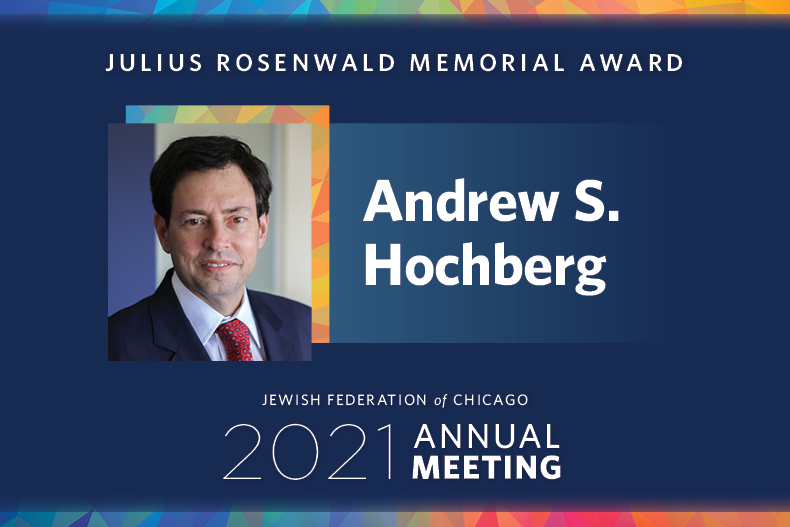
Meet Andrew S. Hochberg, 2021 Julius Rosenwald Memorial Award recipient
Celebrate Andy Hochberg at the virtual Annual Meeting on Sept. 14
Read more -
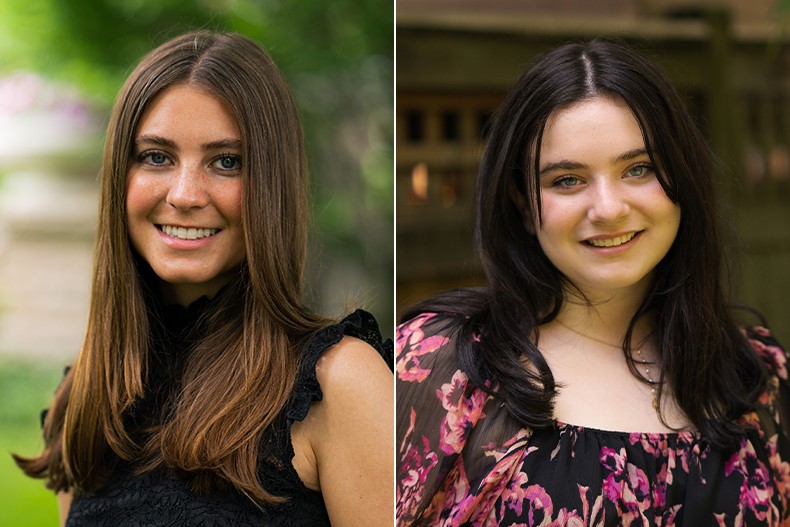
Two local teens win national recognition
Recipients of the annual Diller Teen Tikkun Olam Awards
Read more -

Celebrating six young award winners cultivating the community
Introducing young adult award winners
Read more