Eulogy for Ernie Michel, Holocaust survivor and American Jewish leader
STEVEN B. NASATIR
JUF President Dr. Steven B. Nasatir delivered the following eulogy at the funeral of Ernie Michel on May 11, 2016.
Like each and every one of you, I loved Ernie Michel.
And Ernie loved us back as we were all dear to him.
We loved and admired him because of his character, strength and special genius. And let’s be clear, he was in his own way a genius and a giant.
We also loved and admired him because Ernie through his relationships and accomplishments provided each of us a personal and up close look at the finest and best example of Jewish resiliency.
I am deeply honored that Ernie left instructions requesting that I speak here today. He told me many years ago that was something he wanted me to do and I laughed and changed the conversation because the last thing I wanted to do was engage in a discussion of his mortality.
All of us know Ernie’s remarkable story. Much of it came to each of us when he personally shared parts of his journey. And, because he couldn’t share all of it with everyone, in 1993 at, age 70, he wrote his wonderful book, Promises to Keep .
Fifteen years later, a somewhat amended version was published with the appropriate title, Promises Kept . Those titles weren’t accidental. From the time of Ernie’s liberation from the hell of the Nazi genocidal killing machine till age 85, step by step, position by position, relationship by relationship, achievement by achievement Ernie Michel labored long and hard to fulfill obligations to his family that perished along with the rest of the 6 million whose lives that were taken. By age 85, promises had been kept.
Ernst Michel was the boy from Mannheim who went to school one day where he and the other Jewish students were told this was their last day — there will be no more school for them. We know how his father set up an apprentice type opportunity for him as a calligrapher. Fast forward to 1943. In Auschwitz, we know that an SS man struck him and he had to go to the infirmary. While there, they came and asked “does anyone have good handwriting?” Ernie raised his hand. That writing skill gift provided by his dear father saved his life.
With his fine penmanship, Ernie wrote documents and filled out death certificates –never was the cause of death identified as being sent to the gas chambers. He was told to write physical weakness or heart failure.
There is more to that story including meeting up with that officer’s son decades later, but the overarching takeaway amidst all the irony was that our Ernie went from writing death certificates to becoming in the second half of the twentieth century one of the important authors of the unfolding book of the Jewish people. That is truly remarkable.
As most of you know, Ernie Michel, after an extraordinary career as speaker and professional with the national UJA, in 1970 became the executive vice president of UJA New York. I didn’t become the executive in Chicago until 1979, but knew Ernie and had the opportunity to work with him a bit in the ’70s partially because of our mutual connection to Al Hutler.
Al Hutler was the kind American lieutenant that met Ernie in the DP camps and became his lifelong friend. It was Al who encouraged Ernie to come to the U.S. and it was Al who opened up his heart and house to this extraordinary Jewish refugee and so we enjoyed a three-way connection.
As regards Ernie, the living legend, it began in post-war Europe when Ernie with his seventh grade education was hired to be the correspondent for the German General News Agency. Somehow, someway, Ernie convinced the GGNA to professionally accredit him as a correspondent for the Nuremberg trials. They did, and this young man from the concentration camps filed each day under the title Auschwitz #104995.
He continued to tell his story when he came to America and worked and studied and began to give speeches leading to a professional position with the national UJA from which came all those fabulous stories of hanging out with Hollywood stars, accepting bags of cash for Israel from Jewish gangsters and Jewish brothel owners and helping strategize the enormous campaigns of ’67 and ’73.
For example, during the Yom Kipppur War, Ernie reached out to a major Jewish donor with strong ties to Israel from whom he asked $5 million. The answer was yes and Ernie said great, now let’s go together and ask at least four more for $5 million each and they did and catapulted the New York campaign forward in a spectacular way.
I spoke Sunday to Rabbi Brian Lurie, another dear friend of Ernie’s and mine, who worked for Ernie and also loved him dearly. Brian seems to recall that in 1973 the New York UJA raised over $130 million for that emergency campaign. God only knows what that computes to today, but both Brian and I do remember Ernie telling us that he had made a terrible mistake — he should have asked for $10 million not 5.
I think the first time Ernie sought me out for my input on something really big was in 1979 in connection with his dream and those of other survivors to have a world gathering of Holocaust survivors in Yerushalayim in June of 1981. Thirty-six years — double chai — since the liberation of the camps. I knew that a couple of years earlier Ernie shared this big idea with the Federation Large City Executive group, and some members of that group at that time had questions most of which centered on logistics, funding and how many would really come.
When Ernie and I talked a couple of years later in advance of a Large City Executive meeting, I was enthusiastic about the proposed gathering not because I didn’t think all those questions didn’t need to be answered, but because at the end of the day the decision to attempt this or not should be totally in the hands of the survivor community.
Who were we to second guess why survivors like Ernie and others thought this to be important for them, their children and a world that still needed reminding of the great tragedy of the Shoah? Who better understood the remarkable rebirth of Jewish sovereignty in our land and the remarkable contribution that survivors had made to Jewish life by those who survived this terrible tragedy?
I shared with Ernie my recollections of a number of years earlier being in a room where survivors in Chicago came to Federation and told us about the announced Nazi march in Skokie and that it must be stopped. I went into that room knowing a bit about free speech issues and thought perhaps we not go against the then conventional Jewish organizational thinking on such a matter.
Within 10 minutes of listening to survivors talk about what jack boots and swastikas marching through Skokie meant to them — with images and memories that were authentic and unique — who were we to patronizingly say, “there, there – it will be okay.” We had no right to drape ourselves in conventional thinking when our fellow Jews within the survivor community were hurting as they were.
So we flipped that conventional wisdom on its head and fought the ACLU and the Nazis did not march in Skokie.
And though that proposed march and that proposed world gathering were different, the obvious conclusion was the same. Our message to survivors must be we thank God you are alive and our role is to support your vision. Ernie agreed.
Many other Federation executives and lay leaders held the same view and the world gathering, which Ernie chaired, was a huge success. Six thousand survivors plus children and grandchildren from 23 countries all gathered to celebrate their survival and the strength of the Jewish people.
Ernie called the world gathering the greatest experience of his life. Ernie always had the great gift of saying the right thing at the right time and though many of you have read or heard Ernie’s speech at Yad Vashem, do yourself a favor and listen to it or read it one more time. He began by talking about a dream born in the darkness of Auschwitz nourished by the liberation and finally brought to life and ended with:
“We came to this place with a great burst of love for one another and for the ideals in which we believe – our Jewishness, our Israel, our ancient heritage.
When the final shofar of that closing ceremony sounds, we shall return home and most of us will never meet again. But we will leave with gratitude in our hearts for the miracle of our survival, for that of the Jewish people, and for the rebirth of the Jewish land. Go my friends – go — knowing that history will tell our story forever.”
Over the years, Ernie, Amy, Carolyn and I spent lots of time together in Chicago and upstate New York; in Arizona and New Yor City. He was an inspirational friend to all five of our sons and that’s why my youngest son, Eli, flew in today.
I remember when Ernie learned that the Mormon Church was accessing names of Holocaust victims and was posthumously baptizing the deceased including his father and mother. Ernie was someone who respected all people of all religions, and though he understood the theology of this Church, he thought this was terribly wrong.
My friend was extraordinarily hot over this issue and I knew that the Church of the Latter Day Saints probably didn’t know what was about to hit them. They weren’t just dealing with a group of angry Jews, it was a group of angry Jews headed by Ernie Michel.
When Ernie’s blood was up, he didn’t just reach out to a couple of people, he recruited an army. U.S. Senators, corporate executives, media, attorneys — of which my wife was one — communal professionals; quite a group was assembled and it became a big story. Following his meetings with Senator Oren Hatch a successful negotiation resulted in the withdrawal of 400,000 names of Jewish Holocaust victims from Church records.
These examples and all the rest that Ernie did is the stuff from which more than one novel could be written. And for those of us who were privileged to watch Amy and Ernie’s love story evolve, there is a novel or a film yet to made.
They loved each other dearly. Each would sacrifice for the other. Ernie told everyone that his Amy had given him a new life. I remember their marriage in Westchester like it was yesterday. The love and respect they had for each other was obvious.
And like any good Hollywood musical, Amy’s uncle, Sammy Kahn, who wrote so much of America’s songbook was in attendance and serenaded the loving couple by inserting Amy and Ernie in his classic song, “Love and Marriage.” It was a glorious day, they were a remarkable couple and they had a fabulous life together. Amy always knew that as Ernie got older the responsibility to care for him would become hers, and that, of course, did happen.
And Amy’s care for her beloved Ernie was astounding in all respects.
As the Federation Executive asked to speak today, I want to make special mention of my colleagues, Steve Solender , John Ruskay and Eric Goldstein. We are informed by this week’s Parsha that we are to have special regard for our elders. An elder is someone who has acquired much wisdom by virtue of rich life experiences. The Torah says, “You shall see as beautiful and wondrous the face of the elder.” Steve, John, Eric and so many others always saw Ernie as beautiful, wondrous and possessed of real wisdom, and so they always treated Ernie with respect and love during his retirement.
It’s hard to think of a more fitting time in the annual Jewish calendar to celebrate the life of Ernie then in these seven or eight days. Last week we honored the 6 million murdered members of our family.
Tomorrow we honor the memory of those more than 27,000 members of our family who fought for the establishment and defense of the State of Israel and the very next day we commemorate Israel Independence Day.
Auschwitz, where Ernie spent an eternity of years, was liberated in January of 1945. It is awesome beyond expression when we note the State of Israel, marking the assumption of power by the Jewish people, was established but three years later. Ernie was a man whose very life bridged these two universes — Auschwitz and its evil; a restored Jerusalem and its golden beauty.
In the last sentence of Promises Kept , Ernie tells us in simple but with insightful language that “every person has ups and downs. That is life. When things get tough, there is always hope. Always a new day. Never forget this.”
We will never forget this, Ernie and we will never forget you. Your memory will continue to be a blessing to us all.
Other stories
-
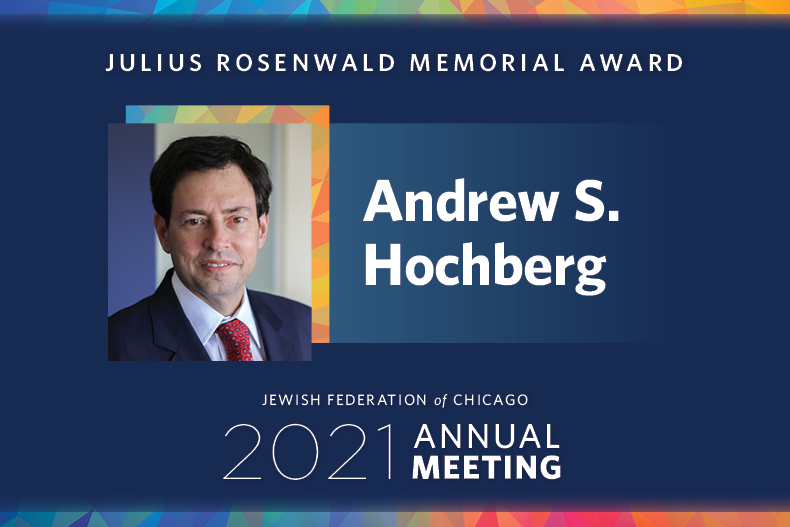
Meet Andrew S. Hochberg, 2021 Julius Rosenwald Memorial Award recipient
Celebrate Andy Hochberg at the virtual Annual Meeting on Sept. 14
Read more -

Two local teens win national recognition
Recipients of the annual Diller Teen Tikkun Olam Awards
Read more -

Celebrating six young award winners cultivating the community
Introducing young adult award winners
Read more