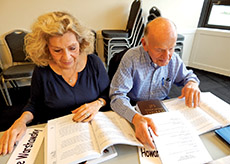
“Provide yourself with a teacher, and get yourself a companion…” (Pirke Avot 1:6)
In recent years, adult Jewish learning has been getting its own spotlight in the Jewish communal world. Research, professional development, and leadership have finally realized that adult education is different from teaching kids. These learners want to be there, they choose to carve out time and money, they are usually quite skilled in their own fields of work, yet choose to put themselves into situations where they don’t know answers, and their learning is done on their terms, not the educators.’ The Chicago Jewish learning landscape is lucky to have so many opportunities for this unique group of seekers, and what follows doesn’t even include individual congregational adult education, much less being an exhaustive list of what’s available communally.
Spertus
To begin, perhaps the grand dame of adult Jewish learning is Spertus Institute for Jewish Learning and Leadership. Begun in 1924 as the Chicago College of Jewish Studies, Spertus offered three courses. Today, it is a center for academic and public classes, offering local and distance learning, conferring graduate degrees in Jewish studies, Jewish communal leadership, and non-profit management. Programs include films, classes, exhibits, workshops at their Michigan Avenue location, and throughout city and suburban locations. Spertus is now convener, too, organizing a series of monthly meetings for communal professionals for community building and professional development. Over 40 individuals, representing about 30 organizations, have been working on a learning market analysis, and will offer a cross-communal pilot event on Thursday, June 2. ( www.spertus.edu )
Melton
For the last 15 years, the Chicago BJE has sponsored the Florence Melton School of Adult Jewish Learning, along with other organizational support. They currently offer 28 classes in city and suburban locations, for over 250 adult learners. The basic Melton experience is a weekly study session, for 25 weeks, for two years. The program is offered to students of all backgrounds, welcoming those with a desire to make Jewish learning a way of life. With a uniquely developed curriculum, Melton is a non-denominational, academically sophisticated experience that enables adults to be more passionate, knowledgeable Jews, and serve as role models within their families and community. After spring enrollment, Melton hopes to end up with 285 Melton students for the school year. (www.bjechicago.org .)
JCC Chicago
Adult learning at JCC Chicago aims to bring meaningful content and personal relevance to the individual and the entire community. Offerings of the J include Seed613 (formerly JCC PresenTense Chicago) to mentor budding entrepreneurs and help realize projects for social impact, and the annual Chicago Jewish Film Festival to use film as a medium to foster connection and conversation. In addition, “Say It In Hebrew” provides an innovative curriculum to develop Hebrew literacy through it’s a learner-centered approach as part of a national movement to change the way Hebrew is taught. In its third year, with 5 levels in 3 locations around town, about 120 adults participate each year to build language skills and deepen their connection to Israel. Mens’ groups, speakers and other cultural happenings also populate the JCC calendar located at www.jccchicago.org .
Orot
Two years ago, communal Jewish educators Rebecca Minkus-Lieberman, Sam Feinsmith, Jane Shapiro, and Jordan Bendat-Appell, opened Orot (Hebrew for “lights”), as an innovative, pluralistic, and progressive home for mindful learning that brought Jewish wisdom into people’s lives. Orot offers a new paradigm for Jewish study and practice. It interweaves text study with different disciplines in order to allow individuals to bring Jewish wisdom into every part of their lives, no matter their background or style of observance. Combining traditional learning with mindfulness meditation, music, visual arts, creative writing, and movement, Orot offers classes, programs, workshops, and retreats that provide opportunities for cultivating transformative habits of body, heart, and mind. Orot launched an innovative new high school program for 9-12th graders, using text study with reflective practices, the arts, and a social-emotional lens to support identify development. ( www.orot.org )
Davar
On a cold night in February, people packed into Milt’s Guide for the Perplexed restaurant for a night of learning, sponsored in part, by Davar, a privately supported Orthodox program with a unique perspective. It was formed to bring untapped topics to the Orthodox learning table that have been censored by the community, hearing teachers from all across the Orthodox spectrum. Based in Skokie, Davar was begun to supplement educational opportunities, hearing voices that aren’t getting heard. Davar looks for edgy speakers, on edgy topics, like pre/post nuptial agreements. Most of Davar’s programming is on Shabbat and Sunday, mostly in Skokie, but they hold Shabbaton weekends that draw from are larger area. ( www.davar.com/skokie )
Yeshiva University/Torah Mitzion Kollel of Chicago
Like pioneers of old, in 2008, eight Rabbinic families went forth from New York Yeshiva University to Chicago to form a Kollel, a learning community, within the Orthodox world of Skokie, West Rogers Park, and Lincolnwood. Meeting at synagogues, people’s homes, and other locations, on any given day or evening, you can find men studying in an open-community Beit Midrash (house of study). The program has been so successful, the Kollel has recently expanded programming to include a Women’s Institute of Learning. Their aim is to develop future leaders, and there are already 10 alumni who are serving in various capacities. The Kollel is adding staff and expanding to Highland Park, Buffalo Grove and Northbrook. All classes are free to the community, thanks to generous local support. ( www.chicagotorah.org )
SVARA
In 2003, Skokie native Rabbi Benay Lappe started a “traditionally radical” yeshiva that drew 90 percent of its participants from the LGBTQ community. Today, it’s more of a 50-50 split. SVARA comes from the Rabbinic tradition of being willing to make radical moves, sometimes even to overturn Torah itself, to make Judaism “more meaningful, compassionate, and responsive to the human condition.” Lappe has said her goal is to bring study tools of interpretation to those who have been considered marginal to the Talmudic tradition. In the past 13 years, thousands have taken part in SVARA’s curriculum, including two 5-day retreats and evening 6-week sessions, and a full time yeshiva training program. Students study in Hebrew, yet Lappe’s unique technique lets Hebrew beginners study alongside with more advanced Hebraists. ( www.svara.org )
Chai Mitzvah
Unlike other adult learning programs, Chai Mitzvah goes beyond the classroom, blending spirituality, social action, and self-guided individual study, in addition to a monthly group learning experience. Chai Mitzvah is an international non-denominational program, originally marketed to congregations from across the spectrum. Over a dozen local congregations have run Chai Mitzvah groups. Currently, groups are being formed outside the congregational model, such as Interfaith Family and friendship groups. Chai Mitzvah’s goal is to re-engage Jews by encouraging them to explore their personal “bucket list” of study, spiritual practice, and social action commitments over nine months, helping them define what a meaningful Jewish life looks like. ( www.chaimitzvah.org .)
Jewish Learning Institute
Jewish Learning Institute’s mission is to make Jewish learning accessible and meaningful to every Jew, regardless of background or affiliation. For 15 years, at over 13 locations in the city and suburbs, the Chabad-based program is meant to go beyond pure intellectual study, and become life-altering opportunities to grow one’s connection to Judaism and life in general. All classes are given with English translation, so the first-time learner and the advanced learner can benefit. Between 600 and 700 individuals have taken part in JLI classes, and most re-register for another of their trimester, six-week courses offered. They also have a CLE class for attorneys, co sponsored by the Decalogue society, JNF, and the American Association of Jewish lawyers and the Jewish Judges of Illinois. Classes are in everything from Talmud, Kabbalah, Holocaust studies, Israel, to Happiness and the Jewish Course of Why. ( www.myjli.com )
Limmud
And finally, over the last six years, thousands of Jews from across the Chicago Jewish community have gathered for one day, once a year, simply to learn. Over 35 years ago, in the UK, Limmud (Hebrew for “learning”) became a world-wide model of an adult Jewish festival of learning in over 80 communities; it changed the idea of what adult Jewish learning can be. Following values of diversity, respect, volunteerism, community building, and empowerment, Limmud participants explore all facets of Jewish life, identity and culture. Limmud is cross-denominational, multi-generational, and completely volunteer-run. There is no Limmud “agenda;” Limmud is who shows up. For a Limmudnik, everyone has something to learn, everything has something to teach. ( www.limmudchicago.org )
“Shammai said, ‘Make the study [of Torah] a fixed habit'” (Pirke Avot 1:15) In Chicago, there are plenty of places to make that happen. Check it out, Chicago.
Anita Silvert is a freelance teacher and writer, living in Northbrook. You can read more of her weekly Torah musings on her blog, Jewish Gems, atwww.anitasilvert.wordpress.com.
Other stories
-
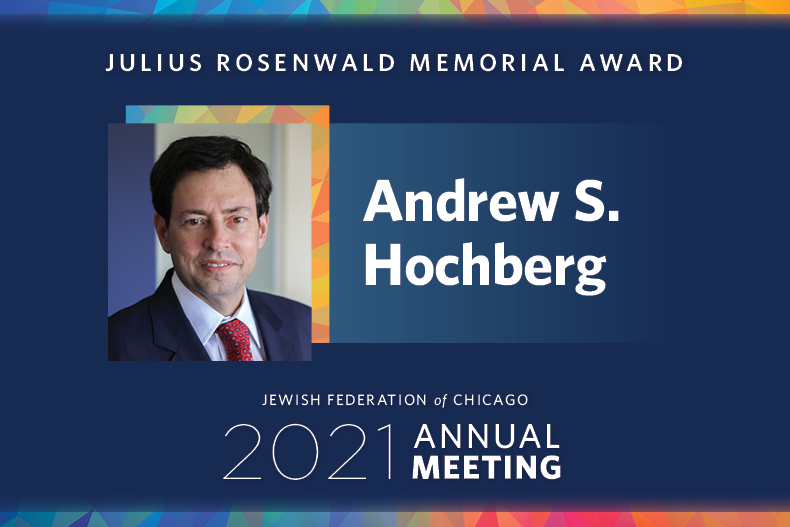
Meet Andrew S. Hochberg, 2021 Julius Rosenwald Memorial Award recipient
Celebrate Andy Hochberg at the virtual Annual Meeting on Sept. 14
Read more -
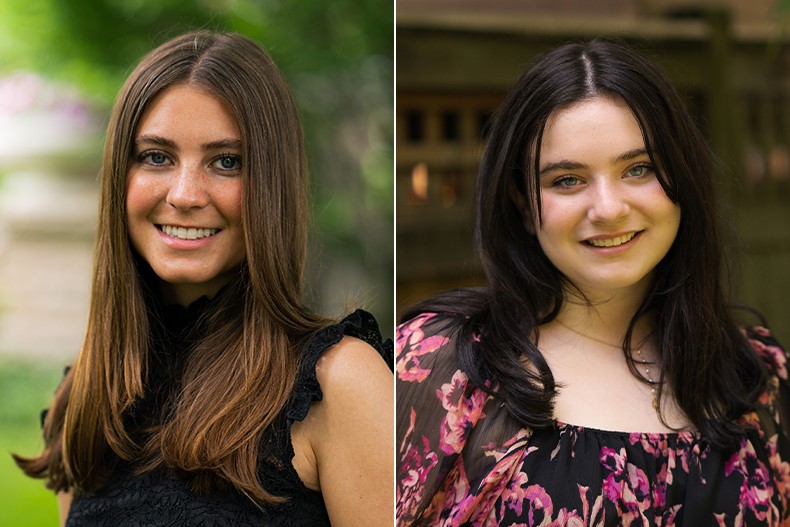
Two local teens win national recognition
Recipients of the annual Diller Teen Tikkun Olam Awards
Read more -
Celebrating six young award winners cultivating the community
Introducing young adult award winners
Read more