Holocaust Community Services transitions to CJE SeniorLife to continue care for local survivors
The consequences of advanced aging—compounded by the physical and emotional horrors endured during the war—are taking their toll on Chicago’s Holocaust survivor community. The average age of a survivor is 79, with nearly a quarter 85 or older, and the number of Holocaust survivors turning to community agencies has increased.
“There’s a major misconception that the needs of the survivor community are dwindling, but in actuality, the reverse is true. The Holocaust Community Services (HCS) received nearly 300 new requests for services in the past year,” said Yonit Hoffman, Ph.D., HCS Program Director.
Since 1999, Holocaust Community Services (HCS), a collaborative effort of Jewish Child and Family Services (JCFS), CJE SeniorLife and the Jewish Federation of Metropolitan Chicago, in partnership with HIAS Chicago, has helped ensure that the Chicago Holocaust survivor community and their families can continue to live independently and with dignity.
With the greater potential for survivors to benefit from the eldercare resources available through CJE SeniorLife’s continuum of care, the administration of Holocaust Community Services has transitioned from JCFS to CJE. Through this shift, HCS can focus its efforts on serving survivors and their families in alignment with CJE’s mission to enhance the lives of older adults.
“The complex needs of many survivors in our community-related to their traumatic histories as well as deteriorating physical, social and economic factors-are just beginning to emerge. Our survivor community has also been affected by reductions in public benefits for older adults, so a particular focus is on assisting the neediest and most vulnerable survivors who may not have other means of support,” Hoffman said.
HCS serves approximately 800 Holocaust survivors and their families annually, offering support groups, socialization programs, and assistance with various Holocaust reparations and compensation programs. About half that number receives ongoing financial help with food, medication, home care, or emergency needs.
The transition to CJE will enable survivors to benefit from CJE’s expertise in counseling, support and referral services for older adults. HCS case managers will also facilitate in-home support, including personal care and housekeeping services, kosher food delivery, and transportation services. In addition, training for professionals who work with survivors and their families is provided to address the growing needs of aging survivors.
CJE will also focus on the strategic development of HCS to address the significant increase in survivor requests for assistance. HCS is supported by social welfare grants from the Conference on Jewish Material Claims Against Germany, Inc., and other generous foundations and donors. Approximately 75 percent of the total funding is from the Claims Conference, which recently increased its worldwide allocations by 21 percent for 2015, for a total of $365 million. Though a small portion of this additional funding will be allocated to local agencies, it will be spread across social service organizations serving Jewish Holocaust survivors in 47 countries, to provide home care, hunger relief, medical care and transportation.
Steve N. Miller, HCS Committee Chair and JUF Board member believes it’s important to provide for the survivors in our community. “These people have suffered so much in their lives-it’s imperative that we provide for them and let them age with dignity.”
For more information on Holocaust Community Services at CJE SeniorLife, call (773) 508-1004.
Other stories
-
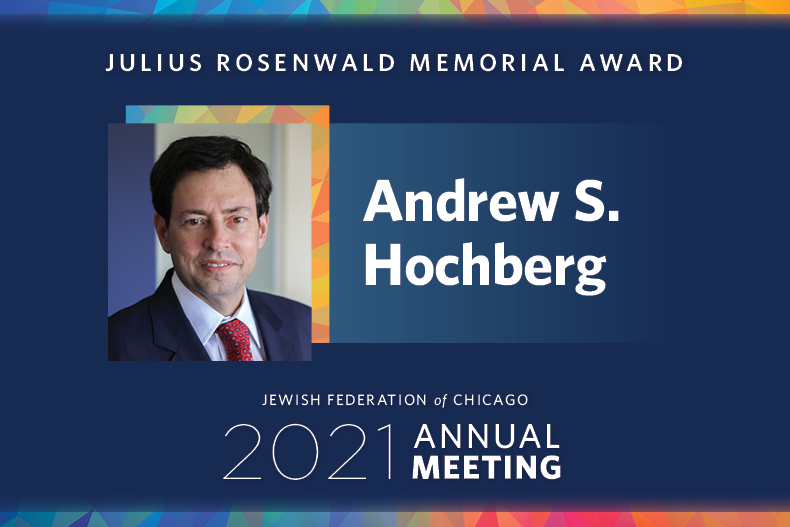
Meet Andrew S. Hochberg, 2021 Julius Rosenwald Memorial Award recipient
Celebrate Andy Hochberg at the virtual Annual Meeting on Sept. 14
Read more -

Two local teens win national recognition
Recipients of the annual Diller Teen Tikkun Olam Awards
Read more -

Celebrating six young award winners cultivating the community
Introducing young adult award winners
Read more