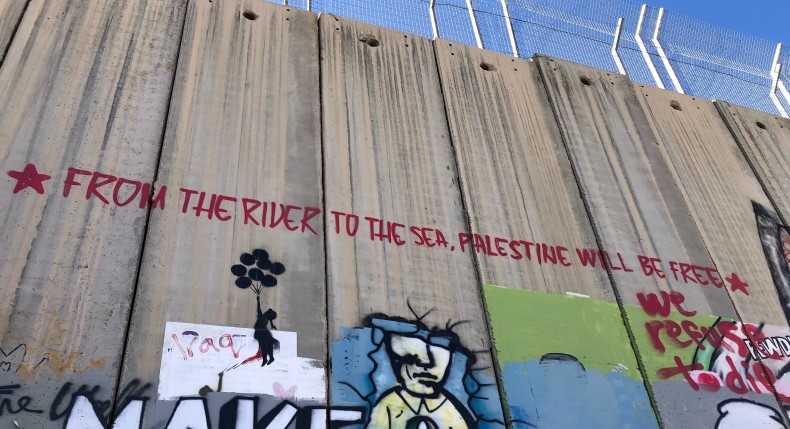
Recently, I participated in a tour of Palestinian population centers for which the words of Rabbi Abraham Joshua Heschel rang true: “The principle to keep in mind is to know what we see rather than to see what we know.” Over four days, I didn’t stroll through Mahane Yehuda, experience the “Start-Up Nation,” or worship at the Kotel. Instead, I toured the West Bank and eastern Jerusalem, spending my nights in Bethlehem and Ramallah as the guest of Encounter’s Intensive Seminar.
Encounter is an American Jewish non-profit that curates tours of Palestinian population centers for Jewish communal leaders in order “to expand their view of the Israeli-Palestinian conflict.” Their trips are neither intended to open a dialogue with Palestinians, nor change our commitment to Israel; rather, we were asked to directly hear and try to understand their reality, and to layer a deeper appreciation of the Palestinian story within our Zionist DNA.
I accepted this free trip expecting to learn more, while also steadfastly holding true to my nearly five decades of commitment to Israel and Zionism, forged by my family, working at JUF, AIPAC and Israel Bonds and eight other trips to Israel.
I was right on both counts.
I’ve been asked if my experience made me optimistic that a real peace – satisfying the national aspirations of both the Israelis and the Palestinians – can be achieved. Unfortunately, I returned home mostly more pessimistic than before; but there were moments when I thought, maybe…just maybe…
On our first day, we visited Bayt Sakarya, a tiny, 400-year-old Palestinian village near Gush Etzion, and met with one of the village leaders on a mosque’s rooftop. He was asked if he was familiar with a local rabbi seeking common ground between Israelis and Palestinians.
The village leader said he was aware of the rabbi but didn’t have time for interfaith dialogue given the more urgent matters of building a kindergarten, installing solar panels, and completing the village’s mosque–all of which he said the IDF was blocking.
I do not know if the IDF is in fact blocking his efforts or why, but what was striking is how, unlike most of the Israel-Palestinian discourse here in the U.S., he wasn’t interested in one state or two, BDS, or whether the Palestinians should hold new elections. He simply wanted to make his neighbors’ lives better. I left Bayt Sakarya wishing we could find ways to help those seeking to build people up, rather than tear people down, because they are the people to lead the region to peace.
Almost on cue to eliminate such modest optimism, we visited the Aida refugee camp outside Bethlehem. There we were met with an oversized sculpture of an old house key, symbolizing the keys to homes in Israel thousands of Palestinians fled in 1948, and to which they (or, in most instances, their descendants) dream of returning. There, another Palestinian community leader made clear his vision for the future: one state–Palestine–in which Jews are “welcome to visit,” and live as a respected religion, but without national rights.
One of our last Palestinian interlocutors was a PLO representative. Thanks to her casual references to Israel’s “apartheid roads,” Israel’s efforts to “make Palestinians invisible,” and Israel’s “colonialism,” it seemed one of the trip’s last experiences was bound to be utterly disheartening.
Then she shocked me. She had spoken at length about the PLO’s desire for a two-state solution based on the pre-Six Day War borders, but during our final conversation atop Mt. Scopus on Hebrew University’s Jerusalem campus, she said she hoped to one day live in the Jaffa home her family abandoned in 1948. I asked if that meant in her version of a two-state solution, that Jaffa would be part of a Palestinian state.
She said that she assumed if she were living in Jaffa, it would be under Israeli rules and laws, which would be OK with her, as long as she was treated equally to Israeli Jews. As heartening as this comment was, I now wonder if she was just saying what she knew a group of American Jews wanted to hear, or if she was playing a more insidious demographic “long game,” whereby Palestinians believe it’s only a matter of time before they outnumber Israeli Jews, thereby ending Jewish self-determination.
It was important for me to hear and see Palestinians hold to their narrative with the same determination that Jews do when it comes to Israel’s history. Back here in the comfort and safety of Chicago, it is easy–even tempting–to discount their narrative. But doing so does not move us closer to peace.
If I’ve come away from the Encounter experience with just one understanding, it is that those of us who live in the Diaspora and wish to play a role in resolving the conflict between Israelis and Palestinians must do more than know ourselves; we must better know the other. We don’t have to agree, but we must be able to meet with, debate and engage in difficult conversations.
Echo chambers are safe and secure, while meeting your opponents is unsettling and frightening, but as Moshe Dayan said in 1977, “If you want to make peace, you don’t talk to your friends. You talk to your enemies.”
I am proud that JUF’s leadership encouraged my participation in Encounter and that they support us having difficult conversations about hard issues with intellectual honesty and transparency. Middle East peace won’t emerge from Chicago, but we can always learn more, empathize more and prepare for the hopeful day when circumstances over there ripen, and play our many important supportive roles as our Israeli brothers and sisters seek peace with their Palestinian neighbors.
Daniel Goldwin is Executive Director of JUF’s Jewish Community Relations Council/Public Affairs.