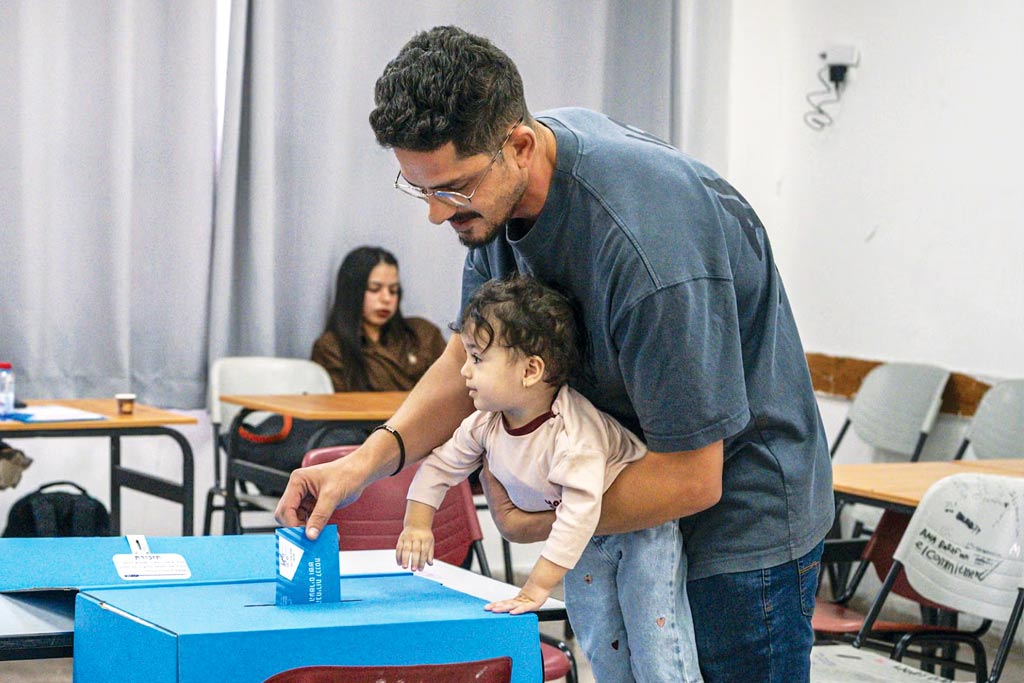
Arab citizens of Israel cast their ballots at a polling station in Nazareth, Israel, during the general elections, Oct. 27. (Photo credit: Adri Salido/Anadolu via Getty Images)
At the time of writing—one week after the election—there is a new Knesset but not a new Israeli government. “Yashar!” party leader Gadi Eisenkott was tasked with forming a coalition that would have the support of a majority in the 120-member legislature. Whether he succeeds or whether he fails and the mandate passes to outgoing Prime Minister Benjamin Netanyahu, a few outcomes of the elections are particularly noteworthy.
The most striking is the high voter turnout. At 78%, it was the highest since 1999. (The record belongs to the first election in 1949, when 86.9% voted.) The high turnout is a testament to how seriously Israelis saw these elections and how high the stakes were.
The election was widely seen as a referendum on the Netanyahu government during whose term the worst massacre in Israel’s history occurred. It was also a referendum on the Haredi demand for exemption from military service, supported by most in Netanyahu’s bloc and opposed by the opposition bloc. The two issues—the October 7 massacre, and the Haredi exemption bill, along with judicial reform—were seen by many Israelis as of cardinal importance, helping bring record-level numbers to the polls. Whether supportive of the Netanyahu government or opposed to it, a huge swath of Israelis felt that their voice needed to be heard.
Also notable was the voter turnout among Arab Israelis who represent roughly 20% of the population and enjoy full rights and benefits, including of course the right to vote and be elected. If all Israeli Arabs were to vote and if all voted for one of the two Arab lists, their combined seats in the Knesset would be 24. As it is, those two parties totaled 19 seats, almost 16% of the Knesset.
In this round of voting, 77% of all eligible Arab voters came to the ballot, a rise of 24% relative to the 2022 elections and a new record turnout. This high turnout is due to several factors, the main one being a reaction to what many Arabs perceive as a prejudicial policy of the Israeli police under Minister for National Security Itamar Ben Gvir and the incitement of other leaders in his party and in the Religious Zionism party against Arabs. Another reason is probably a strong desire to oust Prime Minister Netanyahu and strengthen the opposition bloc. The Arab parties announced that they would do everything in their power to replace Netanyahu, including giving their support to any contender running against him.
While United Torah Judaism maintained its seven Knesset seats, the major loser in this election was the Sephardic/Mizrachi Ultra Orthodox Shas. From 11 seats in the previous Knesset, Shas dropped to only six seats in the incoming Knesset, almost halving its power and reaching an all-time low. For comparison, in the 1999 elections Shas won no fewer than 17 seats and was the third biggest party.
Voter backlash is largely attributed to anger at the party’s demand for exemption from military service, while many of its own voters serve in the IDF. Other voters were disappointed at Shas’ failure at passing the very same exemption law. Finally, Shas lost seats because the high voter turnout among Israelis in general lowered their relative representation in the Knesset.
The new Knesset has a greater number of women, yet still very far from being fairly represented. The last Knesset had only 29 women (representing 24.2% of the seats) while the incoming Knesset has 33 women (27.5%). Still a far cry from 50%, but an important step forward.
Finally, two interesting points of data regarding Knesset Member ages: The youngest-ever MK is Yonathan Shalev, 24 years old, from Naftali Bennett’s “Beyachad” party. Shalev founded a movement of IDF reservists and joined Bennett’s party in an attempt to bring attention (and budgets) to the needs of reservists who spent hundreds of days serving since October 7, 2023. And the oldest serving member in the incoming Knesset will be no other than Benjamin Netanyahu, 77, who has served non-consecutively for 35 years across 14 different terms.
A boring day in Israeli politics is more interesting than the most exciting day in most other countries. Let’s hope that the next four years in Israeli politics are as uneventful as possible so the country can concentrate on rebuilding and repairing the emotional, physical, economic, and social damage caused by years of war, domestic political strife, and growing international criticism.
Ofer Bavly is a JUF Vice President and the Director General of the JUF Israel Office.
In this issue
-

-

Catching up with Molly Yeh
Before the Glenview native was beating eggs, she was keeping the beat
Read more -
Remembering Rabbi Capers C. Funnye Jr.
Beloved spiritual leader’s legacy of faith, service, and dedication
Read more