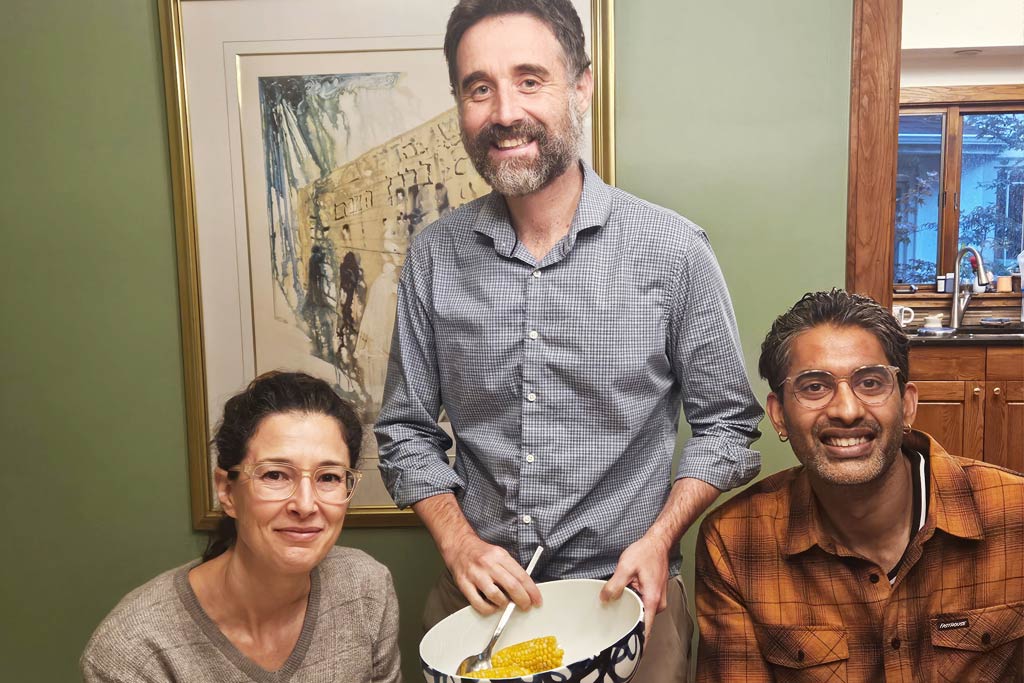
Rabbi Adir Glick of Temple Har Zion serves summer corn during Sukkot at his River Forest home. His menu also featured a salad with kale and sweet potatoes. (Photo courtesy of Rabbi Adir Glick)
One experimented with Oreo-crusted chicken at age 11. Another grew up in Jerusalem, where his family were regulars at an Indian restaurant outside the Old City. The third is the son of a California chef.
What do they have in common? They’re Chicago-area rabbis who find joy in cooking—and the hospitality that goes with it.
Rabbi Rebecca Benoff, Assistant Rabbi at Chicago Sinai Congregation since 2023, is a proud guardian of her great-grandmother’s brisket recipe. “It smells like home to me. It smells like the Jewish holidays,” she said.
Raised in the Philadelphia suburbs, some of her fondest memories are rolling sweet-and-sour meatballs in the kitchen with her bubbe, Elaine Shapiro, and her mom, Sharon. Benoff and her older brothers, Greg and Jared, flipped pancakes and added chocolate chips to the batter. “[Cooking] really brought us together and made me love food and food culture,” she said.
Her father, Jack, encouraged experimentation. As a kid, Benoff took that to heart: She once tried breading chicken with crushed Oreos. “I think I get creativity points for that,” she joked.
By 2018, during Benoff’s first year of rabbinical school in Israel, her passion for cooking deepened at weekly Shabbat potlucks. When the pandemic hit, she tackled more complex recipes. “I remember being in a Zoom class studying Talmud while my shakshuka was simmering on the stove,” she said.
Eventually her culinary curiosity turned into scholarship, and she wrote her rabbinical school thesis on regional Jewish food traditions in America.
Today, food remains a way to build community, whether she’s bringing homemade banana bread to her Saturday Torah study group or hosting Shabbat dinners.
“There’s so many stories in the Torah and Jewish tradition about welcoming a stranger… it’s something I was raised with, and I didn’t even realize the value,” she said. “Now I see the impact of inviting someone into your home.”
Rabbi Adir Glick also finds spiritual meaning in the kitchen.
He points to a Hasidic teaching rooted in Kabbalah that all physical creation, including food, has hidden fragments of divine light. “When you eat, especially when someone has cooked the food with love, then you are liberating the holy sparks in the food and you’re part of the process of repairing the world,” Glick explained.
At Temple Har Zion in River Forest since 2015, Glick views cooking as another way to care for congregants. Recently, when a synagogue member experienced a medical crisis, he brought them a homemade quiche.
Born in Jerusalem and the son of a rabbi, he developed a lifelong love of Indian food after his parents took him to an Indian restaurant run by a Jew from Kolkata. That influence found its way into synagogue life at Har Zion. In 2020, he prepared rajma with dal for a Jewish history of Bollywood program.
For Shabbat, Glick might prepare poached cod with couscous, adding fresh eggplant from his wife’s garden and Israeli pickles. No matter what dish he’s preparing, Glick appreciates the structure of a good recipe.
“I’ve found it wonderfully peaceful to follow a recipe,” he said. “You put love into it, and you create something for guests to enjoy,” he said.
Rabbi Aaron Finkelstein of Anshe Sholom B’nai Israel Congregation in Lakeview grew up immersed in food in the San Francisco Bay Area. His father, Alan, worked as the resident chef at San José State University and taught hospitality classes at a high-end hotel. His specialties included cinnamon challah and smoked eggplant dip often served around a crowded table.
“The kitchen was always open, and the Shabbat table was filled with people,” Finkelstein recalled of his childhood. “That’s my model for community building and hospitality.”
During Finkelstein’s freshman year at Washington University in St. Louis, it was time for him to prepare his own Shabbat dinner. He turned to his father for advice on making challah and chicken soup. While the two live in different states, they still trade cooking techniques. Before Shabbat, they compare notes on each other’s menus, whether it’s beef tagine with couscous or another favorite dish.
“I like to consult him and see what he’s doing. Finkelstein said. “That’s a fun thing we do.”
Today, Finkelstein’s Shabbat table combines Ashkenazi staples with tahini and mezze dips inspired by time spent in Jerusalem and Efrat.
“Whatever places I’ve lived in, I liked cooking food and having people over. That anchors and grounds me,” Finkelstein said, adding he’s passing that love of food on to his daughters, who sometimes help mix the batter for their favorite crepes.
Jennifer Brody is a freelance writing living in the Chicago area.
In this issue
-
-
Catching up with Molly Yeh
Before the Glenview native was beating eggs, she was keeping the beat
Read more -
Remembering Rabbi Capers C. Funnye Jr.
Beloved spiritual leader’s legacy of faith, service, and dedication
Read more