JUF provides emergency cash for rabbis to assist needy community members
LINDA S. HAASE
The Jewish United Fund will once again partner with local synagogues in 2015 to provide emergency financial assistance to individuals and families in need, and is now inviting congregational rabbis to apply for funding.
The JUF Rabbinic Discretionary Fund Program (formerly J-HELP) enhances, and in some instances creates, a pool of discretionary resources for rabbis to assist community members in crisis who turn to them for help. Since 2008, $414,500 has been made available through this program to 2,200 individuals to prevent homelessness and hunger, to ensure seniors have needed medications, to cover funeral expenses, to provide respite care, and for car repairs that ensure people’s transportation to work.
In 2012, the program was expanded to enable rabbis to support synagogue programming designed to help community members regain stability, such as helping to stock the synagogue’s food pantry and providing on-site financial literacy and employment workshops.
Funding determinations will be made based on congregational size and a consideration of community need as identified in the 2010 Jewish Population Study. Larger congregations and congregational rabbis serving communities with a higher proportion of residents falling under 200 percent of the Federal Poverty Line, or reporting “”difficulty in accessing services” will receive larger allocations. Higher need communities include City North, and the South, West, and Near North Suburbs.
Since the program began, 70 local congregations have participated in this initiative. Participating congregations reflect the full spectrum of the synagogue streams—36 percent Orthodox, 33 percent Reform, 20 percent Conservative, 7 percent Unaffiliated/Other and 4 percent Traditional. The locations of participating congregations cover the Chicago metropolitan area, from North Suburban Vernon Hills to West Suburban Naperville to South Suburban Olympia Fields and Joliet.
“The financial assistance provided through this program serves as a critical safety net,” said Rabbi Michael Weinberg, co-chair of JUF’s Rabbinic Action Committee. “Rabbis report they provide a family with emergency funds to meet many needs. For 86 percent of households assisted, funds were utilized in part to address basic human needs—housing, food, and medicines or medical treatment.”
Other funds often support critical transportation needs and Jewish life cycle events, such as funeral and burial costs, Israel and Jewish school or camp scholarships, and bar/bat mitzvah or wedding commemorations. Funds are not used to support membership fees at a synagogue, unrelated synagogue expenses, or a synagogues’ own grant-making efforts.
Participating rabbis will be able to request additional funds once their initial allocation is exhausted and reporting requirements are met. Requests for additional funding are awarded on a first come, first serve basis until all funds are expended.
“Synagogues are the foundation of Jewish life within the Jewish community. JUF is proud to partner with our congregational rabbis,” said Dr. Steven B. Nasatir, president of the Jewish United Fund of Metropolitan Chicago. “We want to ensure that, whichever communal door an individual or family in crisis walks through, they are able to access the assistance and support necessary to regain stability in their lives.
“Beyond serving as a force for good, we are delighted that the JUF Rabbinic Discretionary Program has deepened the relationship between JUF and local synagogues, as well as between synagogues and our JUF partner agencies, who serve as resources for assisting community members in need.”
Other stories
-
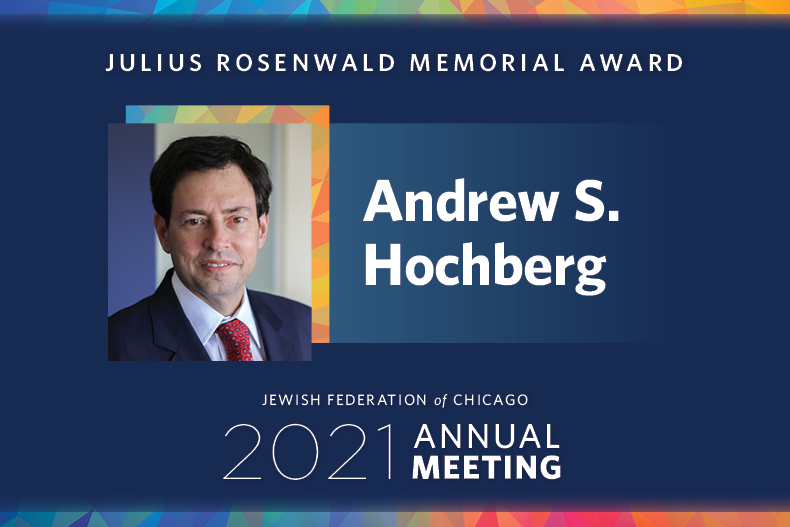
Meet Andrew S. Hochberg, 2021 Julius Rosenwald Memorial Award recipient
Celebrate Andy Hochberg at the virtual Annual Meeting on Sept. 14
Read more -

Two local teens win national recognition
Recipients of the annual Diller Teen Tikkun Olam Awards
Read more -

Celebrating six young award winners cultivating the community
Introducing young adult award winners
Read more