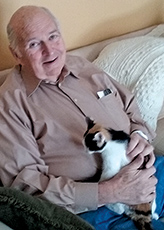
For years, my dad said he didn’t want a cat.
Although we’d always had cats when I was little, it had been ages since my parents had pets to look after. My mother missed having pets around, though, and started suggesting adopting a little kitten. She started visiting animal shelters, looking at the cats-“wouldn’t a sweet little tabby be nice?” she’d ask-but my father always said no. It was too much work, too much expense-better to remain cat-less and leave things as they were.
Increasingly, though, we-my dad’s kids and grandkids-thought maybe my mother was right, and they’d be happier as pet owners once again. After all, my parents are getting older, slowing down. My father finds it difficult to walk without a cane or a walker. But while they might be slowing down physically, emotionally they still have so much to give. Perhaps having a cat to love would give them some much-needed company and lift their moods.
We might not have realized it, but when we asked whether a cat would improve their lives, we were echoing a key Jewish teaching.
Rabbi Eliyahu Dessler, a great 20th Century sage, is famous for exploring the nature of love. In Western society, he pointed out, we’re used to thinking of love as an emotion that causes us to act. We have affection for a spouse, this thinking goes-so we offer a backrub when they come home from work. We dote on our grandchildren-and that leads us to want to shower them with gifts.
In reality, Rabbi Dessler wrote, we might have it all backwards. Love can come from giving. The more we offer to others, the more we feel invested in them. And the more we are invested in those around us, the more we come to care about them.
In fact, the Hebrew word for “love”- ahava -seems to back this up. The root of the word is hav , or “give”; through giving, it seems, love can grow.
Animals can be a powerful recipient of this love. Jewish history is replete with examples of loving relationships with pets. The Talmud recounts a cat that wore a leash in order to be walked on Shabbat. The Torah provides detailed instructions of how to be kind to animals-and forbids any form of animal cruelty: the way we treat animals is seen as the barometer of a person’s character. (As King Solomon wrote, “A righteous person knows the needs of the animal.”)
Lavishing affection on a beloved pet helps us exercise our capacity for love too: it helps us grow. Taking care of pets can also aid us in relating to others, as we exercise our reserves of patience and generosity.
That was certainly the case in our family. My mother recently brought home Maisie, an abandoned cat from a shelter. We all enjoy this playful kitten-but my father’s reaction was the biggest surprise. It was love at first sight. Now, as he sits in his chair or on the couch, he often has a little furry companion in his lap. I feel that he’s less on his own when my mother is out at work or running errands.
Watching him contentedly holding Maisie the other day, I asked if my dad was glad they’d finally got a cat. A smile played on my father’s face. “She’s a nice little cat” he admitted-then did something I’d never seen him do with the cats we had when I was a child. He gave her a hug.
Yvette Alt Miller, Ph.D. is a writer and teacher. Her book Angels at the Table: A Comprehensive Guide to Celebrating Shabbat has been used in book groups and classes around the world. Her work has appeared on Kveller.com , Aish.com , Chabad.org . She lives in the northern suburbs with her family.
Other stories
-

Meet Andrew S. Hochberg, 2021 Julius Rosenwald Memorial Award recipient
Celebrate Andy Hochberg at the virtual Annual Meeting on Sept. 14
Read more -

Two local teens win national recognition
Recipients of the annual Diller Teen Tikkun Olam Awards
Read more -

Celebrating six young award winners cultivating the community
Introducing young adult award winners
Read more