Moishe House: Bringing Judaism home for the next generation
MIMI SAGER YOSKOWITZ
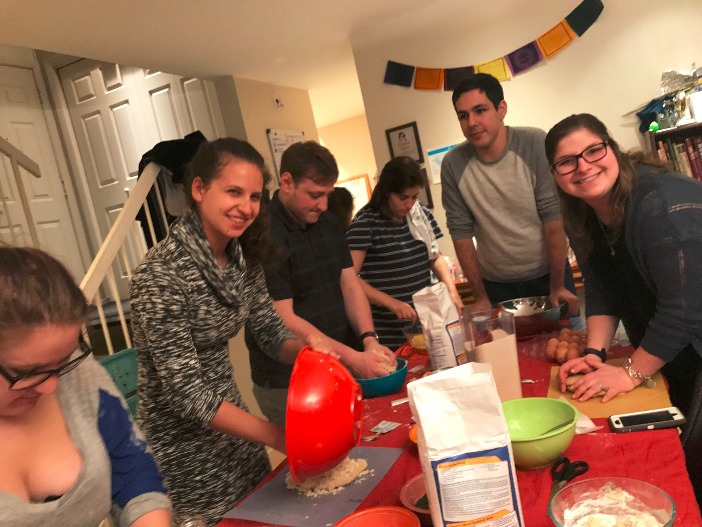
On a rainy night in spring, I joined a group of millennials in the Old Town neighborhood of Chicago to make challah.
We all came together by way of Moishe House, an organization connecting young Jewish adults through pluralistic, home- based programming. The residents of the Old Town Moishe House often host large Shabbat dinners they cook themselves. Their challah is renowned in their community thanks to Jimmy Casen, an Old Town Moishe House resident and JUF Young Leadership Division board member. It turns out he got the recipe from a member of my own suburban synagogue, highlighting the links among Jews, which is the essence of Moishe House.
“For so many young adults… if you ask them are you Jewish, they will emphatically say yes, but they don’t feel a connection to any sort of community per se,” said Larry Gast, Moishe House’s Vice President of Development. “This is why Moishe House exists: To give them a space to come to feel connected to something bigger.”
Moishe House originated in San Francisco in 2006 when its founders realized they could turn their Shabbat dinners into something bigger for young Jews all over the world. Today, Moishe House has 100 residencies around the globe.
According to an internal database, Moishe House Chicago has had more than 30,000 people in total attendance since opening its first house in 2007. Today there are five Moishe House residencies in Edgewater, Lakeview, Old Town, Wicker Park, and Lincoln Park, home to the Russian Speaking Jewish (RSJ) Moishe House.
“When we have Shabbat on Friday, you get 90 percent Russian speakers. Even the jokes are in Russian. There’s cultural things that differentiate each part of this world, and Russian people are slightly unique in what they expect and what they want to achieve,” said Ricky Lekakh, an RSJ Moishe House resident.
Each Moishe House is home for three to five residents, who receive a housing subsidy and program funding from the organization. Residents plan five to seven monthly events for their communities. Programs fall into one of the following categories: Jewish learning, Jewish culture and holidays, repair the world, or social. While Moishe House staff provide guidance as needed, their goal is to give residents the tools to be “autonomous.”
“We really want to empower them,” said Eve Lowinger, outgoing Moishe House Midwestern Regional Director. “The most important thing, and a line we like to use is, ‘it’s people, not programs.’ We invest in the residents and having quality people living in these homes who are stars.”
To become a Moishe House resident, candidates apply as individuals and as a group with those they want to live with in the Moishe House. Staff members then interview potential residents to ensure they are ready to live together and handle the responsibilities involved.
Residents find their own housing, but they may be given certain neighborhoods to choose from depending on their city’s needs and circumstances. A large common area is necessary for a Moishe House, since residents host community members frequently. Smaller events can have eight to 13 people, while Shabbat dinners can attract as many as 45 to 60 people. Before opening up a new Moishe House, the organization works to ensure that it has the necessary funding.
“Overall, any Moishe House we are operating, we like to be at least 75 percent locally supported by the community so that the house is sustainable, and that’s why we strive to have relationships with JUF,” Gast said.
A JUF Breakthrough Fund grant enabled the Wicker Park Moishe House to open last year. JUF also supported the Moishe House in Kyiv, Ukraine, from 2010 to 2015. In return, Moishe House residents attend phonothons, organize a table at YLD’s Big Event, host YLD Leads programs, and partner with JUF’s TOV Volunteer Network for community programs. This past Chanukah, the RSJ Moishe House co-hosted a party with JUF’s Russian Jewish Division.
“We care about the fact that JUF has invested in us and we want to invest back in them,” Casen said.
All five of the Moishe House locations came together this past Purim to throw a big bash for all of their different communities. Residents donated money raised from ticket sales to Maot Chitim, a JUF agency that delivers food to those in need. More than 100 Jewish young adults gathered in costume at Y Bar in River North.
“Everyone intermingled no problem. It wasn’t cliquey. It wasn’t like each little house bubble on their own. It was like one community, and it was amazing,” Casen said.
Inclusiveness is a theme I heard repeatedly from all the different Moishe House residents and community members. Even a 41-year-old reporter and mother, far outside the proscribed age range of Moishe House, was made to feel welcome. As I joined community members at the table that spring night, I felt as if I were among old friends, though I didn’t know a soul. My fellow challahmakers helped me with the various steps while we chatted about the Shamrock Shuffle. These young Jewish adults embodied the mitzvah of welcoming the stranger.
As Lekakh of the RSJ Moishe House said, “It’s truly an open door… We’ve seen people in here who we’ve never known, but we automatically feel comfortable with them because we have something in common.”
Mimi Sager Yoskowitz is a Chicago-area freelance writer, mother of four, and former CNN producer. Her work has been featured on various sites including Kveller, Brain, Child Magazine, and in the anthology, “So Glad They Told Me.” Connect with her at mimisager.com.
Other stories
-
Two local teens win national recognition
Recipients of the annual Diller Teen Tikkun Olam Awards
Read more -
Celebrating six young award winners cultivating the community
Introducing young adult award winners
Read more -