Multiple views on minimum wage aired at Government Affairs Committee meeting
MARA RUFF
Following the City of Chicago’s passage of an ordinance increasing minimum wage for Chicago workers, the debate on increasing the minimum wage for the remaining low-income workers in Illinois is building up.
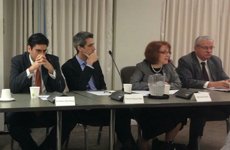
On Dec. 8, the Jewish Federation of Metropolitan Chicago’s Government Affairs Committee hosted a panel discussion on the issue featuring four experts with differing perspectives.
John Bouman, president of the Shriver National Center on Poverty Law and co-chair of Mayor Rahm Emanuel’s Working Group on Increasing the Minimum Wage, began the discussion.
“The demographics of the low-income worker population are growing and individuals can no longer get their families out of poverty by merely working a 40 hour week,” he said.
Alderman Michele Smith (43rd Ward) noted this is the first time in history that the city and state minimum wage differ. “This creates opposition between the city and its bordering suburbs,” she said. Although in favor of a “livable” minimum wage, Smith voted against the propped $13.00/hour rate, an increase from $8.25, because she thought it was too high. Smith said she believes the City needs to consider a more measured approach to improving lives for people living in poverty, such as advocating for restoration of some of the federal cuts to food stamps and housing subsidies.
Unlike the other speakers, Jonathan Greenberg, representing the Illinois Policy Institute, does not support a minimum wage increase, recommending instead that a more practical approach to addressing poverty would be to reform our education and criminal justice systems and implement pro-grow economic policies.
“Minimum wage increases result in job loss because they artificially drive up the cost of labor. So when you raise the wage, employers are forced to cut payroll,” Greenberg said. “Sure, some people will have more money, but others will lose their jobs. And the people who lose their jobs are already at the bottom of the income distribution, so you’ve not only cost them their jobs, but you’ve made it virtually impossible for them to find other work.” Greenberg referred to this outcome as “deeply immoral.”
In response, Bouman talked about meeting with one of the founders of Costco, which pays their retail staff much higher than the current minimum wage because “you get what you pay for.” Costco searches for ways to cut costs that don’t involve cutting labor.
State Senator Daniel Biss wrapped up the discussion with his observations about the national conversation to increase the minimum wage.
“A state-level increase in the minimum wage will help eliminate inequalities within the labor force and address the systemic, structural problem of wage distribution that is holding our middle class and our national economy back.”
The bill to increase the state minimum wage to $11.00/hour passed in the Senate but failed in the House because of an amendment restricting local municipalities such as Chicago from establishing their own higher levels of minimum wage. However, a statewide advisory referendum on increasing the minimum wage was approved decisively by the voters, so the topic is sure to continue under the new administration and General Assembly in January.
Other stories
-
Meet Andrew S. Hochberg, 2021 Julius Rosenwald Memorial Award recipient
Celebrate Andy Hochberg at the virtual Annual Meeting on Sept. 14
Read more -

Two local teens win national recognition
Recipients of the annual Diller Teen Tikkun Olam Awards
Read more -

Celebrating six young award winners cultivating the community
Introducing young adult award winners
Read more