Mental Health Rehabilitation
Since October 7, one of JUF’s top priorities in Israel has been responding to the overwhelming and rapidly growing need for mental-health support and rehabilitation. Working with key national partners – including Israel’s Ministry of Health for the first time, NATAL and Enosh – JUF is helping build both immediate and long-term systems of care that provide direct treatment to thousands while building capacity and strengthening Israel’s mental-health infrastructure for years to come.
Community Intervention Centers – Ministry of Health
In partnership with Israel’s Ministry of Health, JFNA and other Jewish federations, JUF has supported the establishment of 20 Community Intervention Centers across Israel – a groundbreaking national initiative designed to make professional mental-health care more accessible, affordable, and stigma-free.
The centers were established to provide an immediate and comprehensive response to individuals experiencing trauma or post-trauma symptoms as a result of the events of October 7, as well as to those whose existing mental-health conditions have worsened or whose past trauma has been reactivated. They serve as community-based day programs, bridging the gap between hospitals and community clinics and ensuring that people receive timely and professional care to avoid deterioration.
Each center is operated by a leading psychiatric hospital or department and headed by an expert psychiatrist, with multidisciplinary therapeutic teams offering both individual and group treatments. The centers bring together innovation, research, and AI tools to improve treatment and training, while providing a welcoming environment that encourages people to seek help without fear or shame.
As of November 2025, all 20 centers are fully operational, serving soldiers, civilians, children, and youth across the country. JUF’s substantial grant accounted for close to a quarter of the total philanthropic funding required and has been instrumental in launching this national effort.
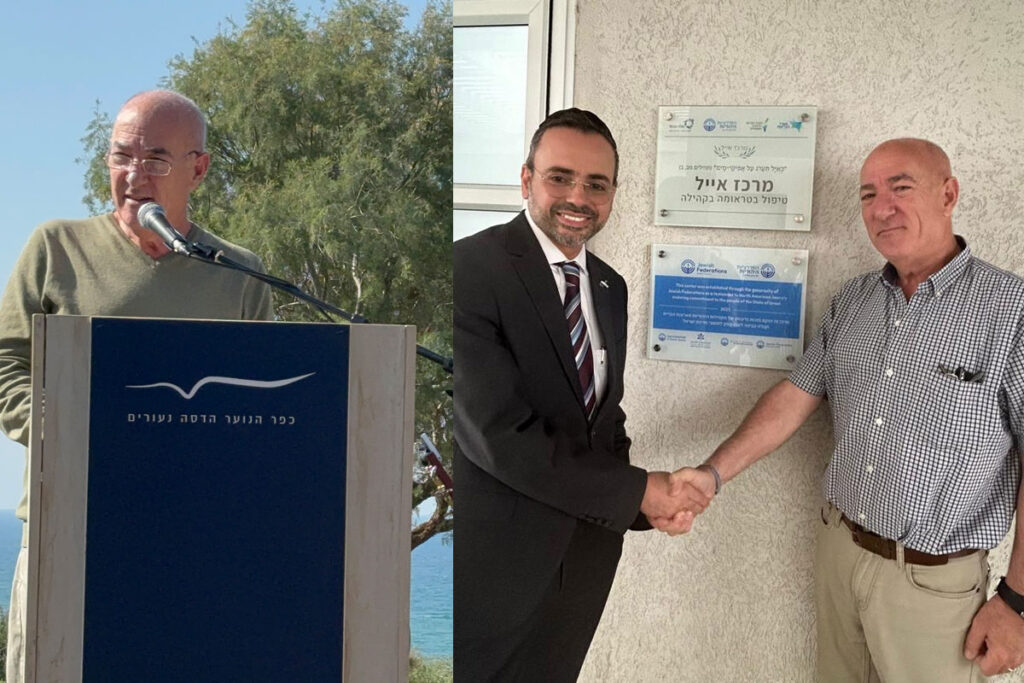
Israel’s Ministry of Health in collaboration with JFNA-The Community Intervention Initiative:
(left): The first center was opened in the youth village “Hadassah Neurim” in the Sharon area. The center was established in memory of Niv Raviv and Nirel Zini, a young couple tragically murdered in their home in Kfar Azza on October 7. The building’s inauguration ceremony was attended by the Minister of Health, Mr. Uriel Busso, JFNA CEO & President, Mr. Eric Fingerhut, Director General of JUF’s Israel office, Mr. Ofer Bavly, the representative of the Jewish Federation of Toronto, family members of Niv and Nirel and many more.
(right): Ofer Bavly, shaking hands with Former Minister of Health, MK Uriel Buso, taken at the opening of the Ayal Trauma Center.
NATAL – The Israel Trauma and Resiliency Center
Since the beginning of the war, JUF has funded several of NATAL’s major initiatives, including a resilience program for the Druze community, psychological treatment for children displaced during Operation “Rising Lion” and most notably, the GRIT Program.
GRIT (an acronym for Growth and Resilience in Trauma. The Hebrew name of the program is Ometz, meaning courage) is a three-year pilot program designed to strengthen emotional resilience, enhance social functioning and build community-based systems of support for youth (aged 16–18) and young adults (aged 21–35). The program was developed before October 7 and had just been approved for funding by Israel’s National Insurance Funds. The outbreak of the war turned GRIT from a timely pilot into a vital national response to needs.
GRIT promotes early detection of trauma symptoms, provides practical coping tools and trains participants and local leaders to identify distress among peers. Its multidisciplinary model combines workshops, support groups, digital campaigns and experiential tools that help people recognize and manage the emotional effects of prolonged stress and trauma.
Currently active in Jerusalem, Tel Aviv, Ashdod, and the Golan Regional Council, the program has already reached hundreds of participants directly and thousands more through their families, workplaces and communities.
Enosh – The Israeli Mental Health Association
For more than 45 years, Enosh has been one of Israel’s leading organizations in the field of mental health, providing prevention, intervention and rehabilitation services to tens of thousands of individuals and families each year.
Following the outbreak of the war, Enosh identified a severe gap in mental-health services for children and young adults – particularly in communities that were directly affected by trauma, in areas with limited access to mental-health care and in regions that welcomed many evacuated families, especially from Israel’s north. In response, Enosh developed a new model of community-based trauma and crisis intervention centers designed specifically for young people aged 12–25.
The first center, established in Ashdod thanks to JUF’s emergency grant, was launched in early 2024 at the height of the crisis to provide immediate psychological and psychiatric support to children and young adults coping with trauma, loss, and bereavement, while also offering parental guidance and consultation to help families create safe and stable environments for recovery.
Building on this successful model, Enosh began creating a national network of youth-focused trauma and crisis centers. Today, six additional centers are being established across Israel – in Kiryat Bialik, Kiryat Shmona, Netivot, Be’er Sheva, Hadera, and Nof HaGalil – all operating in partnership with local municipalities and community services.
Each center offers individual and group therapy, trauma-focused interventions, psychiatric consultations and specialized workshops for parents, educators and community professionals. The centers also integrate innovative approaches such as art therapy, virtual-reality tools and mindfulness-based techniques.
JUF’s funding as well as private donations from the Chicago Jewish community have been central to this transformation – enabling Enosh to raise additional funds and move rapidly from a single emergency response to a nationwide network of healing and resilience.